Gemini 3.8 Live vs Extended Thinking: Which Should You Use?
Gemini 3.8 Live vs Extended Thinking compares response latency, tool execution, and session state for direct and multi-step voice-agent tasks.
A voice agent can respond quickly and still fail its task. The revealing moment comes when it says “done” while a tool is still running. That is the practical question behind Gemini 3.8 Live vs Extended Thinking: not simply which model reasons more, but which session lifecycle your product can handle reliably.
Google launched two stable model IDs in September 2026. The wider Gemini Live API remains in Preview. We did not run the models, so the test below is a reproducible evaluation workflow, not a disguised benchmark.
Quick Verdict by Voice-Agent Task
Choose Gemini 3.8 Live for Immediate Turns and Simple Tools
Choose gemini-3.8-live when natural turn-taking matters more than extended planning. It fits voice search, device control, intake questions, and tools that normally return within milliseconds.
The model supports interleaved reasoning, but it does not expose a configurable thinking_level. Tools may be declared as blocking or non-blocking. More importantly, turnComplete: true indicates that the response has finished and the session has returned to idle. That gives the client a relatively simple state model.
Do not translate “low latency” into a guaranteed first-audio figure. Google has not published a controlled latency comparison covering network location, audio length, tools, and load.
Choose Extended Thinking for Multi-Step Work
Choose gemini-3.8-live-extended-thinking when one spoken request triggers planning, several tools, or slow external systems.
Extended Thinking supports low, medium, and high thinking levels. Tools must be non-blocking. The model can speak short progress updates while reasoning or waiting for functions, reducing silent gaps during tasks such as troubleshooting, booking, and account investigation.
That smoother conversation costs engineering attention. Your client must distinguish an intermediate utterance from a completed interaction. I paused here. A pleasant “I’m checking that now” is not a successful tool result.
How the Two Session Lifecycles Differ
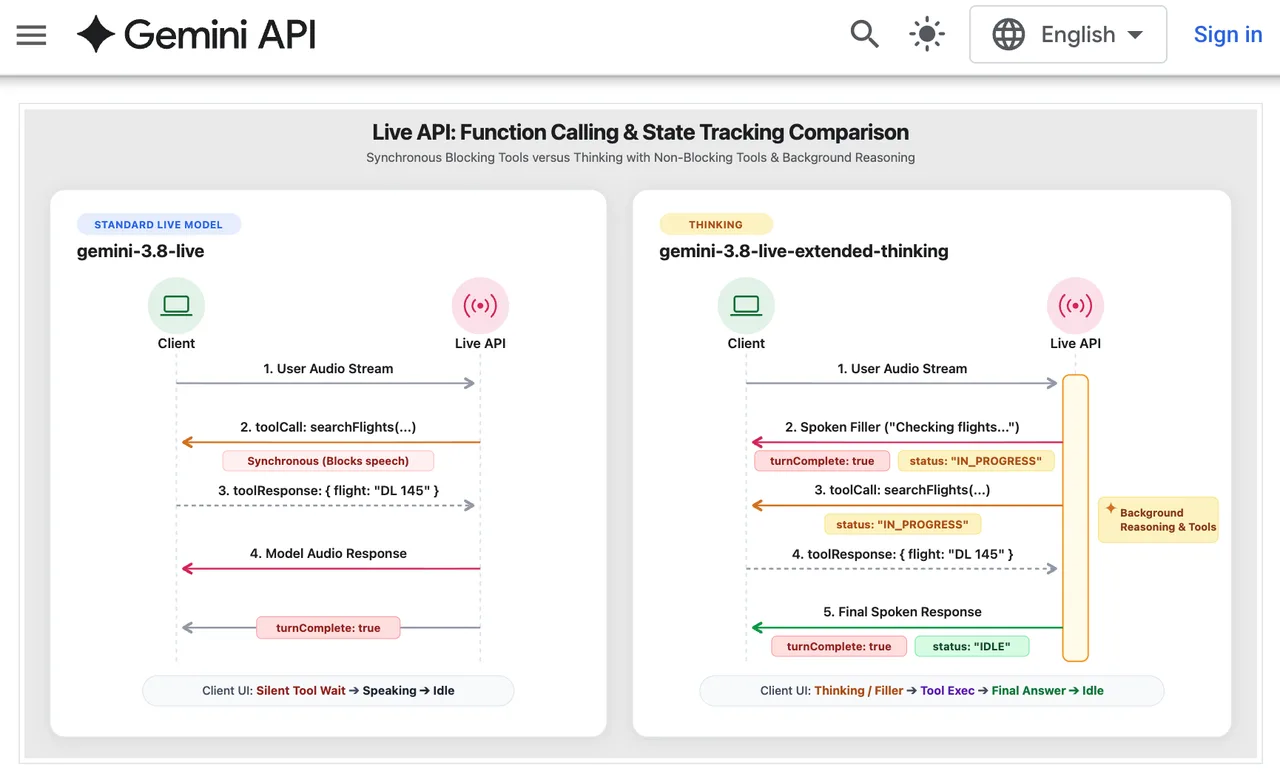
Google’s Live API thinking guide documents the following operational differences:
| Decision point | Gemini 3.8 Live | Extended Thinking |
|---|---|---|
| Reasoning | Fixed interleaved reasoning | Configurable background thinking |
| Tool behavior | Blocking or non-blocking | Non-blocking only |
| While tools run | May wait before speaking | Can provide spoken fillers |
| Completion signal | turnComplete returns to idle | Wait for interaction_status: IDLE |
| Client complexity | Lower | Higher |
First-Audio Latency and Conversational Flow
Measure both speech-onset latency and final-answer latency. Extended Thinking may speak a filler sooner than it produces a verified answer. A timer that stops at the first audio packet would make that experience look faster without showing whether the task completed sooner.
Use the same audio file, connection region, response modality, and warm-up policy. Report p50 and p95 results rather than a single attractive run.
Tool Execution and Background Reasoning
Standard Live can block speech until a function returns or run a non-blocking function asynchronously. Extended Thinking is built around asynchronous tools and may produce several spoken segments during one interaction.
This makes tool-call identifiers, deduplication, timeouts, and late responses essential. A retry must not create two support cases or submit the same purchase twice. The model choice does not remove those application responsibilities.
Turn Completion and Client State
For standard Live, turnComplete can close the user-model turn. Under Extended Thinking, it only marks the end of the current utterance. The interaction may still contain reasoning, tool calls, and a later final response.
A production client should therefore track states such as listening, speaking, awaiting tool, recovering, and idle. Google’s capabilities guide also lists text, image, audio, and video input for both models, with native audio output.
Run One Matched Voice-Agent Test
Hold Audio, Prompts, Tools, and Network Conditions Constant
Use one bounded support task:
“Check order 1847, confirm whether the saved address is valid, and open a support case only if delivery is delayed.”
Give both models identical get_order, validate_address, and open_case schemas. Replay the same 16 kHz PCM recording over the same network path. Keep system instructions, language, voice, thinking level policy, and tool responses fixed.
Run at least 20 repetitions per route. Inject one timeout and one recoverable tool error into predefined runs. An accepted result must report the correct status, avoid duplicate writes, recover within the retry limit, and reach an unambiguous idle state.
Measure Task Completion, Delay, Retries, and Recovery
Record:
- Time to first meaningful audio, excluding generic fillers
- Time to verified final answer
- Successful tasks and false completion signals
- Tool calls, retries, duplicates, and unrecovered errors
- User interruptions and recovery behavior
- Client state transitions and session termination reason
This exposes the real trade-off. Standard Live wins only when faster turns also preserve task accuracy. Extended Thinking earns its extra state handling only when it increases accepted completions or reduces operator intervention.
Limits and Trade-Offs
Preview Status and Changing API Behavior
Although both model IDs are stable, the Gemini Live API is still Preview. Pin model names, log session events, and rerun canaries after SDK or API changes.
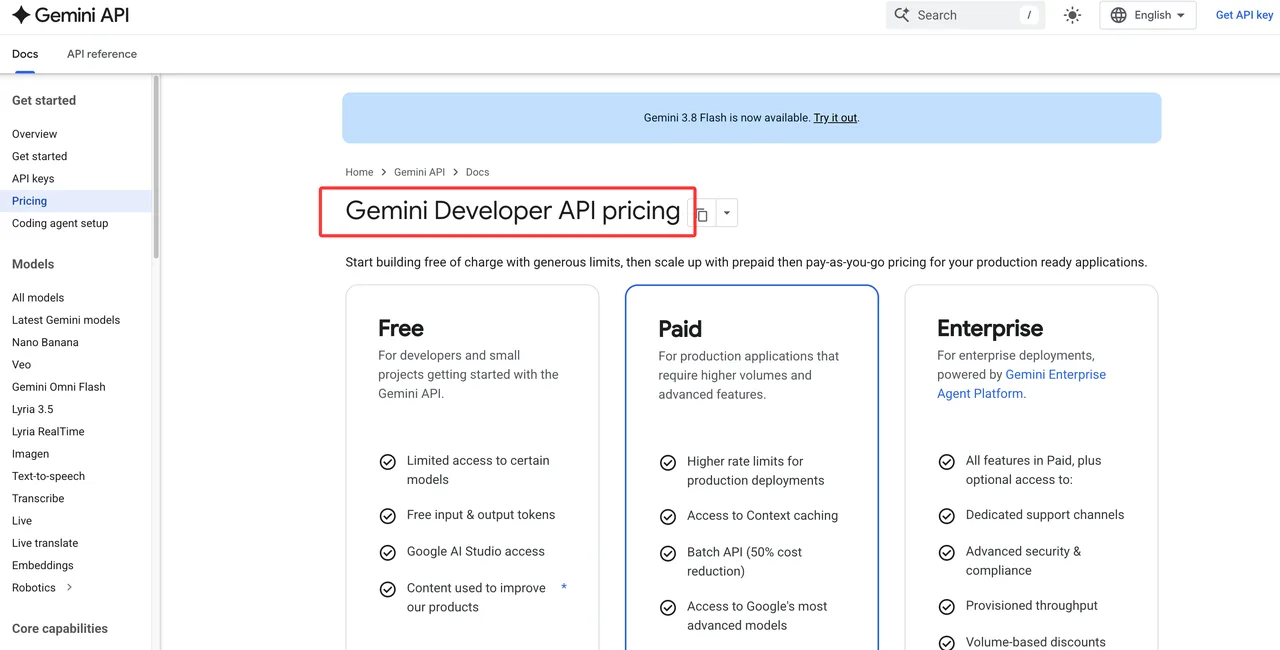
Google currently groups both models under the same published Live pricing, but equal token rates do not guarantee equal session cost. Thinking output, accumulated context, fillers, and retries can change consumption. No model-specific retention difference is published.
When a Non-Live Workflow Is Safer
Use a non-live request flow when the task requires deterministic approval, durable job queues, long processing windows, or exact audit boundaries. Voice can acknowledge the request, while a background workflow performs the consequential action and returns a separately verified result.
FAQ
Do both model IDs support session resumption after a disconnect?
The general session-management documentation does not list an exclusion for either model. Resumption handles can reconnect sessions, but teams should validate both IDs because examples may show only standard Live.
Can both models accept video frames during a live audio session?
Yes. Both model pages list video input. Google recommends JPEG or PNG frames at no more than one frame per second. Without context compression, audio-plus-video sessions have a shorter documented duration than audio-only sessions.
Are ephemeral tokens available for both Live API models?
Google documents ephemeral tokens for the Live API generally and does not publish a model-specific exclusion. They remain a Preview feature. Lock each token to the selected model and configuration where possible.
Do both models support context window compression in long sessions?
The shared Live API supports sliding-window context compression, with no stated exclusion for these IDs. Test whether compressed history preserves tool outcomes and user commitments before relying on indefinite sessions.
Are regional processing controls identical for both model IDs?
Google does not publish a model-by-model statement proving identical regional processing controls. The Gemini Developer API’s country availability is not a data-residency guarantee. Regulated workloads should verify current Vertex AI availability and regional terms separately.
Conclusion
For immediate dialogue and short tool calls, standard Live offers the cleaner lifecycle. For multi-step work, Extended Thinking may improve completion and reduce awkward silence, provided the client correctly tracks asynchronous tools and interaction status.
The right answer to Gemini 3.8 Live vs Extended Thinking comes from matched task completion, recovery, and state logs, not the first voice packet alone. This conclusion has an expiration date while the Live API remains in Preview.
Previous posts:
Related Articles
GPT-6 Astra 3D: Blender MCP vs AI 3D Generators
H3 Max API Review 2027: Choose the Right Video Endpoint
K2 Horizon 36B Review 2027 for Local Agent Workloads

H3 Max Pricing: Cost per Usable Video Clip
H3 Max vs MiniMax H3: Speed, Output, and Access