Ornith Hugging Face Model Card Checklist
Ornith Hugging Face checklist for builders validating model-card claims, license, source updates, benchmark citations, and release evidence.
Hello, I’m Dora. I started this note after seeing the same failure pattern in hot model coverage: one person cites the model card, another cites a GitHub README, a third copies a benchmark table, and nobody can say which page changed first. Ornith Hugging Face checks need a colder process than that.
As of July 29, 2026, the public facts I would treat as publishable come from DeepReinforce, Hugging Face, and the project’s own repository. The job here is not deployment. It is citation control. Model cards move. Hot launches move faster.
Hugging Face says model cards are Markdown files with metadata used for discoverability, reproducibility, licensing, datasets, and evaluation results in its model-card docs. That is the baseline. A card is not just a README. It is a living source that search pages, filters, widgets, inference providers, and downstream tools read.
What to Validate on Ornith Hugging Face
Model owner, variant list, license, and file types
Start with identity. The model namespace matters more than the headline.
For deepreinforce Ornith, the owner string to capture is deepreinforce-ai. The public release page, the Hugging Face pages, and the GitHub repository all use that identity. I would still snapshot the owner at publication time because renamed orgs, transferred repos, and forked quant uploads are common around a hot Hugging Face model.
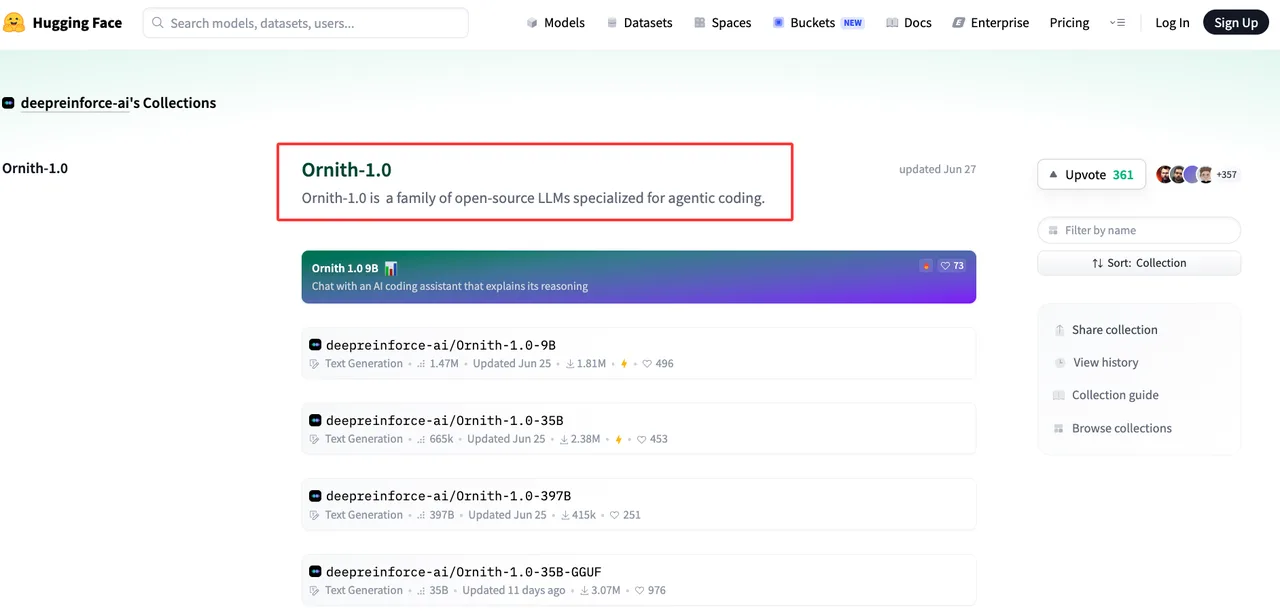
The next field is the variant list. The public Ornith-1.0 collection currently groups the visible Hub items: 9B, 35B, 397B, GGUF builds for 9B and 35B, and FP8 builds for 35B and 397B. It also includes a demo Space.
I paused here.
DeepReinforce’s official Ornith release describes the family as including 9B Dense, 31B Dense, 35B MoE, and 397B MoE. The collection I checked did not show a 31B checkpoint as a published Hub model. That does not mean the release page is wrong. It means the article should not list 31B as an available download unless the specific model repo exists and is captured.
License gets its own line. The visible Hugging Face model cards mark the license as MIT, and the GitHub repo also exposes an MIT license file. For an article, “MIT license” is enough only if the snapshot includes where that label came from. For a client-facing deployment note, I would keep the license text separately.
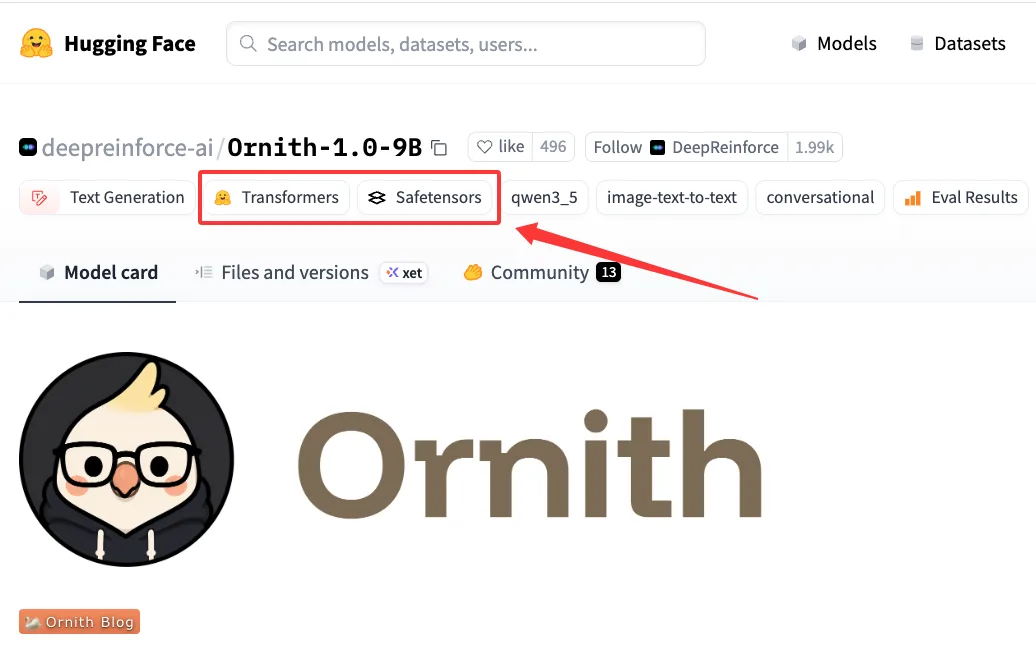
Artifact format and numerical precision need the same discipline. The Ornith-1.0-9B model card shows Transformers and Safetensors. Other variants are published as GGUF files or as FP8-compressed Safetensors. Do not merge those into one generic statement. “Ornith supports GGUF” is too loose. “The 9B-GGUF and 35B-GGUF repos are listed in the collection” is a cleaner claim.
| Field | Evidence to capture | Publishable wording |
|---|---|---|
| Owner | Namespace, org page, repo owner | “Published under deepreinforce-ai” |
| Variants | Collection list and individual repos | “Visible Hub variants include…” |
| License | HF license tag and repo license | “Marked MIT in the sources checked” |
| Format / precision | Repo tags and file tree | “This specific variant uses…” |
| Updated date | Model card and collection timestamp | “As of July 29, 2026…” |
Model-card claims vs production evidence
A model-card claim is not production evidence. It is a claim with a source.
For Ornith, the model card describes agentic coding, reasoning behavior, tool calls, OpenAI-compatible serving, benchmark scores, and runtime expectations. Those are useful facts. They are not proof that the model will behave the same in a team’s coding agent stack.
The difference matters in docs. “The card says the model emits tool calls” is one statement. “Our coding agent can safely use those calls in production” is another. The second one requires internal eval logs, parser failure rates, sandbox traces, and regression tests.
This is where my data ends.
For publication, I would split claims into three buckets: source-verified, internally verified, and not yet verified. Source-verified claims can cite the model card. Internally verified claims need your own run ID. Not yet verified claims should not appear as guidance.
Source and Citation Checklist
Benchmark provenance and update dates
Benchmark tables are the easiest part to copy and the easiest part to misrepresent.
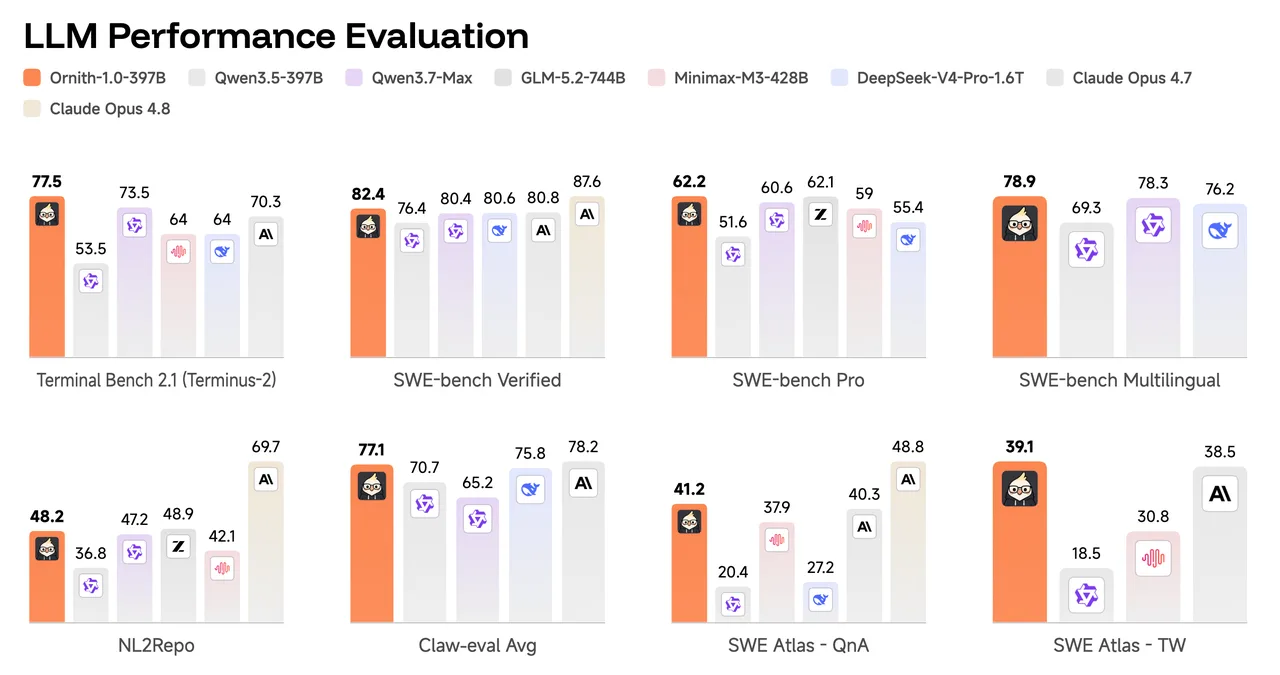
The Ornith materials mention Terminal-Bench 2.1, SWE-bench Verified, SWE-bench Pro, SWE-bench Multilingual, NL2Repo, ClawEval, and SWE Atlas. The GitHub README also gives evaluation notes: harness names, sampling settings, context windows, timeouts, and averaging details. That is the useful part for citation.
Do not lift the score table without the method notes. A score without harness context is decoration. It looks technical. It does not help an engineer decide whether the number applies to their repo.
For every benchmark citation, capture:
- Benchmark name and version where shown.
- Model variant.
- Score.
- Harness or runner.
- Temperature, top-p, context window, and timeout where stated.
- Number of runs or averaging method.
- Page URL.
- Page update date or commit date.
- Screenshot or saved HTML.
If the article says “state-of-the-art,” I would require one extra check: comparable size class. The Ornith materials phrase the comparison around open-source models of comparable size. That boundary belongs in the sentence. Removing it makes the claim louder and less accurate.
GitHub, Hugging Face, and downstream quant references
The Ornith GitHub repository is useful because it centralizes README claims, benchmark notes, citation text, and license files. Hugging Face is useful because it shows live model repos, metadata, files, tags, collection membership, download context, and hosted evaluation entries. They are not interchangeable.
For downstream quant references, I would treat official DeepReinforce GGUF repos differently from third-party quantizations. Official GGUF variants in the collection can be cited as project-published artifacts. Community quantizations should be cited only when the article is about downstream packaging, not when the article is describing the upstream family.
The same rule applies to open-source model deployment notes. If the runtime command belongs to a third-party quant repo, it should not be used to describe the official Safetensors checkpoint. That sounds obvious until launch week happens.
Maintenance After a Hot Model Launch
Evidence snapshots, changelog tracking, and publish-date notes
Hot model pages need a small evidence folder. I would keep it boring.
Store the model card HTML or Markdown, collection page, file tree, license text, benchmark notes, and GitHub README snapshot. Add the capture date. Add the person who captured it. Add the article section that depends on it. Good enough. That is the most honest assessment I can give.
For the article itself, use publish-date notes in the places where facts can change. “As of July 29, 2026” belongs near variant lists, license wording, benchmark references, and tool-call claims. It does not need to appear every paragraph.
The practical maintenance trigger list is short:
- New or removed model repo.
- License tag changes.
- README benchmark table changes.
- Runtime requirement changes.
- File type changes.
- New official quantization.
- Deleted or renamed collection.
- GitHub repo archived, renamed, or transferred.
- Model card adds safety, limitation, or intended-use text.
Once one of those changes, the article needs a review. Not always a rewrite. Sometimes one sentence is enough.
When to revise an article after model-card changes
Revise when the change affects a reader’s decision.
A typo fix does not matter. A new GGUF repo does. A license wording change definitely does. A benchmark score update matters if the article used performance as a reason to care. A tool calls note matters if the article describes coding-agent behavior.
I use this rule: if a reader could make a different citation, compliance, or production-planning decision after seeing the update, revise the article.
Do not silently patch major claims. Add a short note: “Updated on [date] after the model card changed its variant list.” This protects the article and the reader. It also protects whoever has to explain the page later.
FAQ
Who should approve model-card citations before publishing docs?
For a hot Hugging Face model, approval should sit with the docs owner and a technical reviewer who can read model-card metadata, repository structure, and benchmark notes. If the article mentions MIT license terms, legal or open-source governance should approve that wording.
Marketing should not own this alone. Neither should engineering. Citations sit between both.
What source wins when Hugging Face and GitHub disagree?
The source closest to the claim wins.
Hugging Face wins for live Hub metadata: model owner, model repo, file list, tags, license label, collection membership, and update dates. GitHub wins for repository README claims, license file text, benchmark method notes, and citation blocks. The official release page wins for launch framing.
If the sources disagree on something material, the article should say there is a mismatch or avoid the claim. I don’t know. Better than making something up.
How long should teams keep evidence snapshots for a hot model?
For normal docs, I would keep snapshots for the life of the article plus at least 12 months. For client docs, contracts, regulated work, or open-source compliance reviews, follow the company retention policy and keep them longer.
The useful unit is not “a screenshot.” It is a traceable evidence packet: source URL, capture date, saved page, reviewer, and the exact claim it supports.
Conclusion
The point of an Ornith Hugging Face checklist is not to slow publishing down. It is to stop one fast model launch from turning into ten unsupported claims.
Validate owner, variants, license, file types, benchmark provenance, and update dates before the article goes live. Keep Hugging Face, GitHub, and downstream quant references in separate lanes. When the model card changes, revise only the claims that depend on it.
Previous posts: