SWE-bench for Builders: Reading Coding Scores for Model Routing
SWE-bench tells you more than a leaderboard rank. How builders should read coding scores for model routing decisions.
Dora here. I treat SWE-bench as a routing signal, not a scoreboard. A high coding score can tell me a model is capable under a benchmark setup. It does not tell me whether that model should handle every code edit, every repository, or every customer-facing workflow.
For model routing, the useful question is smaller: when does a benchmark result change routing behavior?
This note is about that decision layer. No model ranking. No “who is first.” Just how to read coding scores without letting the leaderboard drive the architecture.
What SWE-bench Actually Measures
Verified vs Pro and why the variant matters
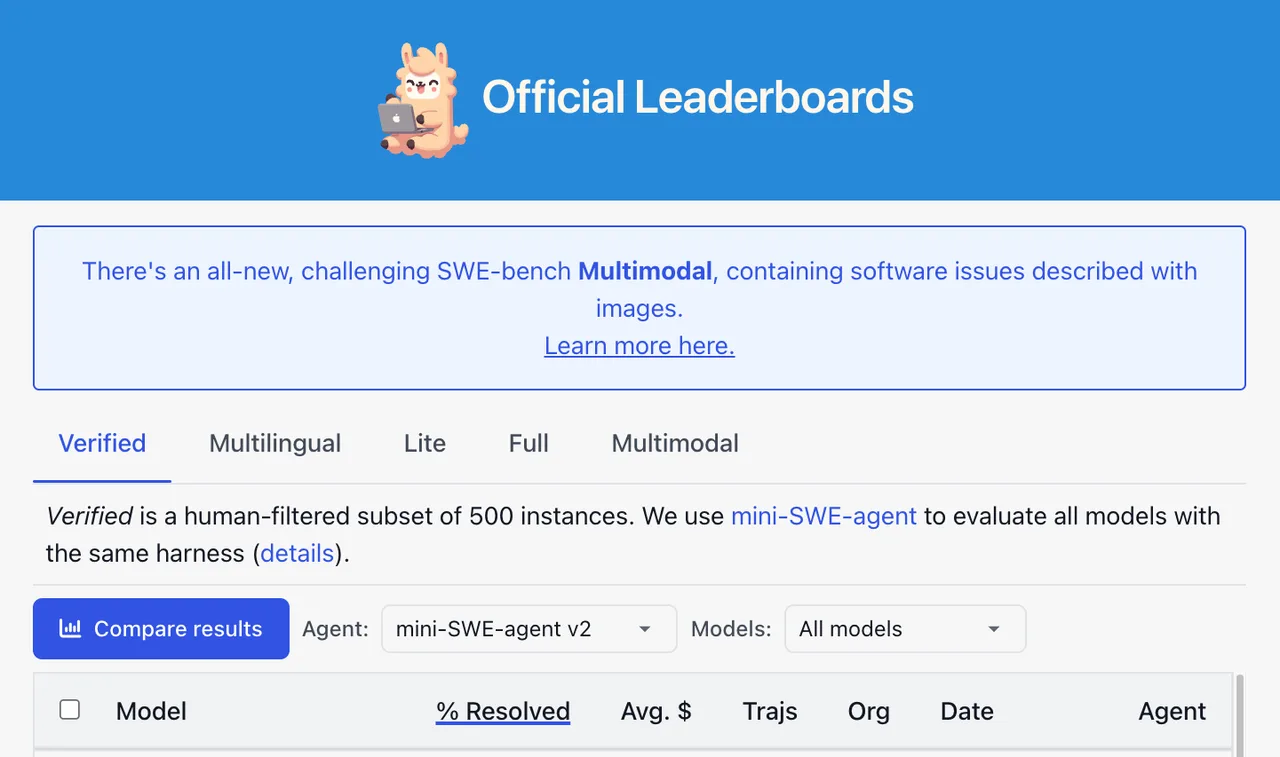
The official SWE-bench leaderboard evaluates whether an agent can resolve real software issues from repositories. The agent gets a codebase and issue description, then produces a patch. The patch is checked against tests that verify the issue is fixed and existing behavior is not broken.
That setup is useful because it resembles real coding work more than short algorithm prompts. The model has to inspect files, infer intent, edit code, and survive tests. Good. Still bounded.
Verified matters because it was created to clean up noisy tasks. OpenAI’s SWE-bench Verified release describes it as a human-filtered subset built to remove unclear issue descriptions and unfair tests. For a while, it was the cleaner signal.
SWE-bench Pro tries to push the evaluation toward longer-horizon software engineering tasks. The variant matters because each version asks a different question. Verified asks whether a model can solve a curated set of known real issues. Pro asks a harder, longer-workflow question. Neither asks whether your repo, tool setup, pricing, latency, review process, and fallback rules will work.
I paused here. This is where benchmark reading usually goes wrong.
What the score does not tell you
A benchmark score does not include your latency budget. It does not include token price, tool-call overhead, shell-command risk, retry waste, reviewer time, or support tickets.
It also does not tell you why failures happen. A model may fail because it misunderstood the task. It may fail because the test is flawed. It may fail because the scaffold did not retrieve the right file. It may fail because the repository is weird. Real repositories are allowed to be weird. They usually are.
For routing, I care about four missing signals:
- time to first useful action
- total task cost including retries
- regression rate after patching
- recovery quality after failure
A model that wins on raw solve rate but burns three times the tokens and still needs human cleanup may not be the right default.
Why the Top Rank Isn’t the Routing Answer
Latency, token cost, and tool-call overhead
Coding agents spend money in more places than the model response. They inspect files, call tools, read logs, run tests, retry patches, and explain decisions. A frontier model may use fewer attempts, but each attempt can be expensive. A cheaper model may need more rounds, but still win on simple tasks.
The routing question is not “which model is best?” It is:
Which model reaches an acceptable result at the lowest total cost for this workload?
Total cost includes latency. If a developer waits 90 seconds for a minor import fix, the route is wrong. If a customer-facing agent waits too long before saying it needs help, the route is wrong. Speed is not the goal. Not breaking flow is.
Tool-call overhead changes the answer. A model that is good at reasoning but poor at tool discipline can spam file reads, rerun tests too often, or produce patches without checking context. The benchmark score may not expose that in the way your infrastructure feels it.
Failure rate, regressions, and fallback needs
Routing needs failure behavior, not only success rate.
A model can fail cleanly: state uncertainty, ask for more context, avoid risky edits. It can also fail messily: modify unrelated files, invent APIs, delete tests, or produce a patch that passes one narrow check while breaking surrounding behavior.
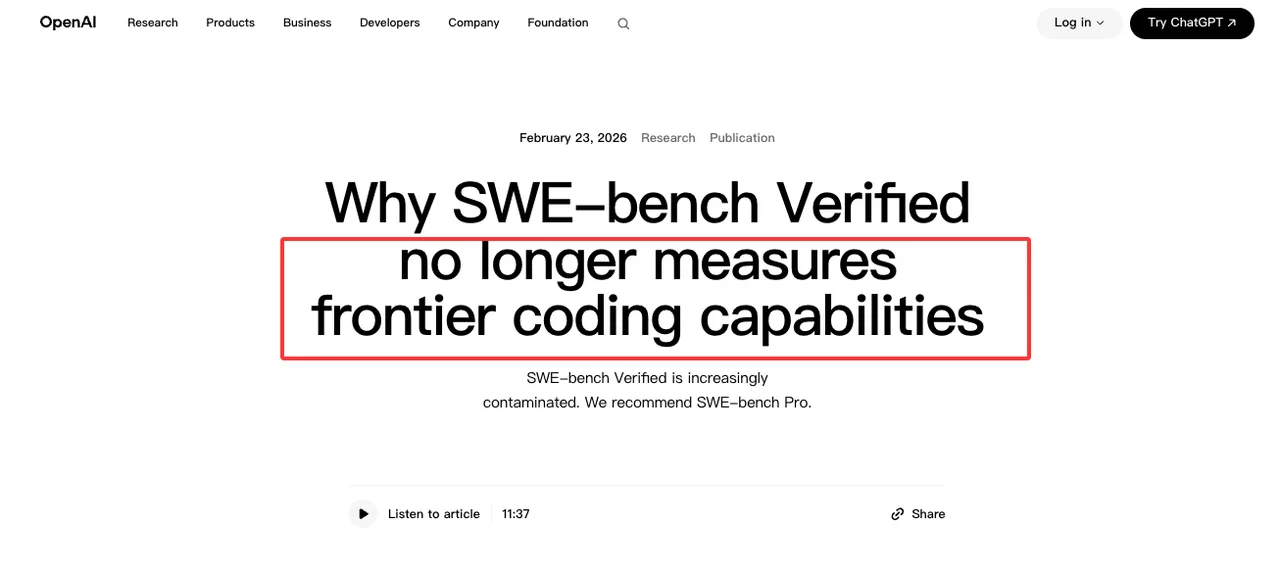
OpenAI later argued that Verified no longer measures frontier coding capabilities well because of contamination and residual task-quality issues. That does not make Verified useless. It means builders should stop treating it as the final production answer.
For production coding agents, regression risk matters more than elegance. A bad answer in chat is annoying. A bad code edit can become incident work.
Fallback design should be part of model selection. If the cheap model fails, does the system escalate to a stronger model? If the frontier model fails, does the system ask for human review? If two models disagree, which one gets authority? Benchmarks rarely answer those questions. Routing has to.
An Evaluation Methodology for Builders
Mapping workloads to the right model
I would not route all coding tasks through the top-scoring model. That is expensive and usually unnecessary.
A practical routing matrix starts with workload shape:
| Workload | Default Route | Escalation Trigger |
|---|---|---|
| Code explanation, docs, simple search | cheaper fast model | missing context or user asks for patch |
| Small bug fix with clear tests | mid-tier coding model | first patch fails or touches many files |
| Multi-file bug, unclear failure | frontier model | repeated failure or high-risk area |
| Refactor, migration, security change | frontier model plus review | broad diff, weak tests, policy risk |
| PR review or triage | cheap or mid-tier model | architectural concern or severe bug |
This is not a fixed rulebook. It is a starting point. The point is to stop using one benchmark score as a global routing policy.
Task metadata helps. Use file count, diff size, failing test count, repo familiarity, language, dependency graph, issue length, and risk label. A routing layer should know when a task looks routine and when it looks expensive before spending frontier-model money.
Combining benchmark + cost + reliability signals
I use benchmarks as prior belief. Then I correct that belief with production data.
A builder-friendly evaluation stack has five layers:
- benchmark signal: variant, scaffold, date, caveats
- workload match: language, repo type, task length, tool needs
- cost signal: tokens, tool calls, retries, wall time
- reliability signal: pass rate, regression rate, failed recovery rate
- review signal: human accept rate, edit distance after review, rollback rate
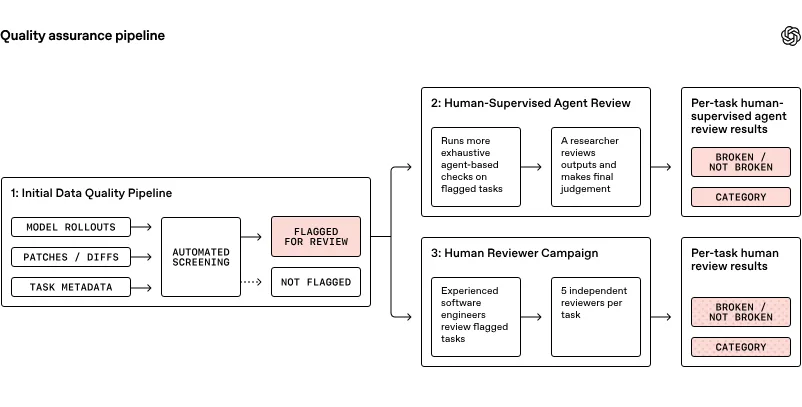
OpenAI’s later coding evaluation audit makes the caution sharper: even harder coding benchmarks can contain broken tasks, so failure may not always reflect true model limits. That is not a reason to ignore benchmarks. It is a reason to read them with brakes on.
The benchmark gives the model a starting trust score. Production traces decide whether it keeps that trust.
This is also where vendor-reported numbers need labels. If a model provider publishes a score, mark it as vendor-reported unless the run is independently reproduced or leaderboard-verified.
Applying It to Model Routing
When to route to a frontier model vs a cheaper one
Route to a frontier model when failure is expensive or task complexity is high.
Signals I would use:
- many files likely involved
- unclear issue description
- weak or missing tests
- production-critical area
- unfamiliar framework
- security or auth logic
- repeated failure from cheaper model
- expected patch requires planning across modules
Route to a cheaper model when the task is narrow, reversible, and easy to verify. Examples: explaining a stack trace, summarizing a file, updating docs, finding where a function is defined, or proposing a small local patch.
There is a middle route too. For many teams, the best setup is staged routing: cheap model for triage, mid-tier model for first implementation, frontier model for hard cases or failed attempts. The top model becomes an escalation path, not the default tax.
When benchmark gains don’t justify the cost
Benchmark gains do not justify the cost when the workload does not need the extra capability.
A higher score may not matter for:
- read-only repo analysis
- simple code search
- generated documentation
- small syntax fixes
- low-risk test scaffolding
- internal prototypes
- tasks already covered by strong linters or tests
It also may not matter when review cost dominates. If every patch goes through strict human review anyway, the cheaper model may be acceptable for first drafts. If test coverage is weak, a frontier model can still produce risky code. Model quality cannot compensate for missing verification.
The clean routing question is: what failure are we paying to avoid?
If the answer is “a serious regression,” pay for the stronger model. If the answer is “a slightly worse explanation,” probably do not.
FAQ
How reliable are SWE-bench scores when making actual routing decisions in production?

Reliable enough to inform initial routing. Not reliable enough to own it.
SWE-bench scores are useful as a capability signal for coding agents. But they depend on benchmark variant, scaffold, task quality, contamination risk, and evaluation setup. Production routing needs live traces from your own repositories.
Treat the score as a prior. Update it with your own pass rate, rollback rate, latency, retry count, and human accept rate.
What other signals should builders combine with SWE-bench results for coding workloads?
Combine benchmark results with cost, latency, tool behavior, repo coverage, language-specific success, diff size, test pass rate, regression rate, and reviewer edits.
I would also track failure shape. “Failed safely” and “failed by breaking unrelated behavior” are not the same event. A route that fails safely can stay in the system. A route that fails destructively needs limits.
When do high SWE-bench scores fail to translate into better real-world agent performance?
They fail when your tasks do not match the benchmark distribution.
Common gaps: private repositories, unusual frameworks, monorepos, weak tests, proprietary build tools, UI-heavy work, infra changes, security-sensitive code, and long-running tool workflows. The model may be strong, but the environment changes the task.
High scores also fail to translate when latency or cost makes the route unusable at scale.
How should teams adjust their model routing strategy as new SWE-bench variants appear?
Do not replace the routing table every time a new variant appears. Add the variant as another evidence column.
Ask what changed: task source, contamination controls, scaffold, harness, languages, repository type, hidden tests, public/private split, and audit findings. Then rerun your internal workload set against the same candidate models.
If the new variant better matches your workload, increase its weight. If it measures a different kind of coding task, keep it as context.
Conclusion
SWE-bench is useful when builders read it as an engineering signal. It becomes risky when teams read it as a buying guide or universal routing policy.
For model routing, the decision has to combine benchmark variant, workload shape, total cost, latency, tool overhead, failure mode, regression risk, and fallback behavior. The top rank can be useful. It is not the answer.
The routing answer lives in your traces. Benchmarks point where to look. Production tells you what survives.
Previous posts:
Related Articles

Best AI Video Platforms for Production Teams in 2027

Best Sora 2 Alternatives for Video Teams in 2027

Lanta AI Review 2027: Best Uses, Pricing, and Limits

Sora 2 Review 2027: API Quality, Cost, and Limits

Build a GPT-6 Astra 3D Workflow With Blender Assets