Benchmark Inkling for Production Agents
Benchmark Inkling with your own agent tasks, multimodal inputs, long-context cases, latency, memory, cost, and fine-tuning gains.
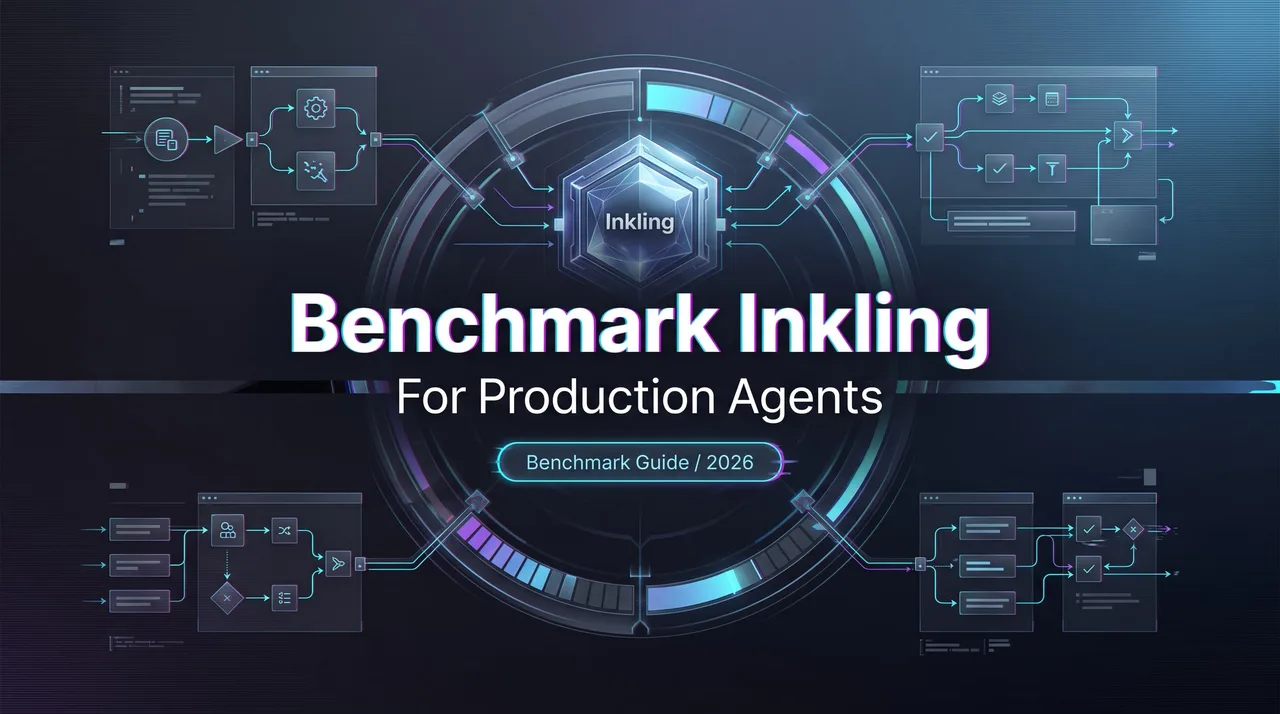
I usually add the ugly columns first: pass/fail owner, max latency, tool-call recovery, rollback. If a team asks me how to benchmark Inkling for production agents, I start there.
A leaderboard score can tell me whether a model deserves a test run. It cannot tell me whether it can handle a customer ticket, a half-cropped screenshot, a six-tool workflow, and a 180-page policy bundle without confidently making something up.
Thinking Machines describes Inkling as an open-weights Mixture-of-Experts model with 975B total parameters, 41B active parameters, up to 1M context, and text, image, and audio inputs. The Inkling model card reports public benchmark scores at effort=0.99, with comparison scores generated on July 14, 2026.
Useful. Not enough.
This piece is the evaluation plan I would use before letting Inkling touch a real agent queue.
Do Not Rely on Public Benchmarks Alone
Why leaderboard performance may not match enterprise agents
Public benchmarks are good at one thing: giving a fast first signal. They are less good at showing how a model behaves inside a real enterprise agent.
The mismatch usually comes from the harness.
Your agent has private tools, custom schemas, retrieval rules, timeout limits, user permissions, logging constraints, and fallback paths. Public benchmarks rarely match that shape. SWE-bench, Terminal Bench, HLE, GPQA, AIME, and multimodal leaderboards can say something about reasoning and tool use. They do not test your refund workflow, your contract parser, your support escalation rule, or your bad OCR scans.
So an Inkling model benchmark should start as a filter, not a decision.
My first question is boring: what task does this model have to complete without a hidden human finishing the job?
If the answer is vague, the eval will be vague. Then the launch meeting becomes vibes with charts. Nobody needs that.
What Inkling’s open-weight status changes in evaluation
Open weights change the evaluation surface.
The model card says Inkling is released with open weights to support research, fine-tuning, and integration into third-party products. That means a team can evaluate more than API behavior. It can inspect deployment formats, compare BF16 and NVFP4 paths, test serving stacks, run private regression sets, and measure what adaptation actually buys.
But open weights do not mean easy deployment.
The same model can look good in a hosted playground and painful in self-hosted inference. The same checkpoint can pass a short agent task and fall apart when context grows, tools return partial errors, or the user asks a question that spans text, image, and audio.
That is where the evaluation starts to matter.
Build a Task-Level Evaluation Set
Text reasoning, tool use, image understanding, audio understanding, and long-context retrieval
I would not build one eval. I would build five.
| Evaluation lane | What I test | Pass signal |
|---|---|---|
| Text reasoning | Multi-step domain questions, policy interpretation, conflicting facts | Correct answer with cited evidence and calibrated uncertainty |
| Tool use | API calls, browser actions, database lookups, retries, malformed tool output | Valid tool sequence, no silent failure, clean recovery |
| Image understanding | Screenshots, charts, forms, visual QA, product images | Correct extraction plus useful reasoning over visual details |
| Audio understanding | Calls, meetings, spoken instructions, noisy recordings | Accurate task extraction and safe uncertainty when audio is weak |
| Long-context retrieval | 100K+ token documents, policy bundles, prior cases | Finds the right section and does not invent missing evidence |
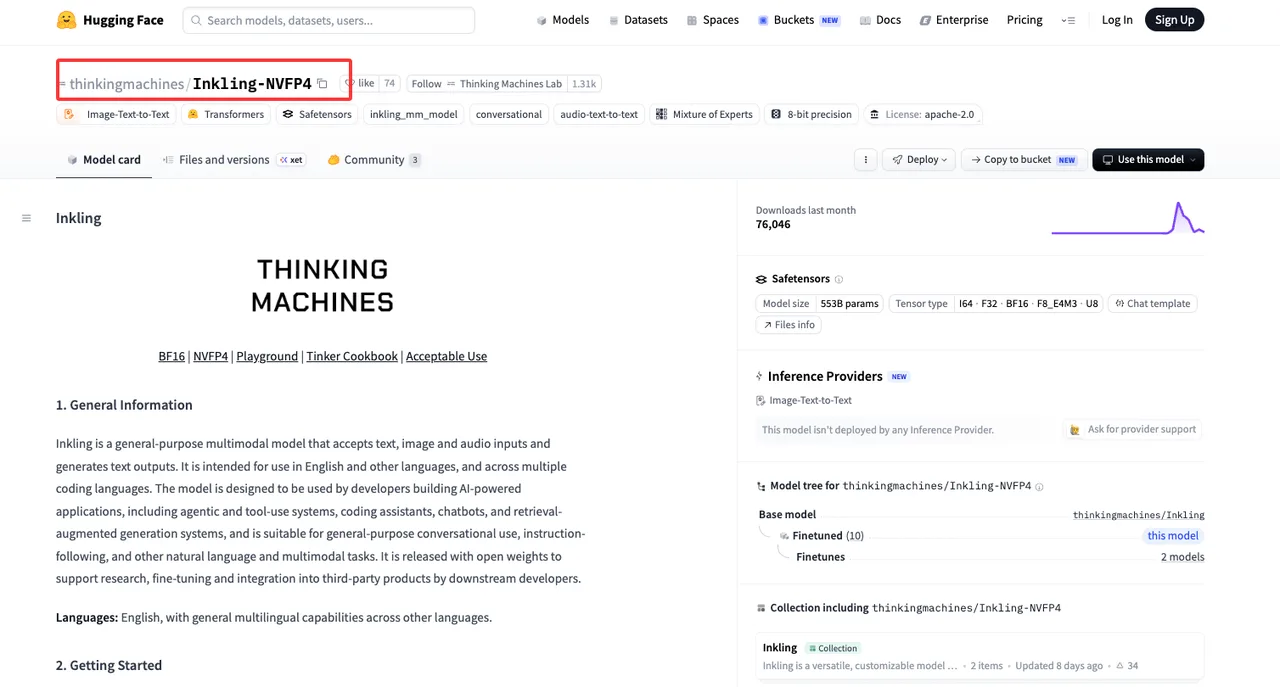
Inkling’s official materials make this split necessary. The announcement frames it as a broad model trained across reasoning, coding, instruction following, factuality, vision, and audio tasks. The Hugging Face page describes text, image, and audio input with text output.
So the multimodal agent benchmark has to be multimodal in practice. Not “one image question at the end.” Actual image tasks. Actual audio tasks. Actual long-context retrieval.
I paused here.
A long-context evaluation is not just “paste a giant document and ask a question.” It needs distractors, stale policy sections, near-duplicate clauses, tables, screenshots, and answers that require saying “not enough evidence.” Long context is useful only if the model can resist the wrong part of the context.
Success criteria, human review, and failure categories
The pass/fail rubric needs to be written before the run.
I use these failure categories:
- Wrong final answer: the output is incorrect.
- Unsupported answer: the output may be right, but the evidence is missing.
- Bad tool plan: the model chose the wrong tool or skipped a required one.
- Tool-call formatting failure: arguments, schema, or call order broke.
- Retrieval failure: the right evidence existed, but the model did not find it.
- Multimodal miss: image or audio evidence was ignored or misread.
- Overconfidence: the model should have hedged or asked for review.
- Unsafe completion: the output violated policy or needed moderation.
- Operational failure: timeout, memory pressure, queue delay, or provider error.
The reviewer should not grade style first. Style is cheap. Correct task completion is not.
For Inkling agent performance, I would track accepted task rate, first-pass pass rate, tool-call correctness, evidence accuracy, reviewer override rate, p95 latency, cost per accepted completion, and rollback rate after deployment.
Public score goes in the notes column. Production pass rate goes in the decision column.
Measure Production Constraints
Latency, GPU memory, throughput, context cost, and provider stability
Once the task eval passes, the infra eval begins.
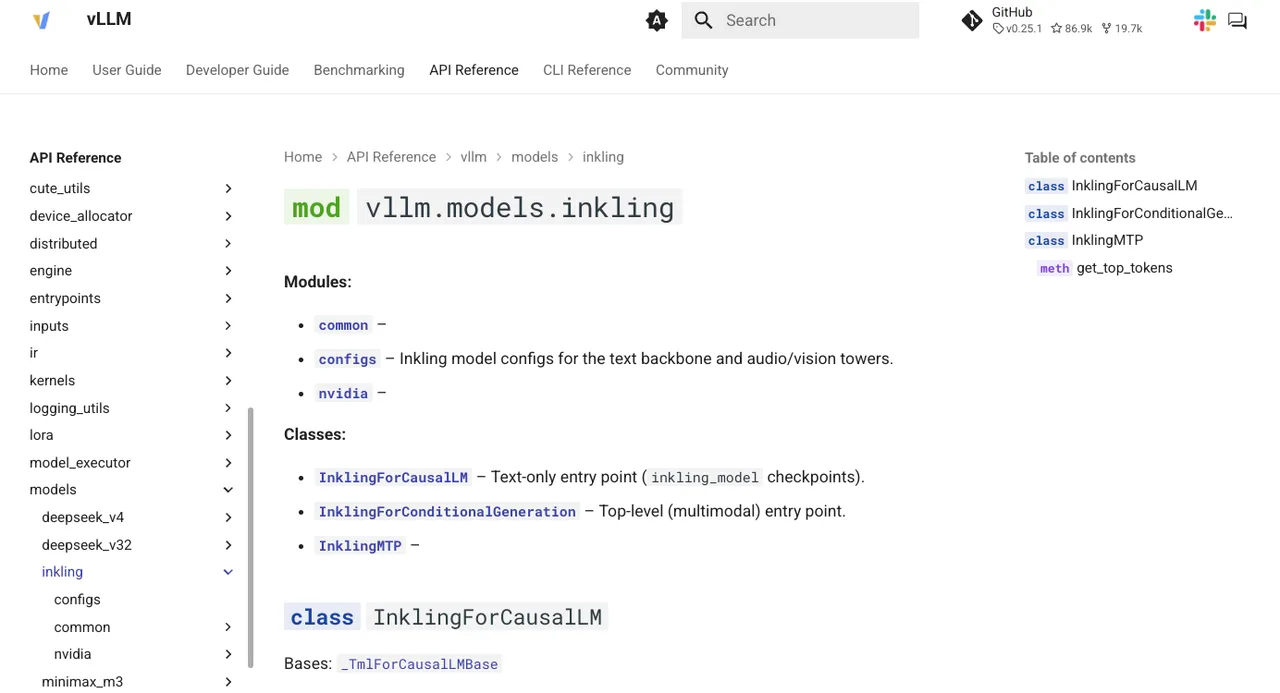
The vLLM Inkling docs show Inkling support paths for text-only and multimodal entry points. The Transformers Inkling docs document configuration and processor classes. These pages are useful evidence that ecosystem support exists.
They are not proof that your SLO will pass.
For self-hosting, I would measure cold start, warm latency, p50 and p95 generation time, concurrent requests, long-context memory pressure, image/audio preprocessing time, queue behavior, and failure recovery. I would run the same task at 8K, 64K, 128K, and the largest context I expect to support.
Context has a cost even when the model advertises a large window. Tokens still move. KV cache still exists. Retrieval still fails in boring ways.
NVIDIA’s Dynamo Inkling recipe is a useful reality check. It describes a day-0 SGLang recipe for thinkingmachines/Inkling-NVFP4 on 8x B200, with a checkpoint around 592 GB, and notes that no benchmark results are published yet for that recipe.
That is the kind of detail I want in a production plan. Not as a universal hardware rule. As a reminder that “open-weight model” and “cheap to serve” are different claims.
Provider stability needs its own lane. If the team uses a hosted provider, test rate limits, quota behavior, regional availability, incident communication, model revision tracking, request logging, and whether the provider exposes enough metadata to debug failures.
Safety behavior, logging, and data governance
The safety eval cannot be a separate PDF nobody reads.
The model card recommends downstream developers run their own performance, safety, and fairness evaluations before deployment, add safeguards such as filtering and monitoring, and use human oversight for high-stakes or safety-critical contexts. That is not decoration. That is launch work.
For production agents, I would log:
- prompt, system instructions, retrieved evidence, and tool calls
- model version, quantization path, provider, and serving config
- refusal behavior and moderation decisions
- user-visible answer and hidden reasoning metadata where allowed
- reviewer decision and correction
- rollback reason if the output is later judged unsafe or wrong
Data governance is part of the benchmark. If the eval uses customer data, the team needs retention rules, access controls, redaction, consent boundaries, and export/delete behavior. If the agent handles audio or images, the governance review should include those modalities, not just text logs.
This is where my data ends. The rest has to be verified against the deployment environment.
Test Customization Value
Prompting versus retrieval versus LoRA fine-tuning
Customization is the reason Inkling is interesting.
Thinking Machines says Inkling is available for fine-tuning on Tinker, and the Tinker documentation describes a training API where developers control data, algorithms, and training loops while the service handles distributed training. That changes the “evaluate open-weight model” question. The team is not only asking whether base Inkling is good. It is asking whether adaptation earns its cost.
My order is simple:
Prompt first. Retrieval second. Fine-tuning third.
Prompting fixes format, role, refusal, and tool-use preferences when the base behavior is close. Retrieval fixes missing or changing knowledge. Fine-tuning is for behavior the base model cannot reliably learn from instructions or retrieved context.
LoRA deserves a separate eval. The Tinker LoRA primer says LoRA adjusts a small number of parameters rather than full fine-tuning, and notes that it can match full fine-tuning in RL or small supervised-learning settings, while underperforming on larger datasets that exceed LoRA capacity.
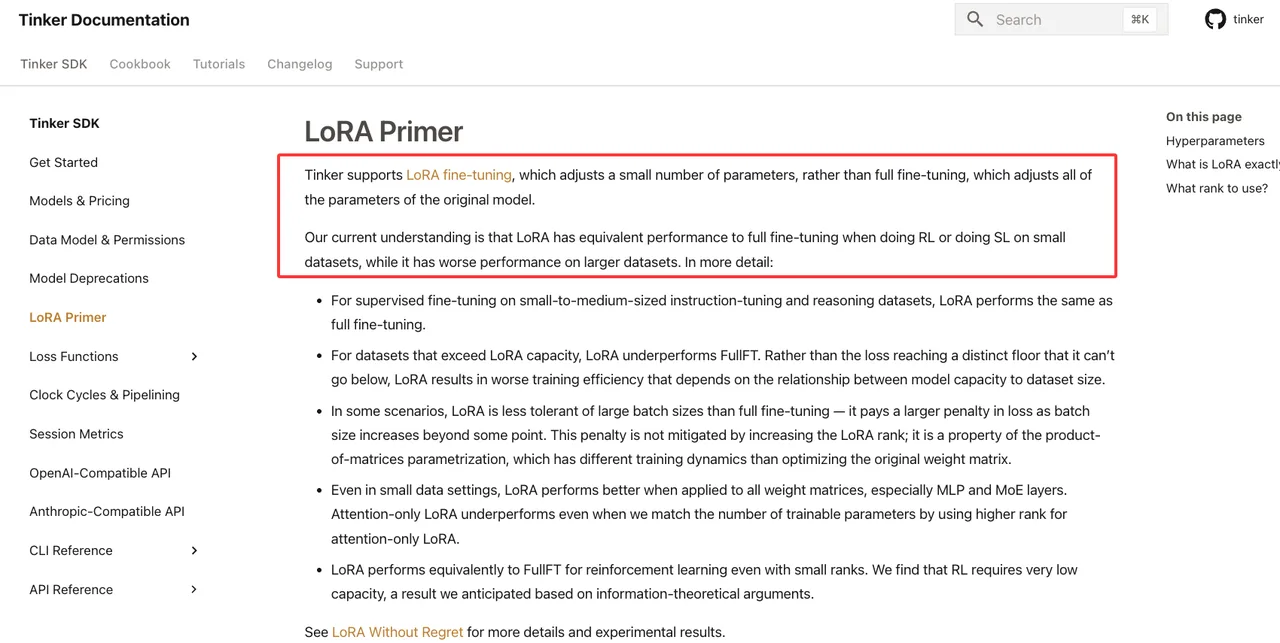
That means the fine-tuning question is not “did loss go down?”
The question is: did the adapted model pass tasks that prompting and retrieval failed, without breaking tasks that already worked?
Found the pattern on the third try. That is usually the test.
Regression tests before and after adaptation
Every adaptation run needs a before/after comparison.
I would freeze three sets:
- Target set: tasks the customization is meant to improve.
- Control set: tasks Inkling already handled well.
- Risk set: safety, refusal, tool errors, hallucination, and long-context traps.
A good adaptation improves the target set, holds the control set, and does not create new risk. If it only improves the demo case, it is not ready.
For production agents, I would also test routing. Maybe base Inkling handles general support. A LoRA-adapted version handles a narrow claims workflow. A smaller or cheaper model handles classification. A retrieval-heavy setup handles policy QA. One model does not need to carry every workload.
Having many options is not the problem. Having no routing policy is.
FAQ
Who owns the final pass/fail decision for Inkling rollout?
The final decision should belong to the system owner, not the model evaluator alone.
The evaluator owns the evidence. The platform owner owns latency, cost, logging, and reliability. The product owner owns customer impact. Security or governance owns policy boundaries. For high-stakes use, legal or risk teams may need a formal gate.
If nobody owns the final decision, the rollout is not ready.
What customer evidence should trigger re-evaluation?
Re-evaluate when customers show failures that your benchmark did not cover.
That includes repeated escalations, corrections from support agents, tool-call failures, wrong answers with confident wording, missing evidence, OCR or audio misunderstandings, long-context misses, unsafe completions, sudden latency spikes, or cost per accepted answer moving past the planned range.
A single weird ticket may not mean the model failed. A pattern means the eval set is stale.
How should teams document benchmark gaps before launch?
Write the gaps in plain language.
I would document: what was tested, what was not tested, which official benchmarks were used only as background, which private tasks passed, which modalities were excluded, what context lengths were actually run, what infrastructure was used, what safety tests were skipped, and who accepted the residual risk.
No poetic launch note. Just the ledger.
Conclusion
To benchmark Inkling well, I would not start with the question “is Inkling good?” That question is too soft.
I would ask whether Inkling can complete the team’s real agent tasks, with the right tools, inside the target latency and cost envelope, while handling text, images, audio, and long-context retrieval without creating review debt the team cannot pay.
Public benchmarks decide whether Inkling enters the test queue. Your task-level eval decides whether it enters production.
That’s it.
Previous posts:
Related Articles

DeepSeek V4.1 Flash API: Access and Migration

GPT-6 Astra Pro Pricing and Real Workload Cost

GPT Image 2.5 vs Nano Banana 2: Quality, Speed, and Cost

GPT Image 2.5 vs Nano Banana Pro for Precision Editing

Is K2 Horizon Open Source? Audit the Release