Inkling Hugging Face: Weights and Inference
Inkling Hugging Face access guide for checking weights, BF16, NVFP4, model formats, inference options, and deployment limits.
Hey, guys. I’m Dora. I opened the Inkling Hugging Face pages the same way I open any large-model release page now: organization first, model card second, files tab third, revision history fourth. Not the demo. Not the launch screenshot. The repo is where the planning starts getting expensive.
This note is for the person who searched Inkling Hugging Face because they need to know what can be downloaded, what format it comes in, and whether “open weights” means “we can run it this week.”
Short answer: maybe. But not on normal local hardware. The weights are real. The infrastructure bill is also real.
What to Check on the Inkling Hugging Face Page
Organization, model card, license, files, and revision history
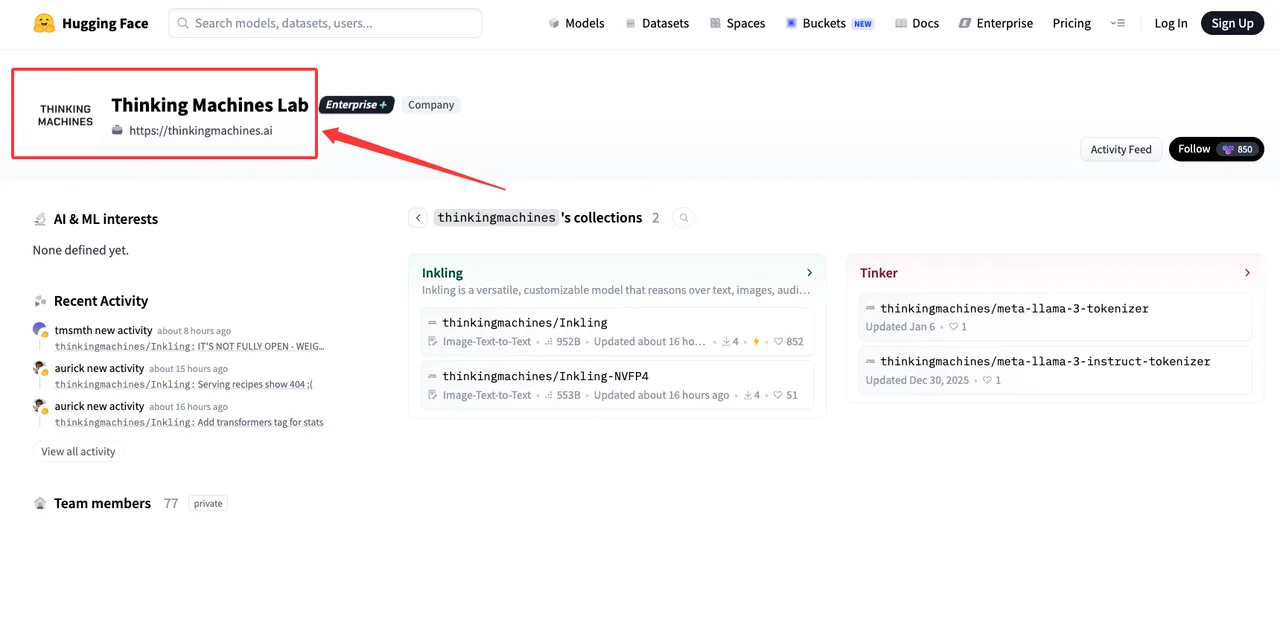
Start with the organization. The official Hugging Face namespace is Thinking Machines Lab, shown as thinkingmachines. That matters because near-release model names get mirrored, renamed, quantized, and repackaged fast. Some mirrors are useful. Some are just noise with a download button.
As of July 16, 2026, the official collection has two main repos:
| Repo | Format | What it means |
|---|---|---|
| thinkingmachines/Inkling | BF16 | Reference checkpoint, full model card, official specs |
| thinkingmachines/Inkling-NVFP4 | NVFP4 | Smaller inference-oriented checkpoint for supported high-end hardware |
The Inkling BF16 model page lists Apache 2.0 as the license, uses Safetensors, and includes the sections teams usually need: intended use, architecture, parameters, input modalities, output modality, safety, risks, and limitations.
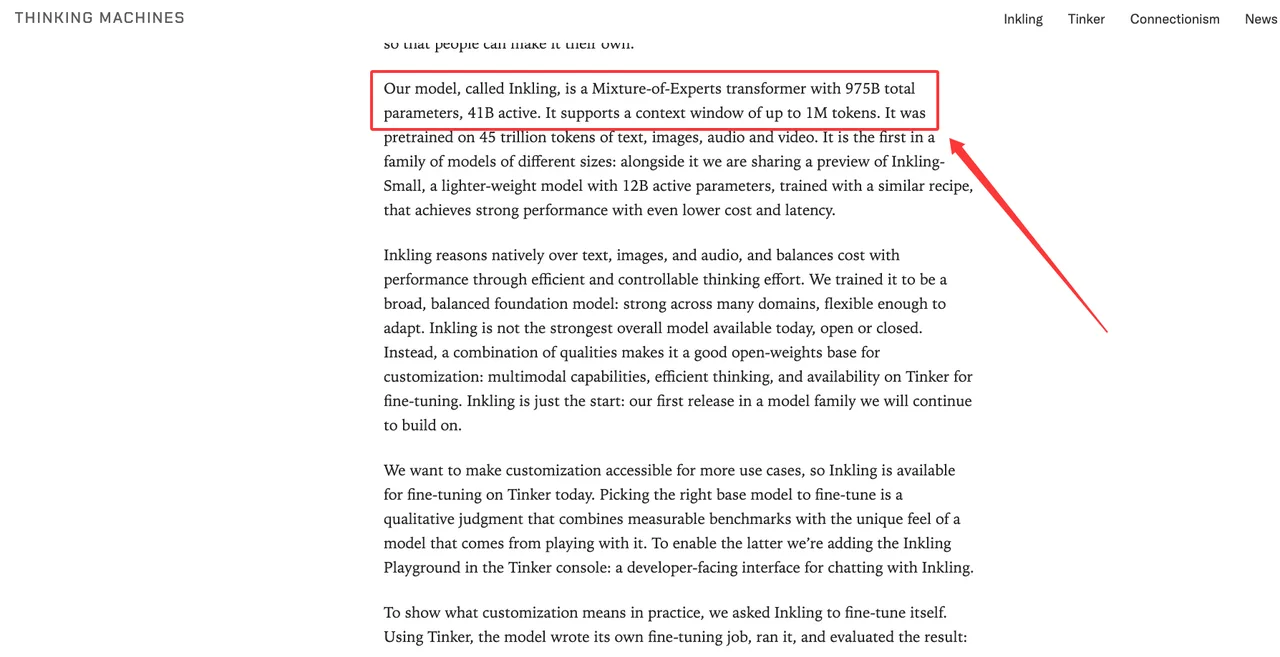
I paused here because the page has two kinds of numbers. The model card says 975B total parameters and 41B active parameters. Hugging Face metadata may show a different repository-level parameter count. I would not turn the metadata number into the architecture claim. Use the model card for architecture. Use repository metadata for repo tracking.
Revision history is not housekeeping. It is evidence. If the README changes, processor files change, or a config file gets updated after release, your internal note should capture the commit hash and date. Otherwise the sentence “we tested Inkling” becomes too vague to be useful.
Why model-card evidence matters before production planning
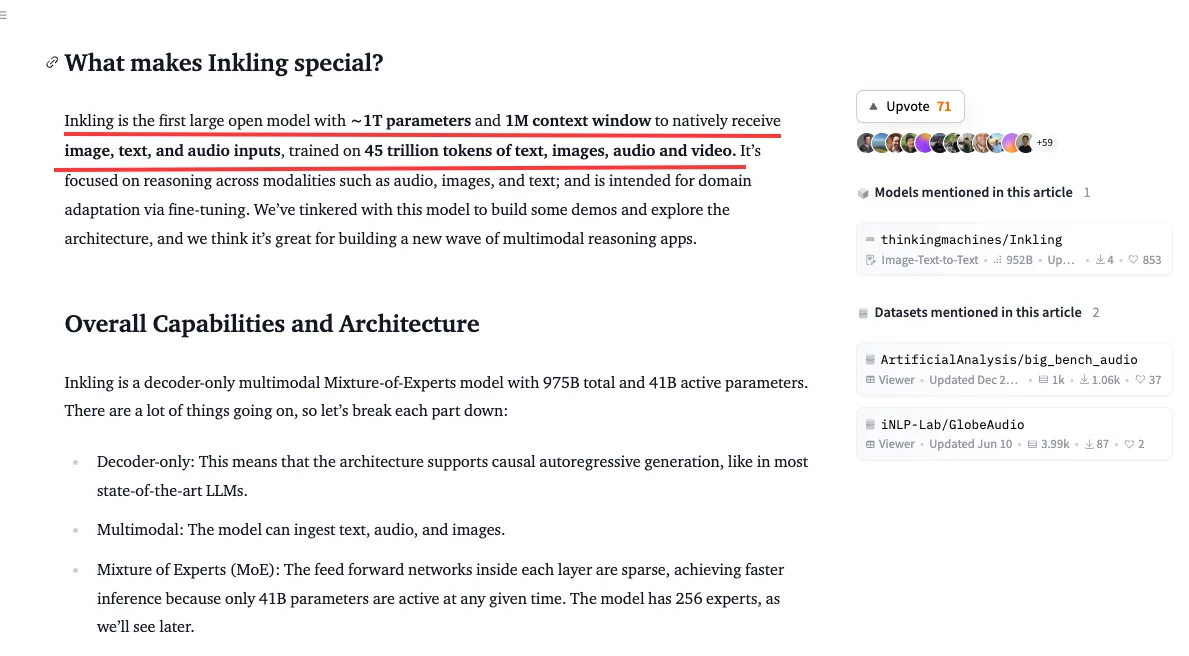
Model cards are where optimistic planning gets corrected. Inkling’s card says the model accepts text, image, and audio inputs and generates text output. It also says the model is intended for developers building agentic systems, coding assistants, chatbots, RAG systems, and multimodal applications.
That does not mean every path supports every modality equally. A hosted provider may expose text and image first. A local stack may support image-text but not audio in the exact way your app expects. A framework may load the checkpoint but still need work around processors, chat templates, reasoning controls, or context behavior.
The record I would keep is plain: repo URL, license field, revision hash, file list, framework version, hardware target, and serving path. Boring. Useful.
Good enough. That is the most honest assessment I can give.
Understand the Available Formats
BF16, NVFP4, shards, config files, tokenizer, and processors
The BF16 repo is the reference-format path. It is large, mostly made of Safetensors shards. The file tree shows a repo size around 1.9 TB and many model shard files. It also includes the small files that affect behavior more than people admit: config.json, chat_template.jinja, tokenizer files, and processor configuration.
The Inkling NVFP4 repo is the inference-oriented path. It is smaller, around 592 GB in the Hugging Face file tree, with fewer Safetensors shards, hf_quant_config.json, model.safetensors.index.json, mtp.safetensors, tokenizer files, and processor_config.json.
That file list tells you what kind of project this is. It is not one binary blob. It is a coordinated checkpoint package. If the tokenizer moves, the processor changes, or the chat template changes, output behavior can shift even when the main weight shards look untouched.
The small files are not optional. They are part of the model.
Download size, storage, and checksum discipline
The first practical question is not “can we download it?” It is “where does it land, who pays for storage, and how do we prove we downloaded the intended revision?”
For BF16, plan around multi-terabyte storage. For NVFP4, plan around hundreds of gigabytes, not a casual cache directory. Hugging Face uses large-file storage here, so the download path may involve Hugging Face tooling rather than a plain browser download.
I would record the repo name, revision, commit SHA, local storage path, visible file count, total visible repo size, download command, and verification method. Two months later, nobody remembers which “latest” they pulled. “Latest” is not a revision.
Choose an Inference Path
Local research, hosted inference, third-party endpoints, and internal serving
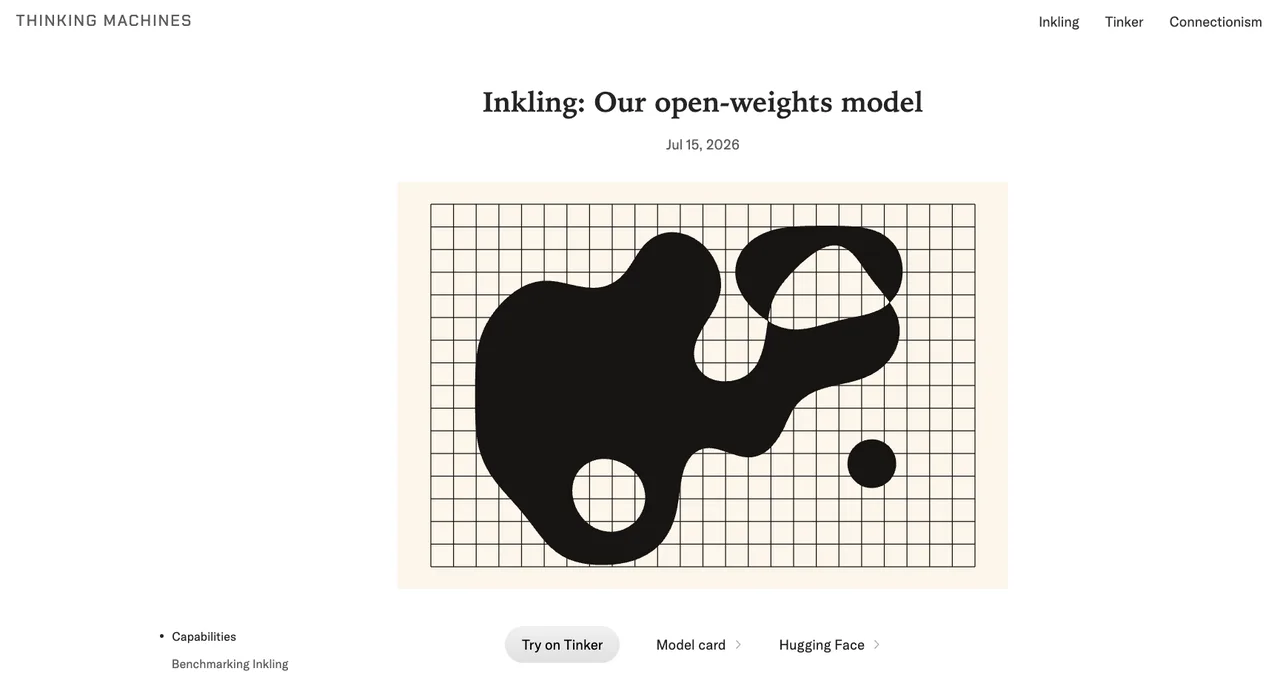
Inkling inference has several paths. They are not equivalent.
The Hugging Face launch post, Welcome Inkling by Thinking Machines, says Inkling has support across Transformers, SGLang, vLLM, llama.cpp, and related local or cluster serving routes. It also states the practical hardware cliff: BF16 needs about 2 TB of VRAM, while NVFP4 needs about 600 GB.
That is the sentence I would put in every internal planning doc.
Local research is useful for inspecting architecture, tokenizer behavior, prompt formatting, and client integration. Hosted inference is useful for fast prompt and product evaluation. Third-party endpoints help teams avoid owning the cluster during early tests. Internal serving gives the most control, but it also brings the most operational work.
Thinking Machines’ own release says Inkling is available via APIs on Together, Fireworks, Modal, Databricks, and Baseten, and that the full weights are on Hugging Face as both the original checkpoint and an NVFP4 checkpoint for Blackwell systems. The official Inkling release is the better source for partner availability than a random provider list.
I would treat third-party endpoints as evaluation routes first. They can be production routes later, but only after legal, security, logging, data retention, latency, rate limits, and modality coverage are checked.
Why near-trillion-parameter models are not consumer local installs
Open weights do not mean consumer local install. That line needs to survive every rewrite.
A near-trillion-parameter MoE model can have only 41B active parameters per token and still require a serious serving setup. Active parameters reduce compute relative to dense activation. They do not erase storage, routing, memory bandwidth, KV cache, multimodal preprocessing, or framework support.
This is where teams misread the release. They see “open weights” and mentally file it next to small local models. Different category.
For a developer laptop, the useful local work is probably repo inspection, tokenizer checks, prompt-format review, and client integration against a hosted endpoint. Full model serving is a cluster conversation.
Production Readiness Checks
Framework compatibility, quantization support, input modalities, and context behavior
The production checklist starts before benchmark testing.
- Check framework support first. Transformers support is useful for loading and experimentation. SGLang and vLLM matter for serving. TokenSpeed, Unsloth, llama.cpp, and GGML-style routes may matter depending on the quantization path and hardware target. I would not assume parity between them.
- Check quantization support next. Inkling BF16 and Inkling NVFP4 are not just different file sizes. They target different hardware assumptions. If the team does not have compatible systems, “smaller checkpoint” may not help.
- Then check modalities. Text, image, and audio inputs are listed in the model card, with text output. Production behavior still depends on the serving layer. Image preprocessing, audio format handling, maximum audio length, and processor behavior all need tests.
- Context needs its own test. Inkling is associated with a 1M context window, but serving long context is a memory problem. KV cache limits, tensor parallelism, and provider caps can reduce what is practical. Write down the actual max context used in your test. Not the theoretical number from the launch page.
License, data policy, and model update monitoring
Apache 2.0 is permissive. It is not the whole approval story.
Enterprise review still needs the model card, the acceptable-use policy linked from the official card, training-data disclosures, and the organization’s own rules for open-weight models. The model card says training data includes text, images, audio, and video from public, third-party, synthetic, or augmented sources. That may be acceptable. It may also trigger review. Better to find out before a team builds around it.
Update monitoring is the part people skip. Watch for new commits, new quantization files, processor updates, tokenizer changes, provider availability changes, and policy edits. A README-only change may be harmless. A chat-template change is not automatically harmless.
This conclusion has an expiration date. Models update fast.
FAQ
Who owns approval for downloading large model weights?
The model infrastructure lead owns the technical approval. Security and legal own the risk approval. Finance or cloud operations owns the storage and transfer-cost approval. If the download touches shared enterprise infrastructure, platform engineering should be in the loop before the first pull.
For Inkling BF16, this is not a casual developer download. For NVFP4, it is still large enough to require a controlled storage location, service-account policy, and revision record.
What should be recorded when a Hugging Face revision changes?
Record the old revision, new revision, commit hash, timestamp, changed files, changed file sizes, changed model card sections, and the reason the update was accepted.
If the change affects config.json, tokenizer files, chat_template.jinja, processor files, quantization config, or Safetensors shards, rerun smoke tests. For Inkling inference tests, also record framework version, hardware, context length, modality used, and provider if the run was remote.
How should teams handle unsupported community mirrors?
Treat them as untrusted until proven otherwise. A community mirror may be useful for experiments, especially quantized variants, but it should not replace the official thinkingmachines source in enterprise docs.
If a mirror is used, record the upstream repo, conversion method, license claim, file differences, maintainer identity, and checksum process. Unsupported mirrors should not be cited as official Inkling model download sources.
Conclusion
The clean path through Inkling Hugging Face is evidence first: official organization, official repos, model card, files, license, revision history, then inference path. The weights are available. The formats are clear enough to plan around: BF16 for reference, NVFP4 for more practical high-end inference work. The hardware boundary is also clear.
Open weights give teams control. They do not remove deployment work.
For this model, the useful question is not “can we download it?” The useful question is: which revision, which format, which serving path, which hardware, and who signs off when it changes. That is where the real evaluation starts.
Previous posts:
Related Articles

DeepSeek V4.1 Flash API: Access and Migration

GPT-6 Astra Pro Pricing and Real Workload Cost

GPT Image 2.5 vs Nano Banana 2: Quality, Speed, and Cost

GPT Image 2.5 vs Nano Banana Pro for Precision Editing

Is K2 Horizon Open Source? Audit the Release