What Is Inkling? Thinking Machines Lab Model
Inkling model explained for builders evaluating Thinking Machines Lab’s open-weights multimodal model, context, reasoning, and limits.
It’s Dora here.
The Inkling model is the kind of release that makes specs travel faster than evidence. As of July 17, 2026, the clean source of truth is Thinking Machines Lab’s July 15 announcement, its official model card, and the Hugging Face repository. Start there. Not with launch-thread screenshots.
Quick answer: Inkling is an open-weights, multimodal Mixture-of-Experts model from Thinking Machines Lab. It is large, customizable, and built for text, image, and audio inputs with text output. It is also not positioned by its own maker as the strongest general model available. That sentence matters.
What Inkling Is
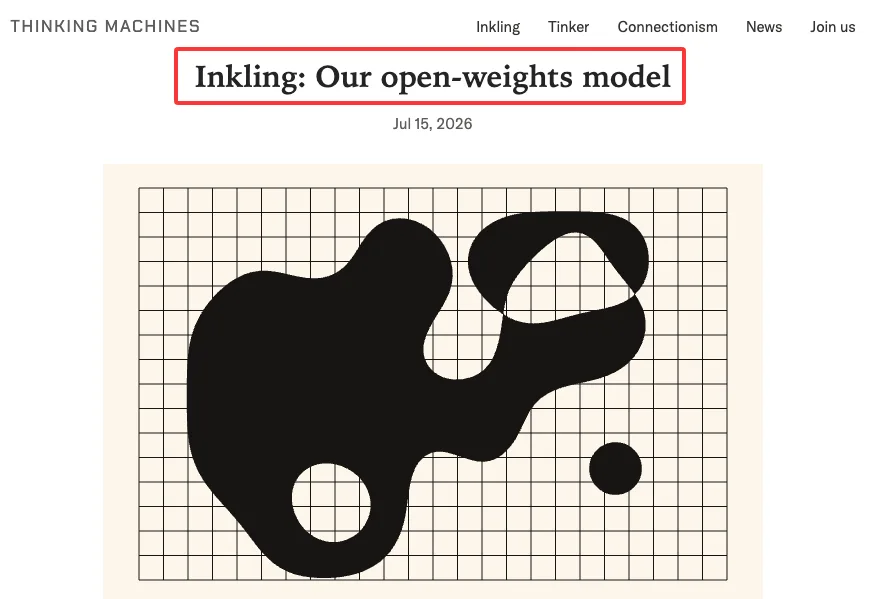
Open-weights multimodal model from Thinking Machines Lab
Thinking Machines Inkling is a general-purpose model released with open weights for research, fine-tuning, and third-party product integration. The official Inkling page lists 975B total parameters, 41B active parameters, a Mixture-of-Experts architecture, a 1M-token context window, and text, image, and audio input support.
It is fair to describe it as an open-weight multimodal model. It is less useful to describe it as “Mira’s model” in serious docs. Mira Murati is identified by Thinking Machines as its cofounder and CEO, so people will search for “Mira Murati AI model.” Fine. For enterprise evaluation, call it a Thinking Machines model and cite the model artifacts.
Why open weights do not automatically mean easy deployment
Open weights mean teams can inspect, download, host, adapt, or fine-tune the weights under the stated license and policy. They do not mean a laptop-friendly local model.
The model card says the BF16 checkpoint needs at least 2 TB of aggregate VRAM, while the NVFP4 checkpoint lowers that to at least 600 GB. That is cluster territory. One fewer marketing misunderstanding. Sounds small. Adds up fast.
Core Specs Builders Should Verify
MoE scale, active parameters, and model formats
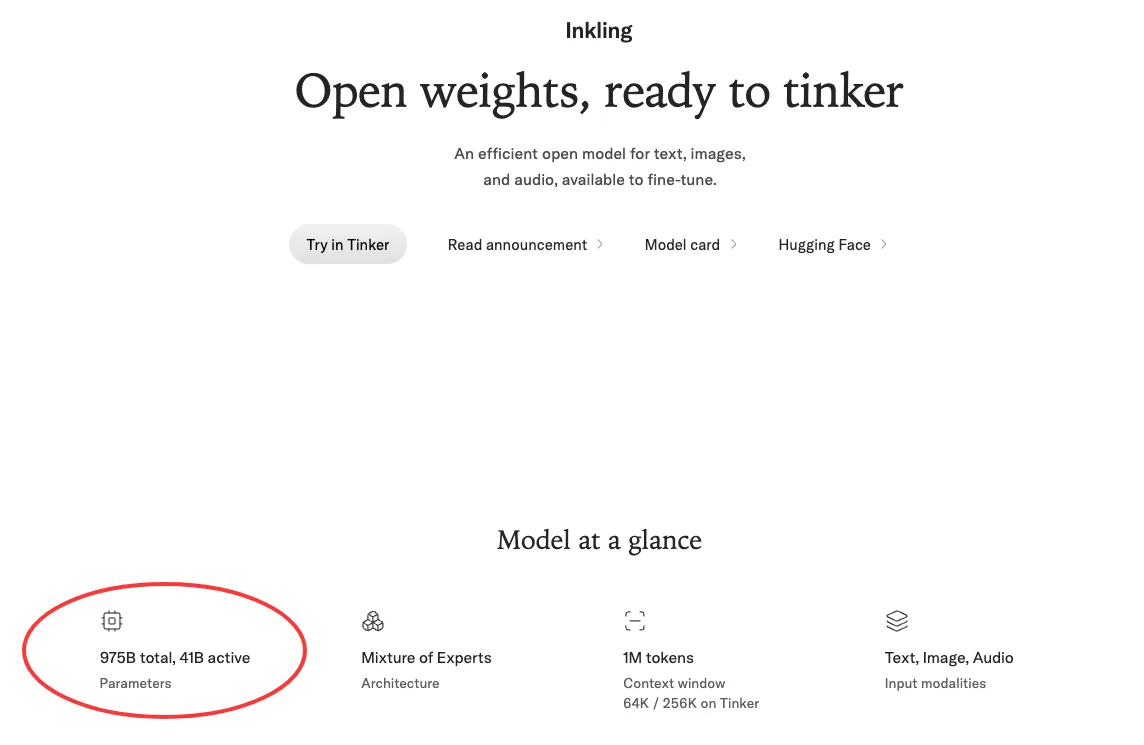
For the Inkling model, the key architecture claim is 975B total parameters and 41B active parameters. The model card describes a 66-layer decoder-only transformer with sparse MoE feed-forward layers, routing each token to 6 of 256 experts plus 2 shared experts.
Do not flatten that into “41B model.” Active parameters are not total parameters. Also keep a note on source differences: Hugging Face currently surfaces “952B params” in repository metadata, while Thinking Machines’ official specs state 975B total. I would cite the official specs for architecture and retain a dated screenshot or export of the Hugging Face page for repository metadata.
Context length, text, image, and audio inputs
The official spec says Inkling supports up to a 1M-token context window. The announcement also says Tinker access has 64K and 256K context options. Treat “1M context” as a maximum model capability, not proof that every serving path exposes the same window.
Input support is text, image, and audio. The model card is more specific: UTF-8 text, pixel-based images, and 16kHz WAV audio, ideally under 20 minutes. Output is text. Training data included text, images, audio, and video, but the stated user-facing input modalities to cite are text, image, and audio.
Controllable reasoning and inference behavior
Inkling’s “controllable thinking effort” is one of the more interesting parts. The announcement describes effort settings used to trade off performance against generated tokens, with benchmark results reported at effort 0.99.
That means benchmark numbers and production behavior may not line up unless the effort setting, temperature, harness, and token limits are documented. I paused here. This is exactly where model claims get too clean.
Where Inkling Fits
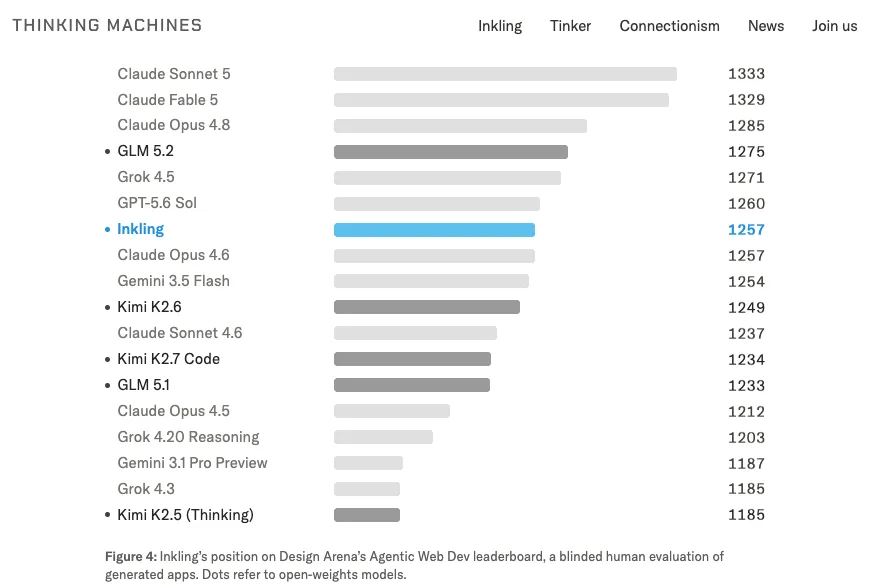
Research agents, multimodal assistants, long-context workflows, and model customization
The practical fit is not “replace every model.” It is more specific.
Inkling makes sense to evaluate for research agents, agentic coding systems, tool-use workflows, retrieval-heavy assistants, multimodal analysis, and long-context internal knowledge tasks. It also fits teams exploring customization, because the release is tied to Thinking Machines’ Tinker platform without making Tinker the whole story.
For product teams, the question is not whether the Inkling AI model is impressive. The question is whether its mix of open weights, multimodal input, long context, and adjustable reasoning effort solves a workflow your current hosted model does not.
When smaller hosted models may be more practical
A smaller hosted model may be the better default when the task is narrow, latency-sensitive, cost-sensitive, or already solved by existing APIs. Basic classification, lightweight chat, simple captioning, and routine support flows do not automatically need a 975B MoE base.
Open weights are valuable when control matters. Hosted models are valuable when operations should disappear. Both can be true.
What Inkling Is Not
Not necessarily the strongest general model
Thinking Machines says this plainly in the launch post: Inkling is not the strongest overall model available today. That is a useful boundary, not a weakness to hide.
The stronger claim is narrower: it is a broad, open-weights base model with multimodal capabilities, efficient thinking, and customization paths. Keep the claim there.
Not a simple local model for consumer hardware
This is not a casual local download for consumer GPUs. The required hardware section names multi-GPU configurations and large aggregate VRAM requirements. If a doc says “run Inkling locally” without qualifying the hardware, remove or rewrite it.
Risks and Open Questions
Licensing, safety policy, benchmark scope, tool support, and production access
The license line says Apache 2.0, but the Model Acceptable Use Policy still matters. Legal review should record both.
Safety is also not “handled” just because the model has safeguards. The model card recommends downstream evaluation, content filtering, rate limiting, monitoring, and human oversight for high-stakes use cases.
Benchmark scope needs care. The published results use specific effort settings, dates, harnesses, and comparison models. Retain those details before turning benchmark rows into sales or product claims.
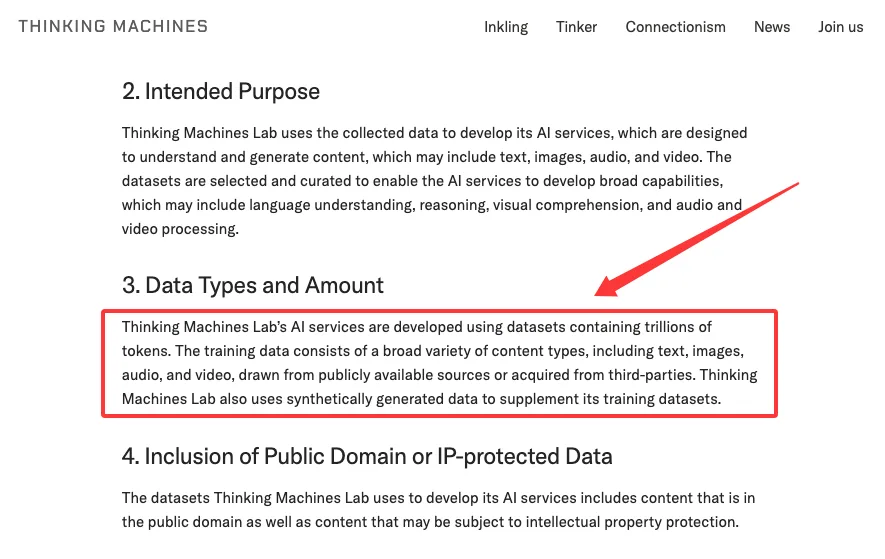
Training data questions will come up. Thinking Machines’ training data documentation says its AI services use public, third-party, and synthetic data, including IP-protected material. That is enough to trigger enterprise review. It is not enough to answer every copyright or data-governance question.
FAQ
Who should approve Inkling for enterprise evaluation?
At minimum: the model infrastructure lead, application owner, security team, legal or compliance reviewer, and the business owner of the use case. If weights are self-hosted, add the GPU platform owner. If access goes through a hosted service, add procurement and vendor risk.
What evidence should teams retain before citing Inkling specs?
Keep dated copies of the official announcement, model card, Hugging Face page, license, acceptable use policy, and any benchmark table being cited. Also retain the checkpoint name, repository revision, serving path, context setting, effort setting, and hardware assumptions.
Good docs age better when they show their receipts.
When should unsupported Inkling claims be removed from docs?
Remove claims that are not traceable to the official release, model card, or Hugging Face repository. Also remove claims that turn “open weights” into “easy deployment,” “1M context” into “always available,” or “competitive benchmark results” into “best model.” That is how hype leaks into technical docs.
Conclusion
The useful reading of the Inkling model is restrained: a large open-weights multimodal MoE from Thinking Machines Lab, built for customization, long context, and controllable reasoning. Strong enough to evaluate seriously. Big enough to plan around carefully. Not magic. Good enough to verify.
Previous posts:
Related Articles

DeepSeek V4.1 Flash API: Access and Migration

GPT-6 Astra Pro Pricing and Real Workload Cost

GPT Image 2.5 vs Nano Banana 2: Quality, Speed, and Cost

GPT Image 2.5 vs Nano Banana Pro for Precision Editing

Is K2 Horizon Open Source? Audit the Release