H3 Max Benchmark: Speed, Quality, and Prompt Tests
Use a matched H3 Max benchmark to separate throughput claims from output quality, prompt following, and usable-video results.
A video returned in three seconds is still slow if nobody can use it.
John. I care about the clip that survives review, not the render that merely finishes first. That is the right frame for an H3 Max benchmark: wall-clock speed, prompt compliance, failures, and usable-output rate on one fixed task. No new API generation was run for this article; the test below is a reproducible plan paired with current published evidence.
Benchmark Verdict and Scope
One matched video task and one decision
The decision is narrow: should a video API team pilot H3 Max for rapid text-to-video drafts?
Use one scorable prompt: a five-second, 16:9 product shot at 768p with synchronized ambient audio, one camera move, three required objects, and a forbidden logo. Test H3 Max against the official MiniMax H3 route. Log H3 Max Turbo separately; do not merge it into the Max row.
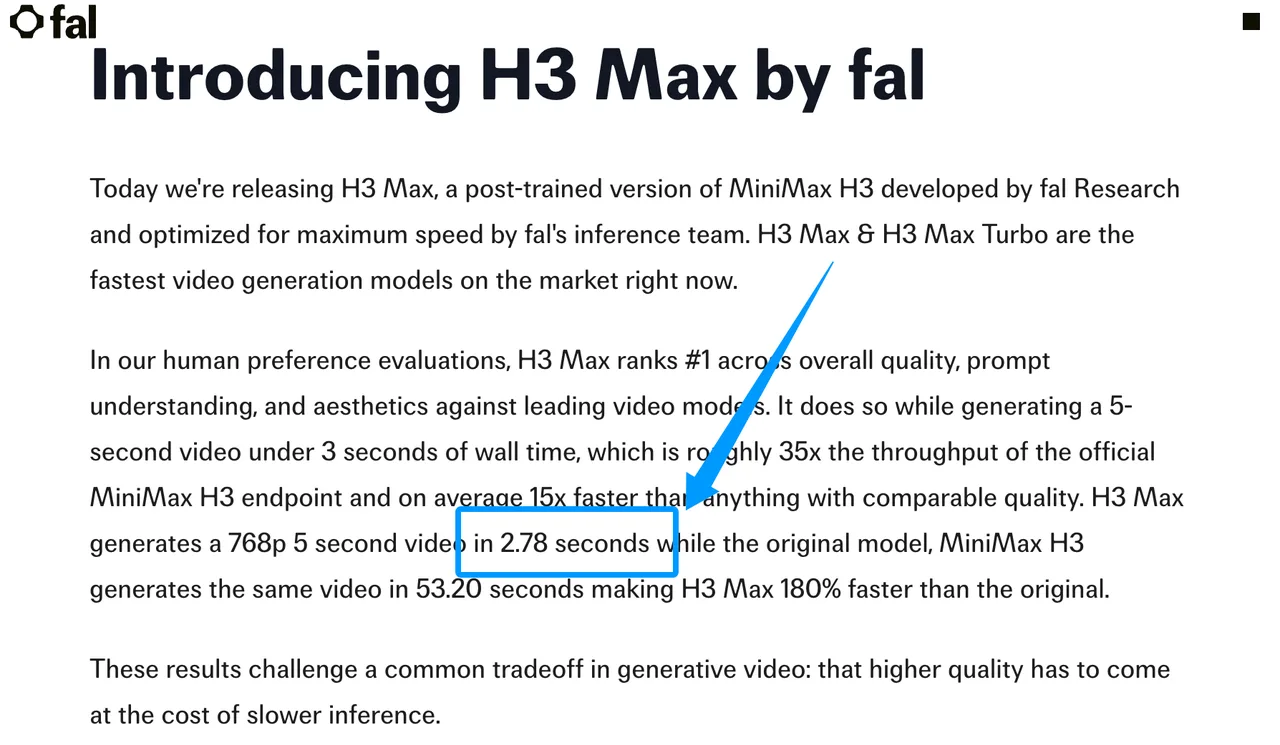
fal’s launch benchmark says H3 Max produced a five-second 768p video in 2.78 seconds, versus 53.20 seconds for its MiniMax H3 comparison. fal separately describes roughly 35× throughput against the official endpoint. These are provider claims with different metrics; the wall-time pair alone is not a 35× ratio.
Metrics that determine a usable result
Record five measures:
- End-to-end latency from submission to download, including median and p95.
- Backend inference time when supplied.
- Prompt score for objects, action, camera move, composition, and forbidden elements.
- Technical validity: duration, resolution, audio, playback, and file integrity.
- Usable-output rate: accepted clips divided by submitted jobs.
Use blinded reviewers and save every failure. Cost per usable output matters more than cost per request.
Build a Reproducible H3 Max Test
Fixed prompts, duration, resolution, and seeds
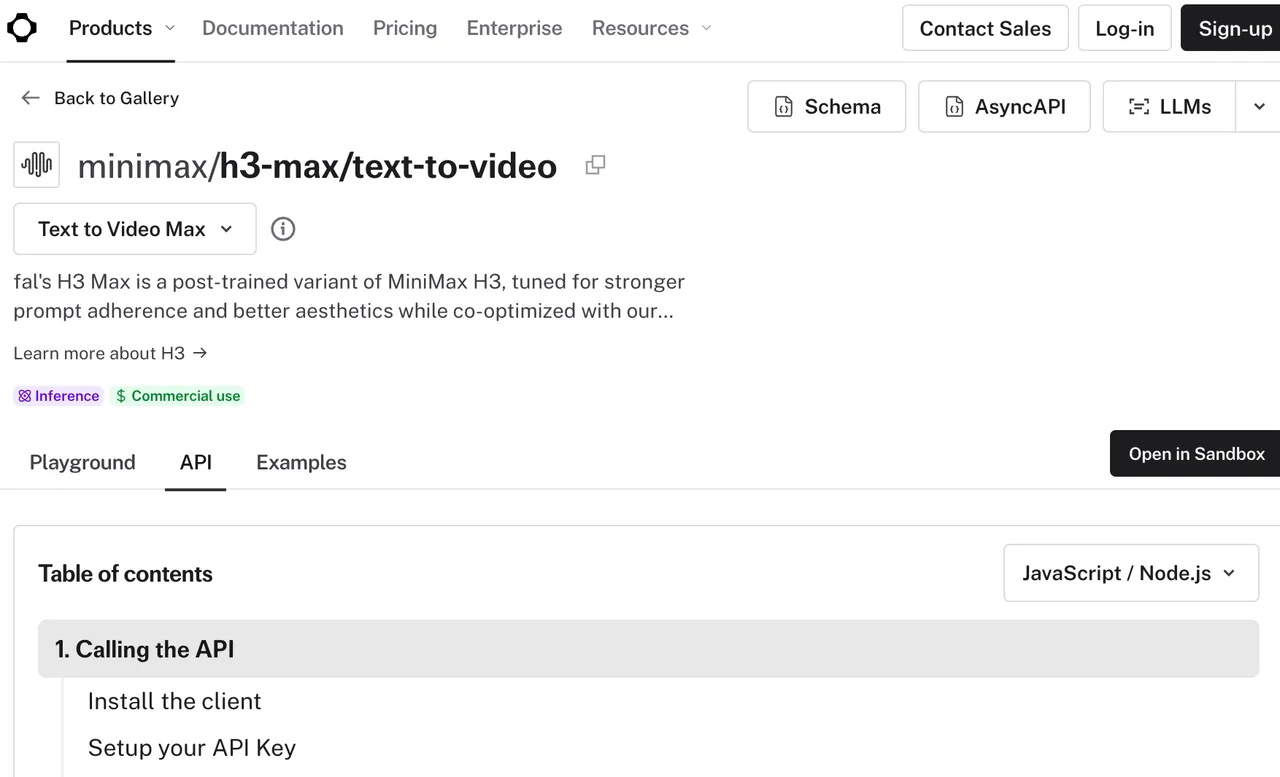
The H3 Max API schema accepts 5–15-second durations, 480p, 768p, or 1080p output, and an optional integer seed. Defaults are five seconds, 768p, 16:9, and balanced prompt expansion.
Pin every exposed field. Store the submitted and expanded prompts. Prompt expansion matters: balanced may return in about one second, while quality can spend up to roughly 30 seconds rewriting. Mixing those modes ruins an H3 Max speed test.
Run at least 30 requests per endpoint across multiple time windows. Disclose dates, region, SDK version, endpoint ID, sample count, and failures. One seed controls the comparison; several fixed seeds expose variance.
Wall-clock timing and failed-run logging
Start timing before submission. Stop after download and validation. Queue wait, polling, inference, encoding, and download all count. Store the request ID, status, queue updates, retries, client timestamps, response timings, and output checksum.
The response can include a timings object whose inference field represents GPU denoising time. That is not end-to-end latency. Report both.
Keep failed jobs in the usable-output denominator. Classify provider errors, invalid files, moderation blocks, timeouts, and review failures. Otherwise, reliability vanishes inside the average.
Read the Results Without Overclaiming
Speed, prompt following, and usable-output rate
fal says H3 Max ranked first in its own study for overall quality, prompt understanding, and aesthetics. That supports a pilot, not a universal verdict. fal designed the comparison and operates the serving stack.
Score each prompt instruction independently. A beautiful clip that misses the camera move does not pass. Report accepted rate beside latency: “2.8 seconds at 40% usable” and “20 seconds at 80% usable” lead to different production decisions.
Reconcile fal and Artificial Analysis evidence
The accessible Artificial Analysis text-to-video leaderboard listed “Minimax H3 Max (post-trained by fal)” on September 10, 2026. Its with-audio view showed 1235 Elo, a ±10 confidence interval, and 5,482 samples. The rank range was 1–4, so the result was competitive but not isolated from every nearby model.
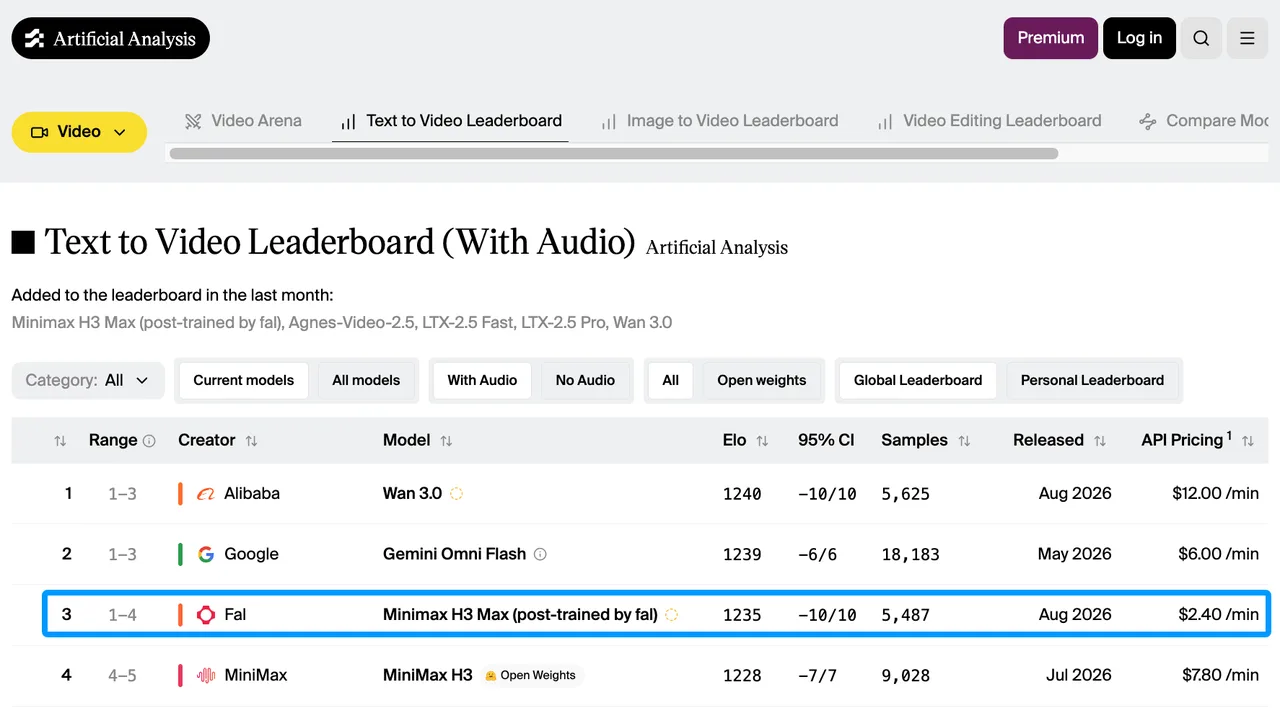
It did not appear as MiniMax H3 Turbo. H3 Max Turbo had no separate row in that snapshot. Max votes cannot be transferred to Turbo.
Artificial Analysis measures blind preference; fal’s evidence includes prompt understanding and provider-side speed. The Artificial Analysis methodology uses 10-second, near-1080p defaults and end-to-end latency over a trailing three-day window. That does not match fal’s five-second 768p example. The sources answer different questions.
Limits and Trade-Offs
Small samples do not prove general quality
Thirty runs can reveal clear failure patterns. They cannot prove performance across people, physics, typography, animation, or every language. Keep conclusions tied to the tested prompt.
Leaderboard settings may differ from production
Arena votes mix taste with task compliance. Resolution, duration, audio, prompt enhancement, queue conditions, and endpoint revisions may differ from your pipeline. Repeat the matched test after endpoint changes.
FAQ
Does H3 Max return seeds for exact reruns?
The input accepts a seed, but the documented output does not return one. Store it yourself. fal does not promise bit-exact output across backend revisions.
Can benchmark requests export detailed timing logs?
Queue requests expose logs, request IDs, and response timings. Inference is backend time, not the full journey. Export client and download timestamps too.
Are failed H3 Max jobs included in usage reports?
The schema does not define billing-export fields. fal’s API FAQ says 5xx failures are not charged; some 422 errors may be charged after GPU work. Reconcile request IDs with account usage.
What concurrency limit applies to benchmark runs?
No H3-specific number is public. New accounts start at two concurrent requests; account limits can rise to 40, while busy endpoints may add limits. Check the dashboard.
Can users download the exact leaderboard prompts?
Artificial Analysis calls its prompt set curated and reproducible, but the cited methodology does not provide a public download link for the exact current video prompts or explain whether user-submitted Arena prompts enter that curated benchmark corpus.
Conclusion
The current H3 Max benchmark evidence supports a controlled pilot, not a broad “fastest and best” claim. fal supplies the speed and prompt-following claims; Artificial Analysis independently shows competitive preference under different settings and names the model H3 Max, not Turbo. Publish failures and choose on latency per usable clip.
Previous posts:
Related Articles
GPT Image 2.5 Review 2027: Quality, Editing, Speed, and Cost
GPT Image 2.5 vs GPT Image 2: Is It Worth Upgrading?
Grok Imagine Video Pricing and Cost per Clip
K2 Horizon Review 2027: What the Open Model Family Includes
Muse Spark 1.3 Max Pricing and Task Cost