
Eleven v4 vs v3: What Changes for Speech Apps?
Eleven v4 vs v3 for speech apps: compare expressive control, voice consistency, and upgrade fit before moving a production workflow.
Test both models on the same task before migrating. That is my answer to Eleven v4 vs v3 for teams: v4 expands expressive direction, language coverage, and cloning support, but a launch does not prove it will preserve your voice, pronunciation rules, latency, or approval rate.
It’s John. I treat this as a workflow change, not a model-name upgrade. A strong demo can fail when a team regenerates one line or maintains a long character performance. This is an evidence review and test plan, not a hands-on verdict.
Quick Verdict for Speech Application Teams
Choose by Delivery Control, Voice Stability, and Workflow Fit
ElevenLabs released Eleven v4 on September 28, 2026 with natural-language direction, inline audio tags, stronger multi-speaker handling, and improved voice cloning. The current model documentation lists 90+ languages and a 10,000-character limit for v4, versus 70+ languages and 5,000 characters for v3.
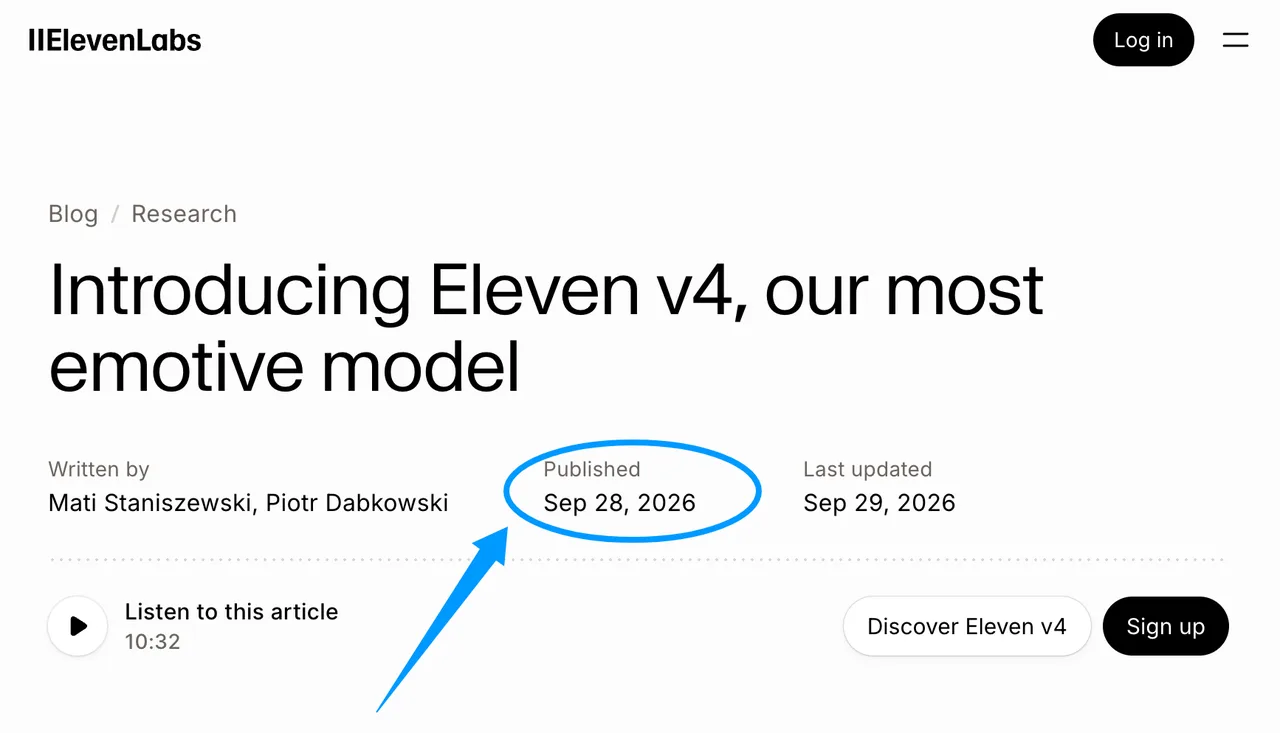
Those are meaningful changes, not migration proof. Choose v4 when directed performance, multilingual delivery, or clone fidelity is the bottleneck. Keep v3 when approved takes are stable and a matched test shows no better usable-output rate. Do not switch models yet. Look at the workflow first.
Compare Both Models With One Matched Speech Task
Hold Voice, Script, Language, and Output Settings Constant
Use one production-shaped script: a neutral opening, emotional turn, difficult name, number, and regenerated closing line. Run the same voice ID, language, stability, similarity, and output format. Stay within v3’s lower limit so length does not bias the Eleven v4 comparison or Eleven v3 comparison.
Save the script, voice ID, model ID, settings, output, timestamp, and audio. For multi-speaker work, preserve assignments and turn order. If a setting is unavailable, log the difference rather than silently substituting it.
Record Usable Takes, Generation Time, and Reruns
Count first-pass approvals, reruns, pronunciation fixes, identity drift, clipped lines, and review minutes. Record end-to-end time. Compare cost and operator time per usable minute of approved audio.
Run several repeats. One attractive take shows only one success, not how often the team must regenerate a sentence or repair a handoff.
How Do v4 and v3 Differ in Expressive Control?
Direction Tags, Pacing, and Multi-Speaker Delivery
v3 supports expressive speech, audio tags, and multi-speaker dialogue. v4 improves adherence to natural instructions for emotion, accent, delivery, and sound cues; official material claims stronger instruction adherence. That may simplify directed scenes.
Test your application’s exact directions. Score whether emotion arrives without distorting pronunciation, pacing, or identity. For dialogue, inspect interruptions, turn boundaries, and cross-speaker trait leakage. This cannot be judged by feel. It needs a sample run.
Which Model Keeps Voices More Consistent?
Voice Identity Across Long Scripts and Regenerated Lines
Among current ElevenLabs speech models, v4 emphasizes long-text speaker preservation and supports Instant and Professional Voice Clones. Clone-heavy work deserves evaluation, not automatic migration.
Split a long script into checkpoints. Compare the opening with the final section, then regenerate one middle line three times. Review timbre, accent, cadence, age impression, loudness, and emotional continuity. Include native speakers for multilingual checks. Richer sound still creates work if replacement lines mismatch the surrounding take.
When Is Moving From v3 to v4 Worth It?
Upgrade for Directed, Multilingual, or Clone-Heavy Work
An Eleven v4 upgrade fits when v3 repeatedly misses direction, work needs languages outside v3’s coverage, or clones drift across material. The larger character allowance may simplify requests, although longer inputs still need consistency review.
For an API-led workflow, test the route you deploy. ElevenLabs, Studio, and third-party availability are separate. A current WaveSpeed v4 endpoint exists, but its schema, price, logging, and failures need an acceptance run.
Keep v3 Until a Matched Test Clears Production Criteria
Keep v3 if it meets delivery targets or v4 increases reruns, latency, correction, or integration work. Set thresholds before listening: minimum first-pass approval rate, maximum identity drift, pronunciation acceptance, p95 completion time, and cost per approved minute.
Roll out by traffic slice, retain stored v3 outputs, and keep rollback simple. A good single output does not mean the production workflow is ready.
FAQ
Can existing v3 voice IDs be reused with Eleven v4?
Generally, yes, because the ElevenLabs TTS API supplies voice_id separately from model_id, and v4 supports Instant and Professional Voice Clones. Still validate every production voice; account access, voice type, and model compatibility can differ.
Do v3 pronunciation dictionaries work unchanged with v4?
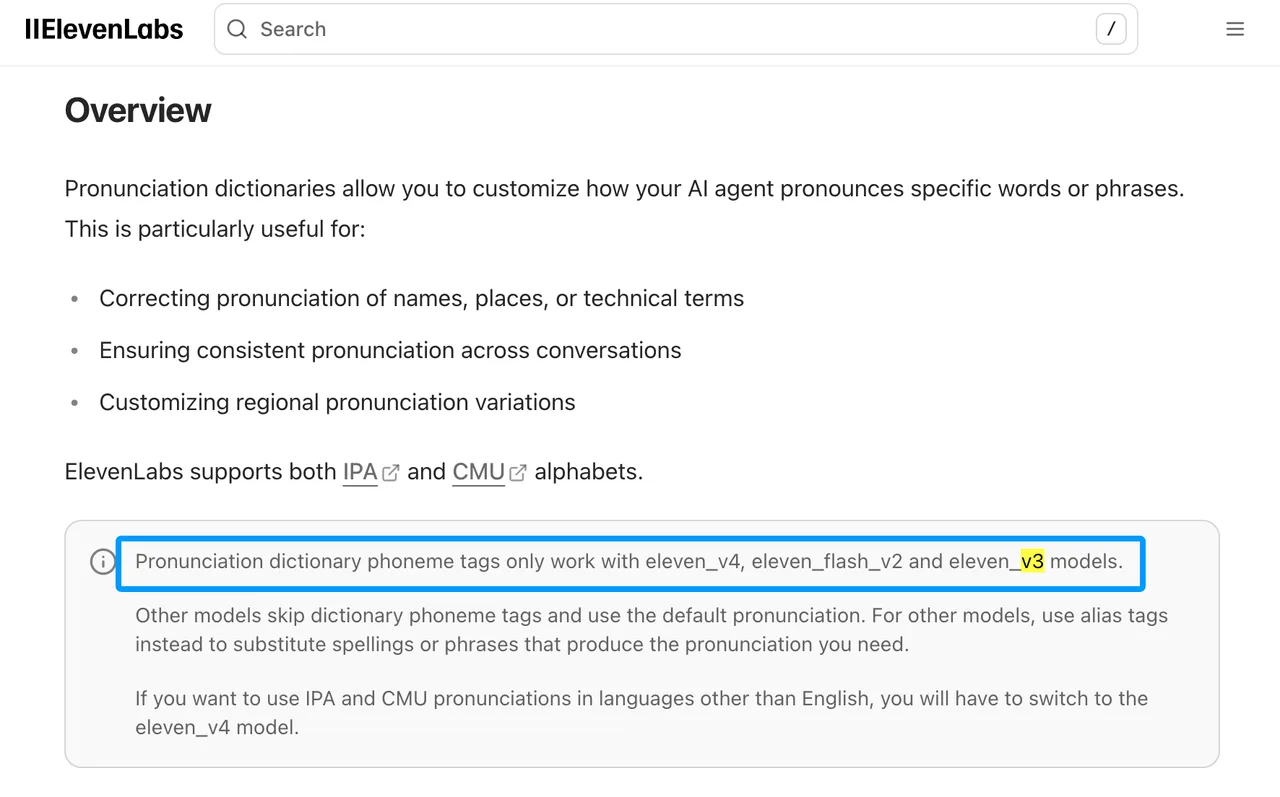
They are supported by both models, but unchanged delivery is not guaranteed. The pronunciation dictionary guide lists v3 and v4 support, while model interpretation may differ. Pin the dictionary version and rerun names, acronyms, and multilingual terms.
Can teams keep v3 pinned after enabling v4 in Studio?
No public documentation I found guarantees a workspace-level v3 pin. Studio can lock generated paragraphs, but that preserves audio rather than the model for future generations. For API workflows that need an explicit model pin, send eleven_v3 explicitly and confirm Studio’s current project controls before migration.
Does Eleven v4 change audio file metadata or output formats?
No v4-specific metadata change is documented. The Create Speech API exposes output format independently from model selection. Preserve the same codec, sample rate, and bitrate, then inspect headers, duration, loudness, and downstream parsing rather than assuming byte-level equivalence.
Are archived v3 generations still downloadable after switching models?
Switching models does not appear to remove retained generations. Current Studio generation history allows previous takes to be played, restored, and downloaded. Deleted items are permanent, and zero-retention API requests do not create history, so archive critical masters outside the platform.
Conclusion
The answer to Eleven v4 vs v3 is conditional. v4 broadens expressive direction, language coverage, request length, and clone support; v3 may remain the safer production choice when its behavior is already approved and predictable.
Run one matched task, measure usable takes and repair cost, then migrate only if v4 clears your thresholds. Recheck model availability, limits, pricing, and interface controls before release because launch-stage specifications can change.
Previous posts:
/filters:quality(82)/media/images/1790757954084144412_1AJT2bku.webp)
/filters:quality(82)/media/images/1790757509548436753_yzIR19zJ.webp)
/filters:quality(82)/media/images/1790758509393182709_xXaltBLV.webp)
/filters:quality(82)/media/images/1790759953031965921_TxT8L5xV.webp)
/filters:quality(82)/media/images/1790758722893740431_0EQ2bkuD.webp)
/filters:quality(82)/media/images/1790673203845090867_ZwbkuCLU.webp)