
Best Tripo AI Alternatives in 2027 for 3D Assets
Tripo AI alternatives for 3D teams: compare mesh quality, cleanup, export paths, and the cost of switching asset workflows.

The replacement spreadsheet looked clean until I added a “handoff” column. Every candidate could produce an attractive turntable. Far fewer could deliver the polygon budget, PBR maps, scale, and pivot the artist needed next. Teams searching for Tripo AI alternatives usually discover that after buying credits.
I compared Meshy, Rodin, Sloyd, and TRELLIS.2 around one controlled brief: an owned image of a stylized camping lantern, 8,000 triangles, 2K PBR materials, real-world scale, and a clean GLB. I did not run paid generations, so this is an evaluation plan, not a tested ranking.
Why Replace Tripo AI for 3D Asset Work?

Match the Source Brief, Not Just the Preview Render
Switching makes sense when repeatability is the bottleneck. Freeze the image, prompt, face count, texture requirement, dimensions, origin, and export. Give each route three attempts. Review starts after download.
Check four-view silhouette, hidden geometry, holes, non-manifold edges, normals, UV overlap, seams, material channels, scale, and pivot. “Looks right in the browser” is one field. Not the verdict.
Tripo already exposes face limits, PBR, texture quality, and task-based generation through its current API. A replacement must remove a specific handoff problem. A newer gallery is not one.
Compare Editable Meshes, Materials, and Handoff Work
Record usable mesh ratio, cleanup minutes, and cost per accepted asset. A mesh is usable when the core form does not need rebuilding. Cleanup includes retopology, UV repair, material relinking, scale, pivot, and export validation.
Cost includes completed rejections, paid remesh or texture steps, self-hosted compute, and artist time. Refunded failures still consume queue time.
Keep the denominator strict. One shippable result from three attempts means a 33% usable mesh ratio. Log hands-on and passive time separately. A slow clean job can cost less than a fast job followed by forty minutes in Blender.
The same rule applies to image to 3D tools and text-first systems: inspect the downloaded mesh. Preview renders are sales material until topology proves otherwise.
-
Meshy for Broad Text-to-3D Production
Where Its Generation Workflow Fits
Meshy is the broadest managed candidate. It covers text-to-3D, image-to-3D, texturing, remeshing, rigging, and animation. The lantern request uses Image to 3D, PBR, texturing, and a fixed polygon target.
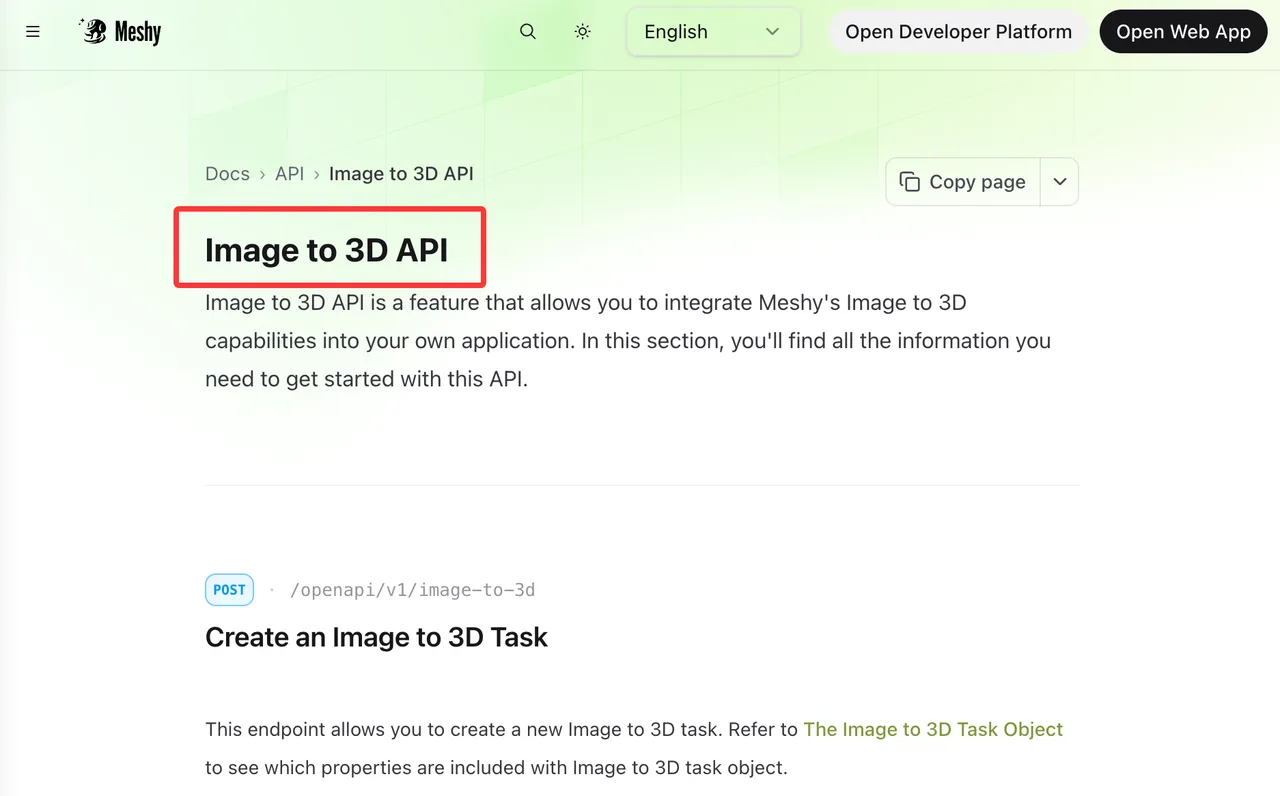
Its Image to 3D API requests GLB, OBJ, FBX, STL, USDZ, or 3MF. Controls include triangle or quad-dominant topology, decimation, polygon targets, pre-remesh output, sizing, and origin placement. That suits several downstream destinations.
Deliver the model, pre-remeshed mesh where available, maps, request JSON, task ID, model version, and QC note. Meshy fits a mixed backlog. Breadth is its reason to switch.
Route the accepted GLB through the production import script. Check map names, material slots, scale, bounding box, and triangles programmatically. Then inspect edge flow manually. Automation catches broken packages, not poor editability.
Cleanup and Control Trade-Offs
A polygon count remains a target, not a guarantee. Smart Topology also changes which remesh controls apply. Lock model_type, model ID, formats, and topology settings before comparison.
Technical failures receive refunds, but artist-rejected outputs remain completed jobs. API files have limited retention, so download them and their metadata immediately.
For one controlled family of simple props, its wider surface may be unnecessary.
-
Rodin for Detailed Asset Reconstruction
Reference-Led Output and Mesh Review
Rodin fits product or hero-prop work where reference fidelity matters more than the cheapest draft. Its API accepts image sets and exposes tiers, raw or quad meshes, face-count controls, materials, and texture effort.
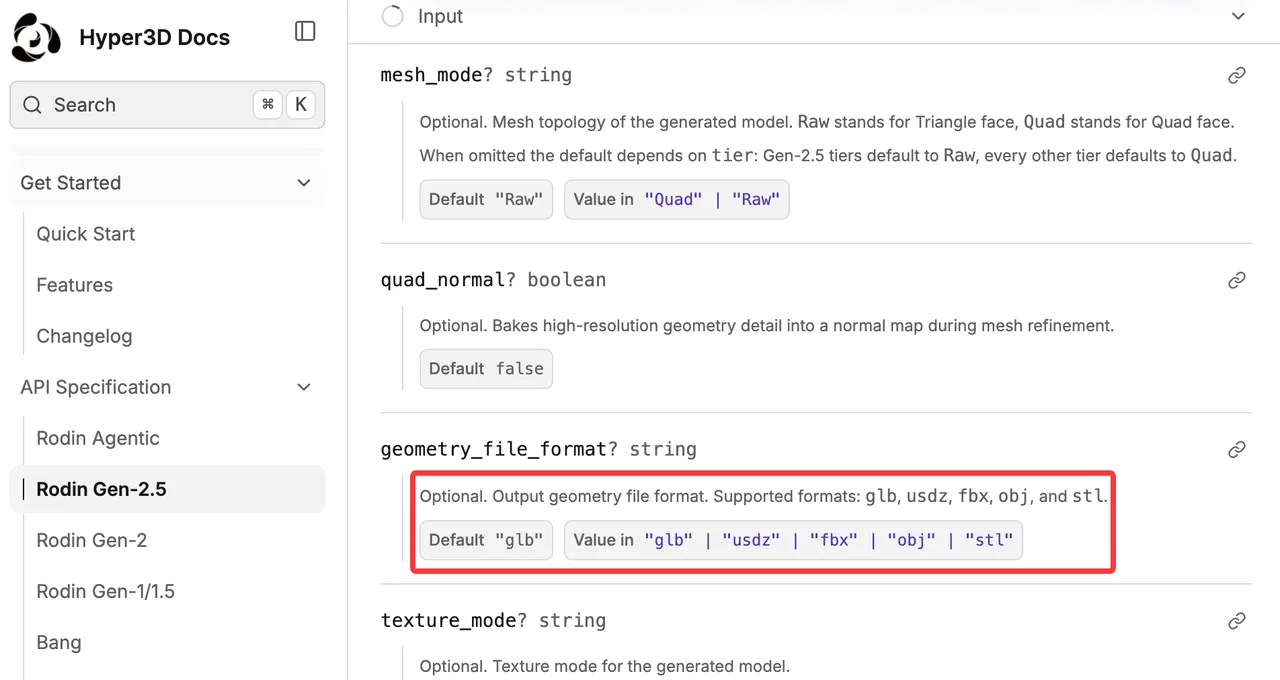
The Rodin Gen-2.5 reference supports GLB, USDZ, FBX, OBJ, and STL, with PBR, shaded, hybrid, or untextured output. Submit the same image, explicit Gen-2.5 tier, GLB, face target, and material mode. Omitting the tier can invoke an older family. Small field. Large comparison error.
Review the handle opening, wall thickness, underside, switch recess, and material boundaries. Deliver the mesh, maps, UUID, parameters, and neutral-light inspection shots.
Score reference fidelity separately. Compare silhouette and part placement, then inspect unseen views. Hidden surfaces may be plausible without being accurate. Never treat product output as dimensional or manufacturing evidence without validation.
Iteration and Cost Trade-Offs
Higher detail can improve reconstruction while increasing time, texture weight, and cleanup. A hero asset may justify that. A background crate probably does not.
The asynchronous integration must preserve the download UUID and status subscription key. Rodin publishes a seven-day API retention window for payloads and output in active systems. Plan downloads immediately.
Inspect Rodin when missed curves, layered materials, or hidden surfaces cost more than another generation pass.
-
Sloyd for Repeatable Game Props
Parametric Control and Asset Variation
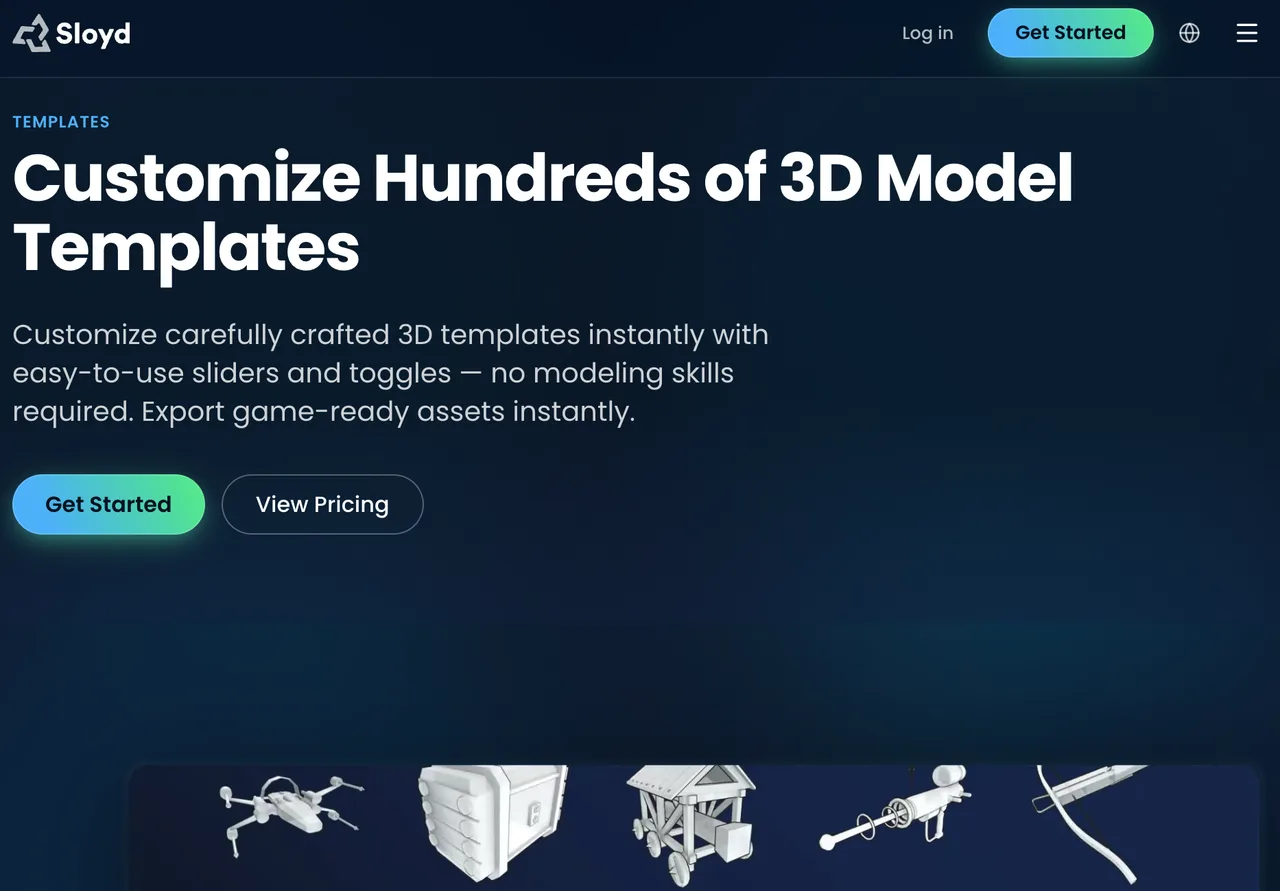
Sloyd has two paths: a generative API returning GLB and a parametric template workflow for buildings, weapons, furniture, and props.
Templates are the stronger reason to switch. A level team needs twenty barrels sharing topology, UV logic, and art direction, not one barrel. Sloyd’s Template Editor exposes LOD control, generated UVs, separate parts, and reusable customization. Test three controlled variants, not random rerolls.
Log jobId, polling time, URL, credits, mesh statistics, and cleanup. The Sloyd API uses create, poll, download and returns GLB. Web subscriptions and API credits are separate.
Change one parameter at a time: handle height, cage width, then material style. A useful asset family keeps pivots, topology class, and UV behavior stable. That beats three unrelated “good” lanterns.
Limits for Organic One-Off Shapes
Parametric control becomes a boundary for a unique creature, sculpture, or irregular garment. Templates preserve topology by constraining design space. They cannot represent every silhouette.
Evaluate generative outputs separately from templates. Sloyd also documents a temporary API concurrency cap, so batches need a queue plan.
Sloyd fits repeatable game asset generators work when controlled variation matters more than maximum fidelity.
-
TRELLIS for an Open Model Workflow
Deployment and Output Options
TRELLIS is not a hosted replacement. Microsoft’s TRELLIS.2 repository provides a 4-billion-parameter image-to-3D model under the MIT License. Its example exports PBR-ready GLB with local decimation, texture, and remesh settings.
It fits local reference handling, model pinning, custom preprocessing, and internal integration. Inputs, outputs, logs, and retention remain under team policy.
Pin the commit, checkpoint, CUDA environment, input hash, post-processing values, and container. Without that manifest, “self-hosted” is not reproducible.
Add peak GPU memory and cold-start time. Store failed inputs with stack traces and rerun after dependency changes. A better render can still change mesh statistics and break validation.
Engineering and Cleanup Burden
The repository says Linux only, requires an NVIDIA GPU with at least 24GB, and is verified on A100 and H100. Installation includes CUDA dependencies. Published speed uses H100 hardware.
TRELLIS.2 handles complex and non-manifold topology, but such output may still fail game, print, or deformation checks. Local inference removes API charges, not retopology, GPU time, monitoring, or maintenance.
It fits teams ready to own inference and post-processing, not artists seeking another web app. I paused here. “Open” describes control, not workload.
Which Tripo AI Alternative Fits Your Pipeline?
Game Props, Product Assets, and Hero Models Need Different Checks
For repeated props, inspect Sloyd templates. For mixed work, Meshy has the widest managed surface. For product or hero reconstruction, inspect Rodin. TRELLIS.2 fits internal platforms willing to operate GPUs.
Game props prioritize topology, UVs, pivots, and variants. Product visualization adds dimensional plausibility and materials. Hero models weight silhouette, hidden geometry, close textures, and editability.
No unconditional winner follows from those checks. These are conditional Tripo 3D competitors, not interchangeable render buttons.
Use one table: source match, topology, UVs, PBR, target count, scale, export, cleanup, and accepted cost. Weight it before generating. Changing weights after seeing the result turns comparison into preference.
When Keeping Tripo AI Is Simpler Than Switching
Keep Tripo when output clears the threshold and the complaint is fashionable restlessness. Its image, text, multiview, face-limit, texture, PBR, and post-processing support may already cover the job. Existing scripts and artist habits have value.
Switch for a measured gap: low acceptance, excessive cleanup, missing controls, unsuitable rights, weak data handling, or poor cost predictability. Run five canary assets through an adapter first.
FAQ
Can Tripo project history be moved to another 3D generator?
No portable project-history format is documented. Export images, prompts, meshes, maps, parameters, invoices, and rights records, then rebuild project organization.
Asset files can move. Tripo task IDs, edit lineage, comments, and provider-specific settings generally cannot.
Do Meshy and Rodin charge for failed asset generations?
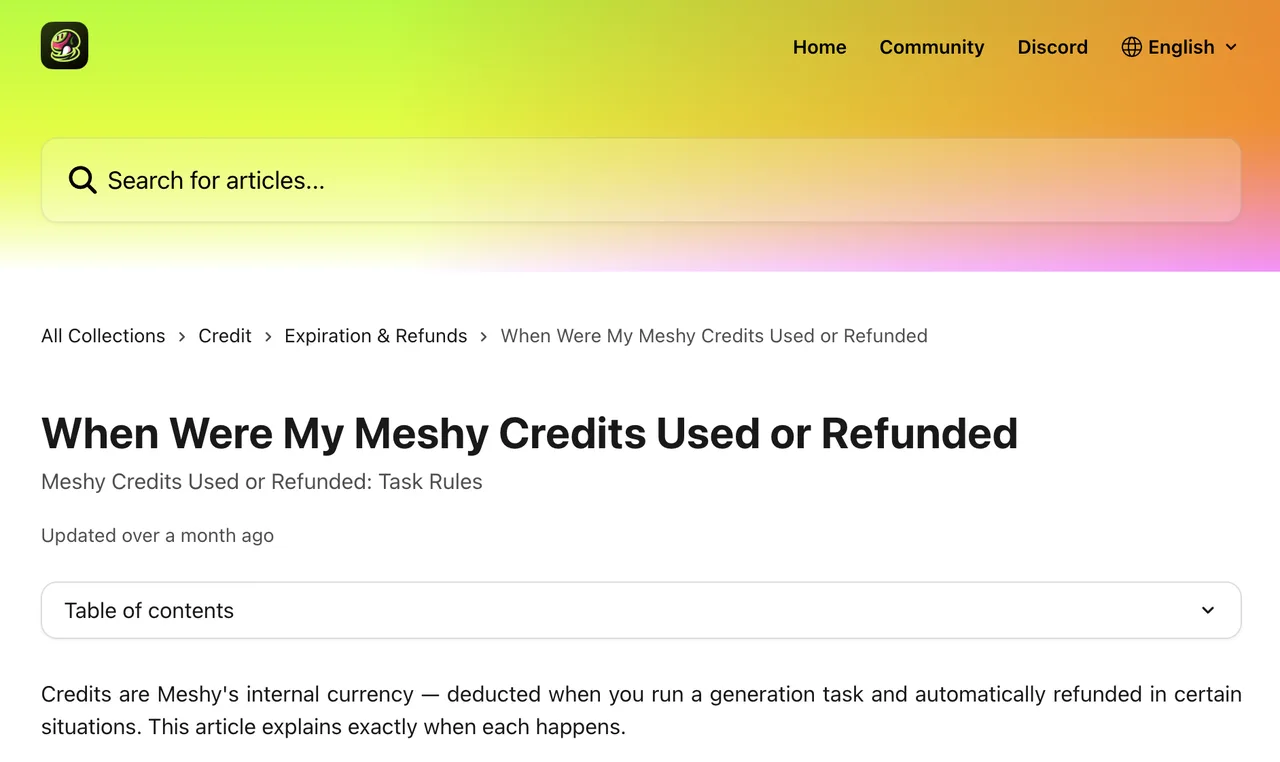
Meshy refunds technical failures but not completed disappointments; its refund guidance states that distinction. I found no equally broad public Rodin promise.
For Rodin, log the returned consumption field and obtain account-specific confirmation before budgeting retries. A failure refund does not cover artist waiting time.
What happens to commercial rights in assets already made with Tripo?
Switching does not rewrite the terms applying when an asset was created. Tripo distinguishes free outputs from paid-plan commercial use, while public assets may carry added licenses.
Preserve the creation date, plan, invoice, source-image license, and applicable terms with each asset. This is general information, not legal advice.
Can a Tripo API integration reuse its request schema with a replacement?
No. Tripo has its own task types, auth, uploads, parameters, statuses, and outputs. Managed replacements use different endpoints; TRELLIS.2 is local Python code.
Keep business logic behind an internal asset-job schema. Provider adapters should translate inputs, status, errors, and outputs independently.
Can teams delete uploaded reference images after switching from Tripo?
Tripo says removed Assets are permanently deleted and API users can schedule deletion. Rodin removes API inputs and outputs from active systems after seven days. Meshy deletes non-enterprise API outputs after three days, but gives no universal deadline for every uploaded image.
Sloyd accepts erasure requests. Self-hosted TRELLIS.2 sends nothing to a provider. Verify deletion for the exact account and route before closure.
Conclusion
The useful shortlist of Tripo AI alternatives depends on what leaves the generator. Meshy favors breadth, Rodin detailed reconstruction, Sloyd controlled prop families, and TRELLIS.2 local ownership of the runtime. None removes mesh inspection.
My migration gate is simple: the replacement must raise the usable mesh ratio or reduce cleanup enough to cover integration work. Until the GLB survives Blender, the engine, and an artist’s edit pass, the preview has not finished the job. This conclusion has an expiration date. The next check belongs in the quarterly asset canary.
Previous posts:
/filters:quality(82)/media/images/1790673203845090867_ZwbkuCLU.webp)
/filters:quality(82)/media/images/1790674052777090724_VkQ0airA.webp)
/filters:quality(82)/media/images/1790673621210536798_7KpzHQZ8.webp)
/filters:quality(82)/media/images/1790667061147571629_q61iPczX.webp)
/filters:quality(82)/media/images/1790674802528777336_lzVsEXlH.webp)
/filters:quality(82)/media/images/1790589731632080935_0wwFPY8h.webp)