DeepSeek V4 Flash Responses API on WaveSpeedAI
Verify the DeepSeek V4 Flash Responses API on WaveSpeedAI by testing release-specific behavior, contract deviations, canary results, and rollback evidence.
The DeepSeek V4 Flash Responses API now has a real source event: DeepSeek’s July 31, 2026 change log says V4 Flash API is in public beta, keeps the deepseek-v4-flash model name, adds native Responses API support, and is specifically adapted for Codex.
For a platform engineer maintaining a coding agent provider, that only answers the first question. It confirms the DeepSeek-side update. It does not prove that WaveSpeedAI needs a new URL.
The actual publishing test is narrower: does the July 31 V4 Flash public beta plus WaveSpeedAI’s /v1/responses route produce a verified contract delta? If not, this belongs as a dated update to an existing protocol page.
Scope the July 31 V4 Flash Update on WaveSpeedAI
Confirm the public-beta model ID and Responses route
The confirmed DeepSeek-side facts are simple.
The model remains deepseek-v4-flash. The release is public beta as of July 31, 2026. DeepSeek says the update only upgrades the V4 Flash API. V4 Pro API and APP/WEB models are unchanged.
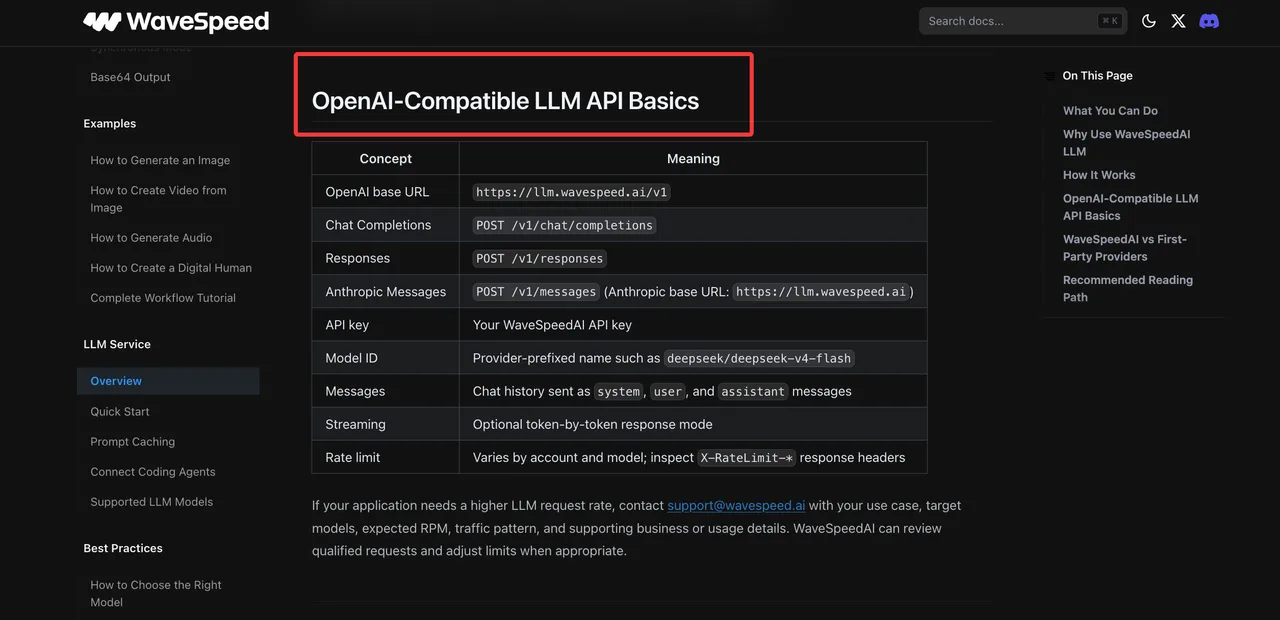 WaveSpeedAI’s side is a routing contract. The WaveSpeedAI LLM overview documents the base URL
 https://llm.wavespeed.ai/v1, with Chat Completions, Responses, and Anthropic Messages endpoints available by protocol.
That gives one testable combination:
| Layer | Expected value |
|---|---|
| Provider model | deepseek-v4-flash |
| WaveSpeedAI model ID | deepseek/deepseek-v4-flash |
| Protocol | OpenAI Responses API |
| Route | /v1/responses |
| Status wording | Public beta, as of publication date |
This is enough for a verification note. It is not enough for a standalone article unless the route behaves differently from the older documented contract.
Define which claims require a new page rather than an old-page update
The historical boundary matters.
The existing Responses API vs Chat Completions for Codex page already owns event model, tool calls, structured output, streaming, cancellation, and error recovery. Do not rewrite that under a new DeepSeek title.
The existing Codex Model Gateway for Third-Party Providers page already owns Responses-style events, SSE conversion, tool state, authentication, model mapping, health checks, retry, and timeout.
A new URL needs a new verified fact. Not a new angle. Not a new keyword. A fact.
Examples: WaveSpeedAI returns a different response item shape, handles tool-call IDs differently, maps reasoning fields differently, changes Codex config requirements, or exposes a reproducible platform-specific failure.
Build a Delta Checklist Against the Existing Contract
Record the expected WaveSpeedAI identifiers and response shape
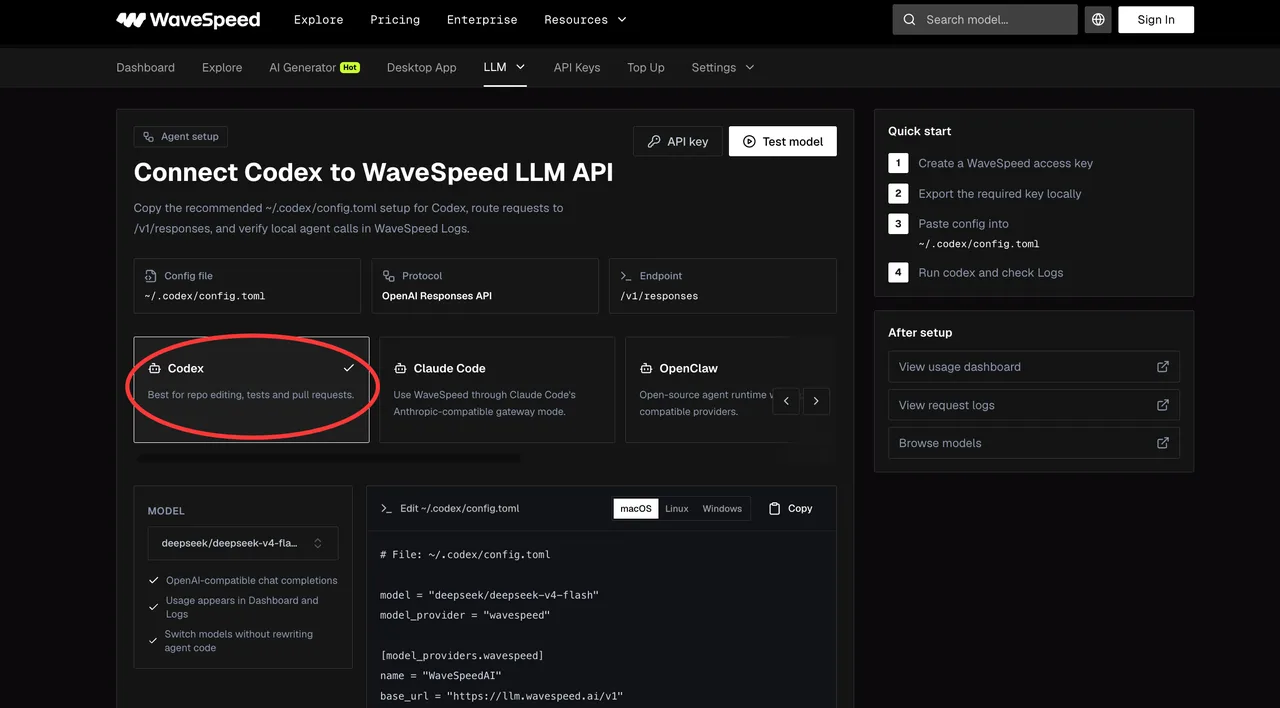
The expected WaveSpeedAI setup is specific. The Codex setup page uses model = "deepseek/deepseek-v4-flash", base_url = "https://llm.wavespeed.ai/v1", env_key = "WAVESPEED_API_KEY", and wire_api = "responses".
Do not mix that with first-party DeepSeek syntax. DeepSeek uses deepseek-v4-flash. WaveSpeedAI uses deepseek/deepseek-v4-flash.
The test record should capture:
- publication date
- model ID
- endpoint path
- client version
- response ID behavior
- output item types
- tool-call item IDs
- reasoning field behavior
- usage object
- final status
- raw error body, if any
Found the pattern on the third try: the useful artifact is not the answer text. It is the raw contract diff.
Log only observed V4 Flash or platform-specific deviations
Do not claim “Codex-compatible” from a model card alone.
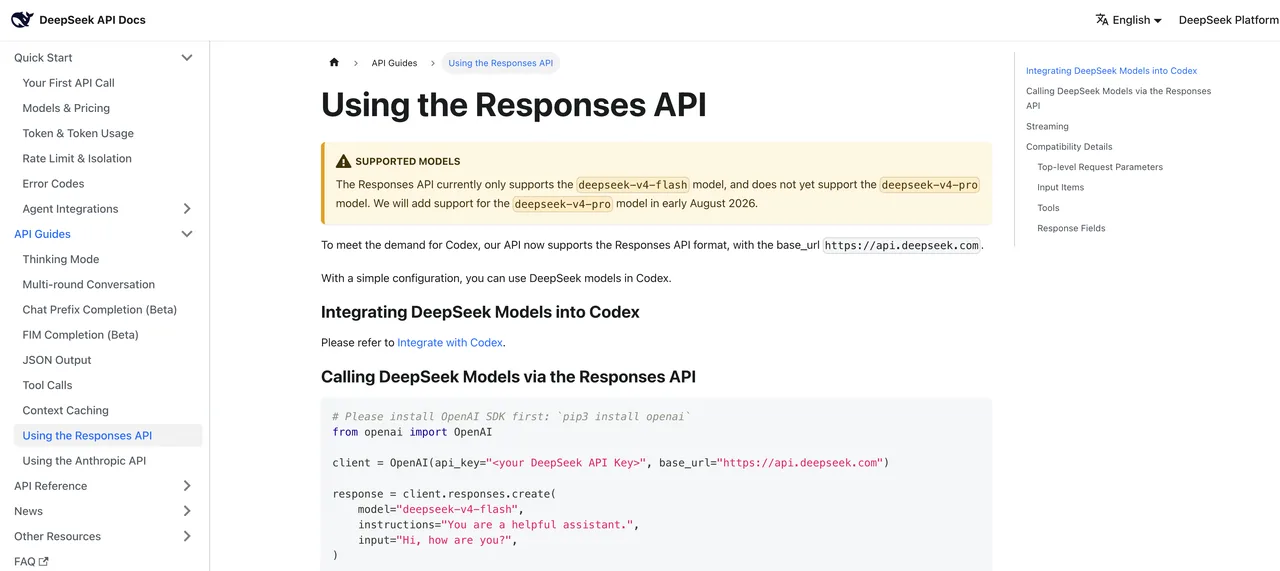
DeepSeek’s Responses API guide is the first-party baseline. It documents V4 Flash support, semantic SSE events, partial parameter support, stateless behavior, unsupported previous_response_id, and tool support boundaries.
WaveSpeedAI still needs its own observed record. If the route matches the expected contract, the right move is a dated update to the closest historical page.
Verify Model-Specific Behavior
Test current thinking-mode and tool-call behavior
Use one boring read-only canary.
Prompt:
“Summarize this repository in three bullets. Identify the main test command if visible. Do not edit files. Do not run shell commands.”
That task is small enough to avoid turning verification into a benchmark. It still checks whether the agent can read context, follow restrictions, return structured reasoning, and preserve the Responses route.
Record whether thinking mode appears, whether tool-call arguments stream correctly, whether IDs are stable enough for support, and whether the final response includes usable token evidence.
Separate model behavior from client or gateway translation
A failed canary does not mean V4 Flash failed.
The failure can come from four places:
- Model: weak instruction following or bad repo reasoning
- WaveSpeedAI: route, response field, usage, or status behavior
- Client: wrong
wire_api, wrong request shape, stale config - Permission layer: sandbox, approval mode, blocked tools, read-only policy
This distinction matters because a public page should not blame the model for a client config issue. The model is just nearby.
Run One Read-Only WaveSpeedAI Canary
Use a fixed coding-agent task with restricted permissions
Run the canary through /v1/responses with deepseek/deepseek-v4-flash.
Keep permissions read-only. No patch apply. No shell command. No background task. The purpose is contract verification, not productivity theater.
The evidence packet should include the raw request, raw response, timestamp, client version, model ID, route, account context if relevant, and any logs from the agent layer.
Capture model, provider, protocol, and permission failures separately
If the model ID is unavailable, classify it as availability or routing.
If /v1/responses returns a payload error, classify it as protocol.
If the agent refuses to inspect files, classify it as permission.
If the response works but IDs or usage cannot be retained for support, classify it as evidence retention.
Good enough. That is the most honest assessment I can give.
Interpret Contract Deviations
Assign each deviation to the model, WaveSpeedAI, or client layer
A publishable delta needs attribution.
A model-only improvement belongs in a DeepSeek V4 Flash update note. A WaveSpeedAI route behavior belongs in a WaveSpeedAI protocol page. A client config issue belongs in Codex setup docs.
The new article is justified only when the combination creates new knowledge: V4 Flash public beta plus WaveSpeedAI Responses route plus coding-agent behavior.
Decide whether the evidence is reproducible and publishable
One run is a smoke test.
Two matching runs are a signal.
A dated test packet is evidence.
If support cannot reproduce the behavior, do not publish it as a public claim. Mark it “needs verification” and keep it internal.
Make the Release or Update Decision
Publish a new URL only when a verified combination delta exists
Publish a new page only if all three are true:
- DeepSeek July 31 public-beta facts are cited.
- WaveSpeedAI
/v1/responsesis tested withdeepseek/deepseek-v4-flash. - The result shows a WaveSpeedAI-specific contract detail not covered by existing protocol pages.
This could be response item ID behavior, reasoning-mode mapping, tool-call compatibility, support evidence, or a known failure class.
Otherwise update the nearest historical protocol page
If no unique delta appears, update the older protocol article with a short dated note:
“As of publication date, DeepSeek V4 Flash is in public beta for native Responses API use. WaveSpeedAI exposes Codex through /v1/responses with deepseek/deepseek-v4-flash. No WaveSpeedAI-specific contract deviation has been verified.”
That is cleaner than publishing a thin page.
FAQ
Does Responses API usage have a separate billing model?
Needs verification in WaveSpeedAI billing evidence. Do not assume /v1/responses has separate billing from Chat Completions unless the dashboard, invoice, or official billing docs confirm it.
Can response item IDs be retained for customer support?
Needs verification. Support policy should define whether response IDs, output item IDs, tool-call IDs, and event logs are retained, for how long, and under what redaction rules.
Is the Anthropic Messages API affected by this release?
No verified impact. DeepSeek’s July 31 note is about V4 Flash API public beta and native Responses support for Codex. Treat Anthropic Messages as unchanged unless a separate test proves otherwise.
Do Responses requests share the same account rate limits?
Needs verification from WaveSpeedAI headers or account documentation. Do not infer shared buckets without X-RateLimit-* evidence.
Should customers be notified when an agent protocol changes?
Yes, if the change affects config, response shape, tool behavior, billing interpretation, support evidence, or failure handling. A model-quality update alone can stay in release notes.
Conclusion
The DeepSeek V4 Flash Responses API update is real. The WaveSpeedAI route is also clear: deepseek/deepseek-v4-flash through /v1/responses.
The publishing decision is still evidence-based. If a read-only canary finds a WaveSpeedAI-specific contract delta, publish the new URL. If it does not, update the existing protocol page and keep the claim narrow.
This conclusion has an expiration date - models update fast.
Previous posts:
Related Articles

Best AI Video Platforms for Production Teams in 2027
Best Sora 2 Alternatives for Video Teams in 2027

Lanta AI Review 2027: Best Uses, Pricing, and Limits
Sora 2 Review 2027: API Quality, Cost, and Limits

Build a GPT-6 Astra 3D Workflow With Blender Assets