Watch the planets
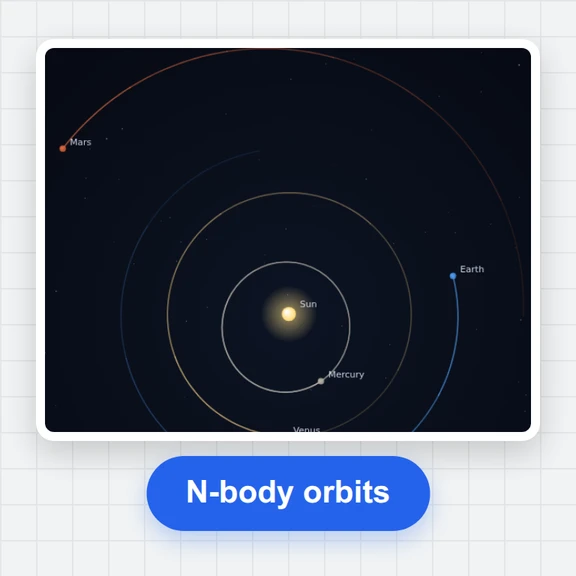
Press Play to see Mercury, Venus, Earth and Mars orbit the Sun; switch the scene for Jupiter to Neptune.
The planets start where they were on 1 January 2000 and move under real gravity, with published orbital data.
Speed time up, follow a planet, add your own worlds and export the motion as a clip.
Loading the simulator…
Press Play to see Mercury, Venus, Earth and Mars orbit the Sun; switch the scene for Jupiter to Neptune.
Set how many days pass per second, follow a planet with the camera and turn on long trails.
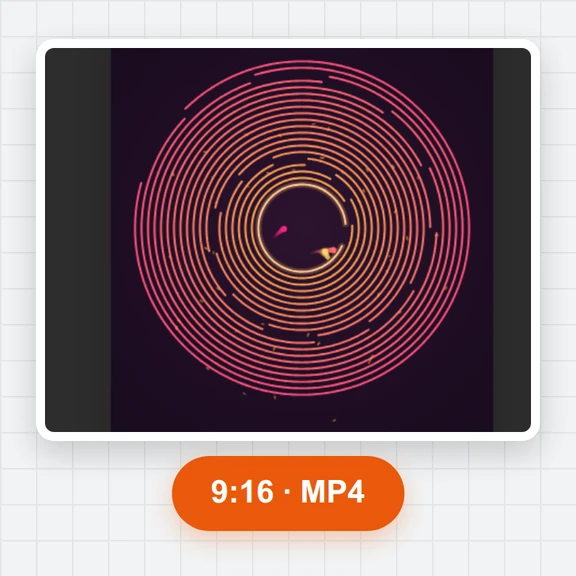
Drop a new planet or throw an asteroid through the system, then export a vertical, square or wide video.
Teaching astronomy or making space content? Create the pictures and clips around your simulation with WaveSpeed AI.
Make planet art, covers and lesson illustrations.
Turn an idea about space into a short cinematic clip.
Turn a sketch of a spacecraft into a 3D model.
$1 in free credits for eligible new accounts. No card needed. Generators have separate account and credit requirements. The Gravity simulator is free.
The planets use published orbital elements and masses and move under the gravity of the Sun and each other, so Earth needs 365.25 days per orbit and Mars 687. Orbits are drawn flat in the plane of Earth's orbit.
Yes. Choose Outer solar system to watch Jupiter, Saturn, Uranus and Neptune; time runs much faster there because Neptune needs almost 165 years for one orbit.
Yes. Switch to Add, pick a planet and click to place it on a circular orbit, or drag to throw it. Make it heavy enough and watch it disturb its neighbours.
Yes, completely free with no sign-up and no watermark on exported videos. Everything runs in your browser.
Real orbital data · Inner and outer planets · MP4 export with sound