Multica Multi-Model Runtime Strategy
Multica multi-model strategy helps teams route planning, coding, testing, review, and repetitive tasks across model providers.
Hey, guys. Dora here. I keep seeing teams treat Multica multi-model planning as a model leaderboard problem. It is not. The harder question is which runtime can touch a repository, which provider pays for the work, what happens when a task fails, and who reviews the output before it moves anywhere near production.
This is for engineering teams already considering Multica or multi-provider coding agents. It is not a Multica setup guide. It is a runtime strategy note: boundaries, model routing, fallback, and cost control.
Start With Agent Runtime Boundaries
Multica task layer versus local coding tools and model providers
Multica is not the model. That is the first boundary.
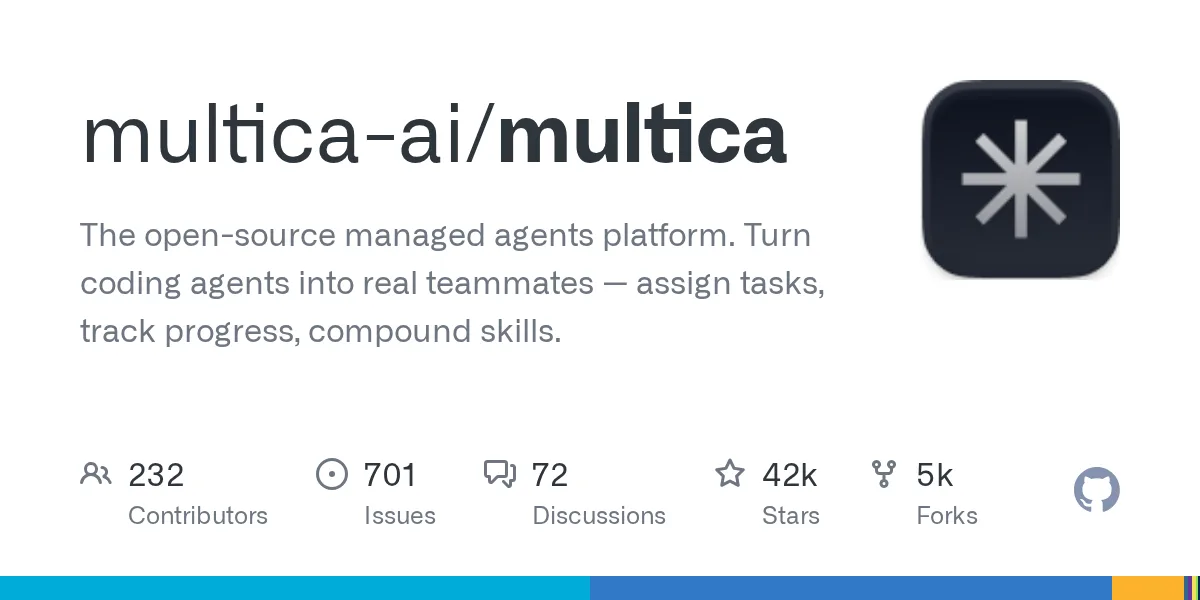
The current Multica docs describe agents as running through a local daemon that drives AI coding tools installed on the user’s machine. Multica coordinates the workspace, issues, comments, task queue, and progress updates. The local coding tool writes code. The model provider handles inference, billing, context behavior, policy limits, and availability.
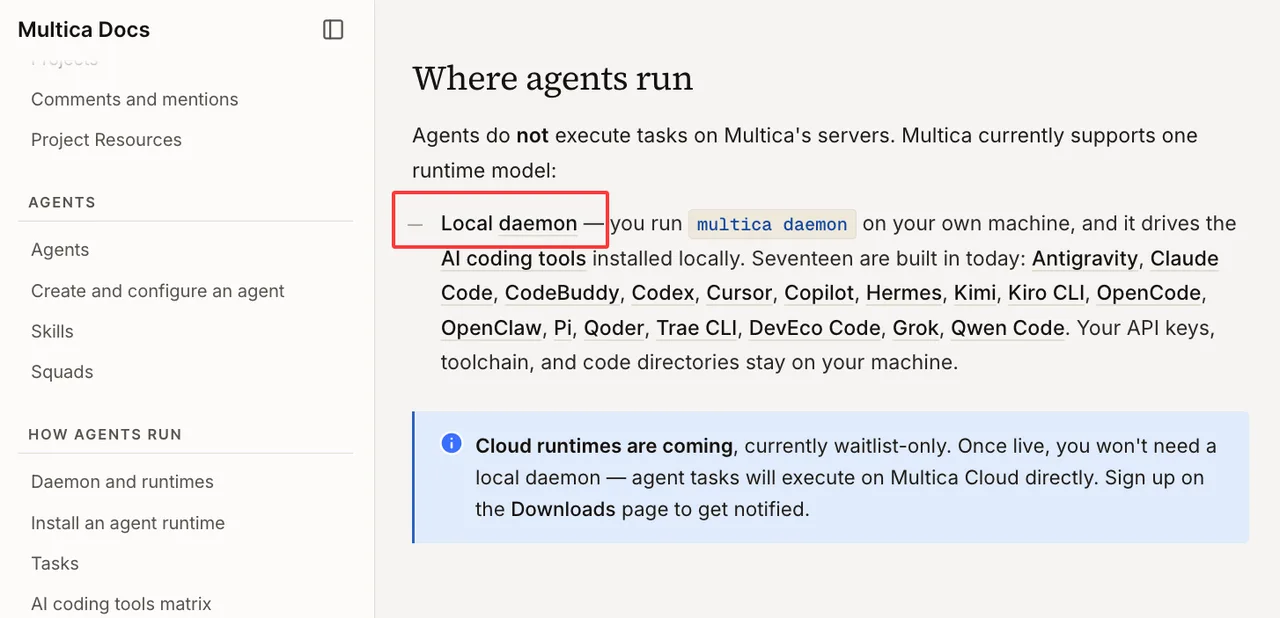
That split matters. A Multica agent is not automatically a universal router. It is tied to a runtime. If a team wants agent model routing, the policy has to be designed through agents, runtimes, model settings, permissions, and fallback rules.
I paused here because this is where many plans get muddy. “Use Claude for planning and Codex for fixes” sounds clean in a slide. In practice, each runtime has its own auth path, session behavior, MCP support, tool permissions, and failure modes.
What must be confirmed about supported runtimes
A runtime is the pairing of daemon and one AI coding tool. The daemon and runtimes page is the first source to check before production planning.
Before approving a runtime, confirm:
- which coding tools are supported today
- whether the daemon detects the tool on
PATH - whether authentication is local, browser-based, API-key based, or entitlement-based
- whether model selection is supported
- whether session resumption works
- whether MCP config is consumed or ignored
- where skills are injected
- what happens when the runtime goes offline
- what concurrency limits apply
This is especially important for Multica Claude Codex and Cursor setups. Claude Code, Codex, Cursor, Copilot, and other tools do not expose the same behavior. Treating them as interchangeable because they all “write code” is how a runtime strategy becomes a support queue.
Map Models to Agent Work Stages
Planning, repository reading, code execution, tests, review, and cleanup
A coding agent runtime does several jobs inside one task. It reads the repo, plans, edits files, runs commands, interprets test failures, repairs mistakes, and reports back. One model may not have the same cost-performance shape across all of that.
I would map stages before mapping models:
| Work stage | Routing signal | Main risk |
|---|---|---|
| Planning | ambiguous scope, architecture decisions | wrong plan |
| Repository reading | context size, search quality | missed dependency |
| Code edits | patch accuracy, style fit | noisy diff |
| Test execution | command permissions, retry control | test loop |
| Review | bug detection, restraint | false approval |
| Cleanup | small fixes, formatting, comments | unnecessary churn |
Planning needs stronger reasoning and better context handling. Repository reading needs search discipline. Code execution needs predictable patch behavior. Test repair needs command awareness. Review needs restraint. That last one matters more than teams expect. An agent that confidently approves a bad diff is more expensive than one that fails loudly.
Claude Code is a useful example. Its model configuration docs show model aliases, explicit model names, environment variables, settings, and provider-specific behavior. That means “use a stronger model for planning” has to be enforced through the actual tool configuration, not just written in a team guideline.
Low-risk repetitive tasks versus high-value reasoning tasks
Low-risk tasks are narrow, reversible, and easy to test. Examples include fixture updates, small docs changes, formatting cleanup, simple dependency renames, generated test additions, and repetitive codebase sweeps with clear constraints.
High-value reasoning tasks are different. Auth changes, schema migrations, billing logic, concurrency bugs, deployment config, data deletion logic, and large refactors need stronger models and stricter review. The cost of one bad edit can erase any token savings.
A good Multica multi-model plan starts with task classes. If every issue is labeled “fix this,” routing becomes guesswork. Better issue templates can do more for model routing than another provider account.
I would use simple labels first: planning, small-edit, test-fix, review, migration, security-sensitive, and docs-only. Once the team can classify work reliably, then model routing has something real to operate on.
Design Routing and Fallback Rules
Provider availability, model capability, context size, and tool behavior
Routing should start with constraints, not preference.
Provider availability comes first. A runtime may be online while the provider account is out of quota, rate-limited, expired, blocked by plan limits, or missing access to a model. That runtime is unavailable in practice.
Model capability comes next. Planning wants reasoning. Repository analysis wants context. Execution wants stable tool behavior. Review wants skepticism. The strongest model on a benchmark may still be wrong for a task if its coding tool cannot resume sessions, consume MCP config, or run safely in the required environment.
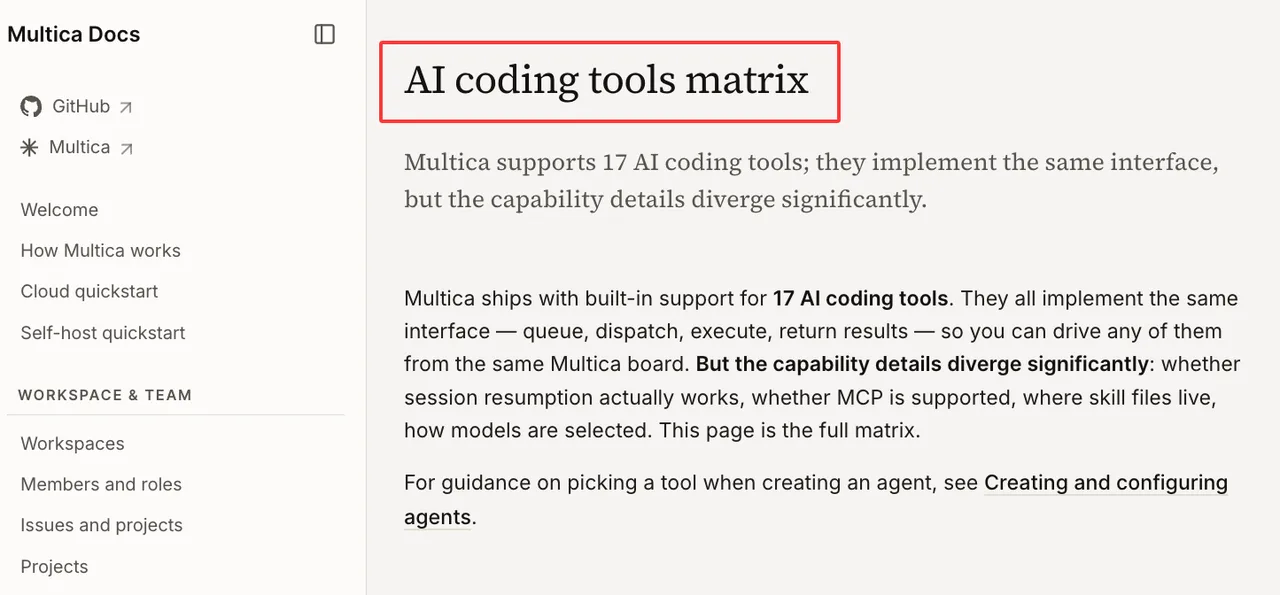
The current AI coding tools matrix is the right place to check capability details across supported tools. It covers session resumption, MCP support, skill paths, and model selection. Those details decide whether a tool is suitable for production agent work.
Codex has its own operating model. The official Codex CLI docs describe local code work, approvals, command execution, and model selection. In a Multica runtime plan, those details affect where Codex fits: exploration, edits, review, or fallback.
Context size is not only about maximum tokens. It is also about state reconstruction. A model with a large window can still fail if the runtime loses session state, ignores project instructions, or starts fresh after a broken conversation.
Fallback after failed edits, broken tests, or unavailable providers
Model fallback needs a written rule. Silent fallback is risky because output quality can change without anyone noticing.
Separate the cases:
- infrastructure fallback: daemon offline, timeout, provider unavailable
- capability fallback: context, MCP, permissions, or model access do not fit
- quality fallback: tests fail, diff is too broad, or review rejects the work
- safety fallback: sensitive code needs human review before continuing
For infrastructure failures, retrying may be fine if the task state and working directory are preserved. For broken tests, do not simply send the task to the next model. Capture the diff, test output, commands, runtime, provider, and failure reason. Then decide whether the same runtime should repair, a stronger reasoning runtime should inspect, or a human should take over.
Fallback is not a rescue button. It is a controlled second attempt with a different risk profile.
Monitor Quality and Cost
Completion rate, retry count, human repair time, latency, and token spend
Track more than completed versus failed.
The useful metrics are completion rate, retry count, task latency, queue time, provider cost, token spend, test pass rate, human repair time, review rejection rate, and rollback rate.
Human repair time is the metric I trust most. A cheap model that needs 40 minutes of cleanup is not cheap. A slower model that passes review first can be cheaper for production work.
Latency also needs two views. Wall-clock latency matters to teams waiting on a task. Re-entry latency matters to humans who have to reload context after a failed run. What I care about is not saving minutes. It is saving re-entry moments.
Cost reporting should be tied to accepted work, not raw model calls. A task that finishes but requires a human rewrite is not a success. It is a paid draft.
When one strong model is simpler than multi-model routing
Sometimes one strong model is the better strategy.
If task volume is low, the repo is sensitive, or most work is ambiguous, one well-controlled runtime may beat a routing matrix. Fewer runtimes means fewer auth paths, fewer support cases, fewer cost explanations, and fewer strange fallback outcomes.
Multi-model routing makes sense when work is frequent, classifiable, and measurable. A platform team handling dozens of agent tasks per week can justify routing. A small product team running two risky migrations a month may be better served by one strong model, tighter permissions, and careful review.
The distance between choice freedom and choice fatigue is short.
FAQ
Who approves runtime changes for production agent work?
The platform owner, repository owner, and security owner should approve runtime changes together. The platform owner checks Multica config. The repo owner checks code risk. Security checks credentials, shell permissions, MCP access, and secret exposure.
A runtime that can edit code is not a casual preference setting. Treat it like a CI system change.
What records should be kept when a model fallback changes output quality?
Keep the task ID, agent ID, runtime, original model, fallback model, provider, failure reason, issue text, instructions, MCP config version, command log, test output, final diff, reviewer decision, and rollback action.
“Bad output” is not enough. “Fallback edited shared auth middleware outside scope” is useful.
How should teams communicate unsupported provider combinations internally?
Use three labels: supported, pilot-only, and unsupported.
Supported means documented, tested, approved, and monitored. Pilot-only means sandbox or non-critical repos only. Unsupported means no production tasks and no customer-facing claims.
This matters for multi-provider coding agents because a combination can be technically possible and still unsupported by policy.
Conclusion
A practical Multica multi-model strategy starts with runtime boundaries, not model hype. Define which daemon runs where, which coding tool edits the repo, which provider handles inference, which task class gets which runtime, and what record is created when fallback changes the result.
The clean setup is usually boring. That is the point. Good infrastructure makes you forget it is there.
Previous posts:
- Managed Agent Stack with Multica, Composio, and Multiple Model Providers
- Codex Model Gateway for Third-Party AI Providers
- Responses API vs Chat Completions for Codex-Compatible Coding Agents
- Benchmark Inkling for Production Agent Routing Decisions
- Deploying the Inkling Model for Production Agent Workflows
Related Articles

DeepSeek V4.1 Flash API: Access and Migration

GPT-6 Astra Pro Pricing and Real Workload Cost

GPT Image 2.5 vs Nano Banana 2: Quality, Speed, and Cost

GPT Image 2.5 vs Nano Banana Pro for Precision Editing

Is K2 Horizon Open Source? Audit the Release