K2 Horizon 36B Review 2027 for Local Agent Workloads
K2 Horizon 36B review for one local agent workload, focusing on memory demand, tool use, latency, and recovery reliability.
A local agent usually fails in boring places: malformed arguments, a parser mismatch, or one bad retry. That is how I would review K2 Horizon 36B—by whether it can repeat one controlled tool workflow on hardware I can operate.
It’s John. This is a deployment review and test plan, not a claimed hands-on benchmark. There are no matched local results here to support a production-ready verdict.
Quick Verdict for a Local Agent
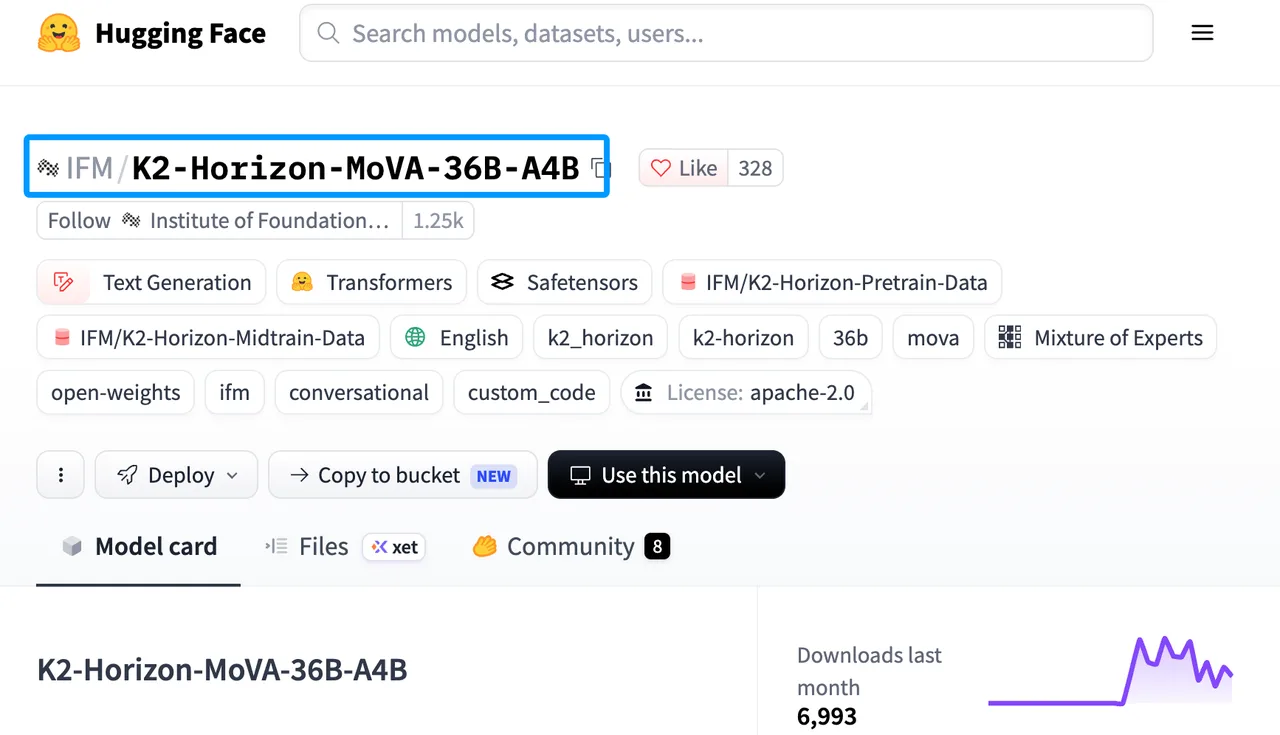
My verdict is conditional: K2 Horizon 36B is worth testing if you can absorb its weight footprint and parser validation. The official model card at revision de2d2ef identifies Apache-2.0 licensing, a native 524,288-token context, and k2_horizon parsers. It uses the 36B total/4B active shorthand; the current vLLM recipe, counting embeddings, reports 37.44B stored and 5.95B active. Pin both revision and counting convention.
Where sparse activation may help
Sparse activation can reduce per-token compute because only part of the expert network runs. That may help K2 Horizon inference throughput, but it does not prove low agent latency. Routing, expert parallelism, prompt length, batch shape, and tool pauses matter. IFM’s benchmarks use BF16 and high reasoning effort; I treat them as vendor evidence, not my task result.
When a smaller checkpoint is safer
A smaller checkpoint is safer when the 36B weights leave too little room for KV cache, concurrency, or recovery, or when parser support is immature. A larger model that frequently OOMs is not a usable K2 Horizon local agent. I would prove the harness on a smaller family checkpoint, then promote the fixture unchanged.
Test One Tool-Using Task
Use one read-only incident-triage task with list_failed_runs, read_run_log, and read_service_config. Ask for the latest failed deployment, observed error, relevant config value, and a structured diagnosis without writes. On a fixed trial, return one retryable read_run_log error. This cannot be judged by feel. It needs a sample run.
Lock runtime, quantization, context, and hardware
Write one immutable run manifest before testing:
| Control | Record exactly |
|---|---|
| Checkpoint | Repository, full commit SHA, weight format, file hash |
| Runtime | SGLang/vLLM/llama.cpp commit, container, CUDA/driver |
| Serving | TP/EP, k2_horizon parsers, reasoning effort, sampling |
| Capacity | GPU model/count, context cap, KV-cache dtype, concurrency |
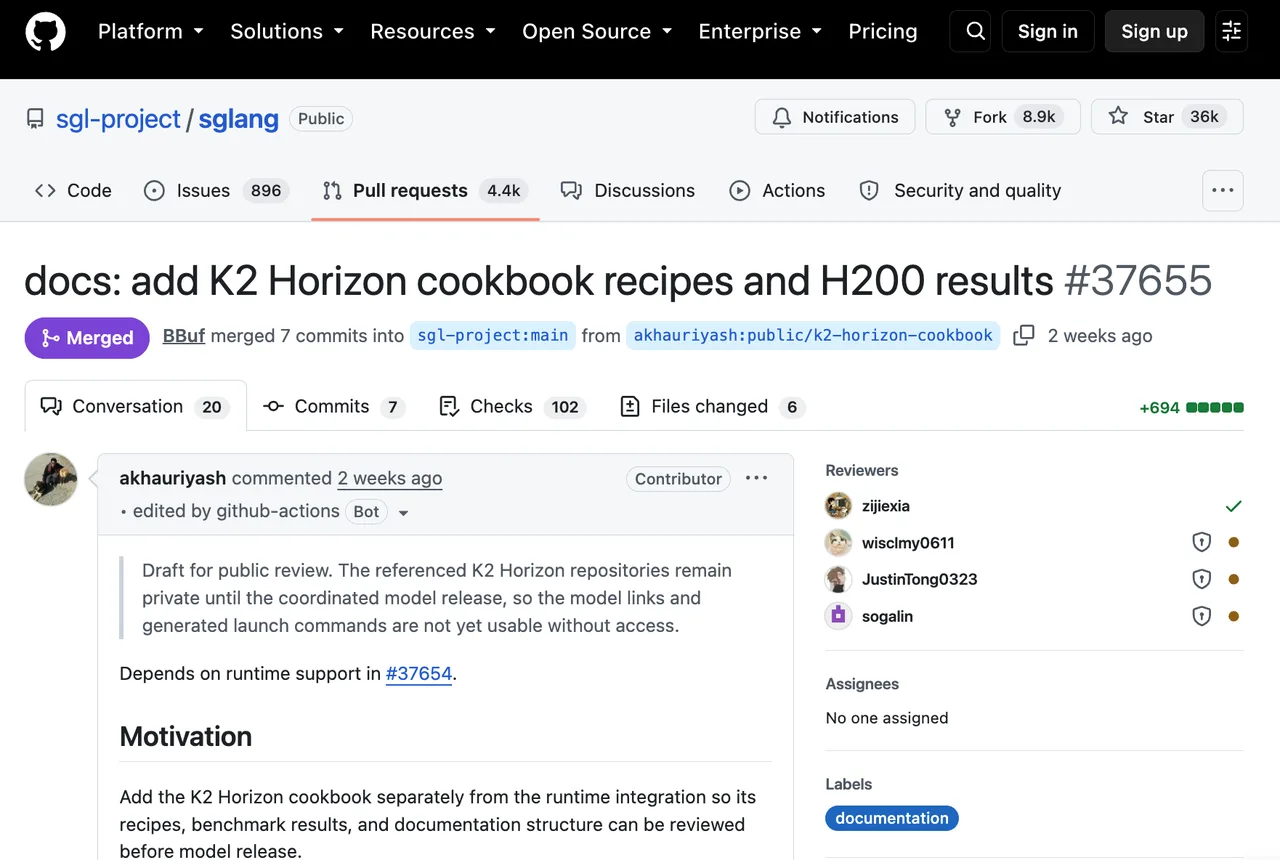 For a baseline, mirror IFM’s validated BF16, TP=2 route. An earlier IFM quickstart used a 131,072-token server cap; treat that as a conservative test setting rather than the current native limit. The SGLang serving recipe also specifies FlashAttention-3 and a router-GEMM override. Do not compare a 32K GGUF run with a 131K BF16 run as if only architecture changed.
Measure tool accuracy, latency, and recovery
Run the fixture at least 20 times after warm-up. Score tool name, argument validity, call order, grounded fields, prohibited writes, and recovery. Record first-tool latency, tool pauses, decode rate, total time, peak memory, and failure traces. Report completion rate with p50/p95 latency. One successful transcript is a demo, not an evaluation.
Evaluate Deployment Fit
Memory footprint and sustained throughput
The BF16 repository is about 74.9GB before KV cache and runtime workspace. Active parameters describe token-time compute, not resident weights. IFM’s mixed FP8 checkpoint quantizes routed-expert linear layers in layers 3–47; attention, shared experts, routers, embeddings, and other tensors remain BF16. Do not budget it as uniformly eight-bit. Measure peak memory and sustained throughput across all runs, including retries.
Parser support, logs, and failure handling
Keep the k2_horizon reasoning and tool-call parsers enabled, log raw text separately from parsed calls, and preserve streaming and non-streaming traces. Reject unknown tools and invalid arguments before execution. The card supports json, xml, and xml_typed tool-call serialization, with XML as default; changing it changes the test.
Limits and Trade-Offs
Active parameters do not equal total memory demand
Do not equate roughly 4B active parameters with a 4B deployment. All expert weights need residence somewhere, while context expands KV cache. Add buffers, fragmentation, concurrency, and observability. My approval threshold requires headroom at the worst accepted context, not merely a successful cold start.
Quantization can change agent behavior
Quantization can alter tool names, braces, enums, and retries. The official K2 Horizon GGUF repository currently stores original BF16 tensors, includes tokenizer metadata and a llama.cpp-compatible template, and says architecture support still requires an IFM fork while an upstream PR is pending. “GGUF” does not mean low-bit or plug-and-play. Re-run the acceptance suite for every quant.
FAQ
Does the 36B model support JSON schema output?
Not as a model-specific guarantee in the current documentation. It supports JSON tool-call serialization, but JSON formatting is not the same as constrained JSON Schema compliance; enforce the schema in the serving runtime and test invalid cases.
Does the 36B model require custom tokenizer code?
The Transformers example loads tokenizer and model with trust_remote_code=True. Other runtimes may implement support natively, so record the exact contract.
Does IFM publish a safety evaluation for 36B?
I did not find a dedicated 36B safety scorecard in the current model card or validated serving recipes. An earlier official model-card revision warned that the model may produce inaccurate, biased, unsafe, or hallucinated content.
Can the 36B checkpoint process image inputs?
No image-input interface is documented. The repository is tagged for text generation and does not list a vision encoder or image processor; MoVA means Mixture-of-Values attention, not multimodality.
Are speculative decoding settings documented?
No checkpoint-specific speculative-decoding configuration appears in the current IFM card or validated recipes. Generic runtime support should not be presented as validated model support without a pinned draft model and matched test.
Conclusion
I would trial K2 Horizon 36B only after pinning weights, runtime, parsers, context, quantization, and hardware. Sparse activation may help compute, but resident memory and parser behavior decide production fit. Approve it only for repeated grounded completion, safe recovery, acceptable p95 latency, and enough memory headroom. Until those numbers exist, it is a promising candidate, not a local-agent winner.
Previous posts:
Related Articles
Gemini 3.8 Live vs Extended Thinking: Which Should You Use?
GPT-6 Astra 3D: Blender MCP vs AI 3D Generators
H3 Max API Review 2027: Choose the Right Video Endpoint

H3 Max Pricing: Cost per Usable Video Clip
H3 Max vs MiniMax H3: Speed, Output, and Access