Should You Use Webhooks or Polling for AI Video Generation?
Webhook vs polling for AI video generation: when callbacks beat status loops, and how to handle duplicates, ordering, and missed events in production.
Overview
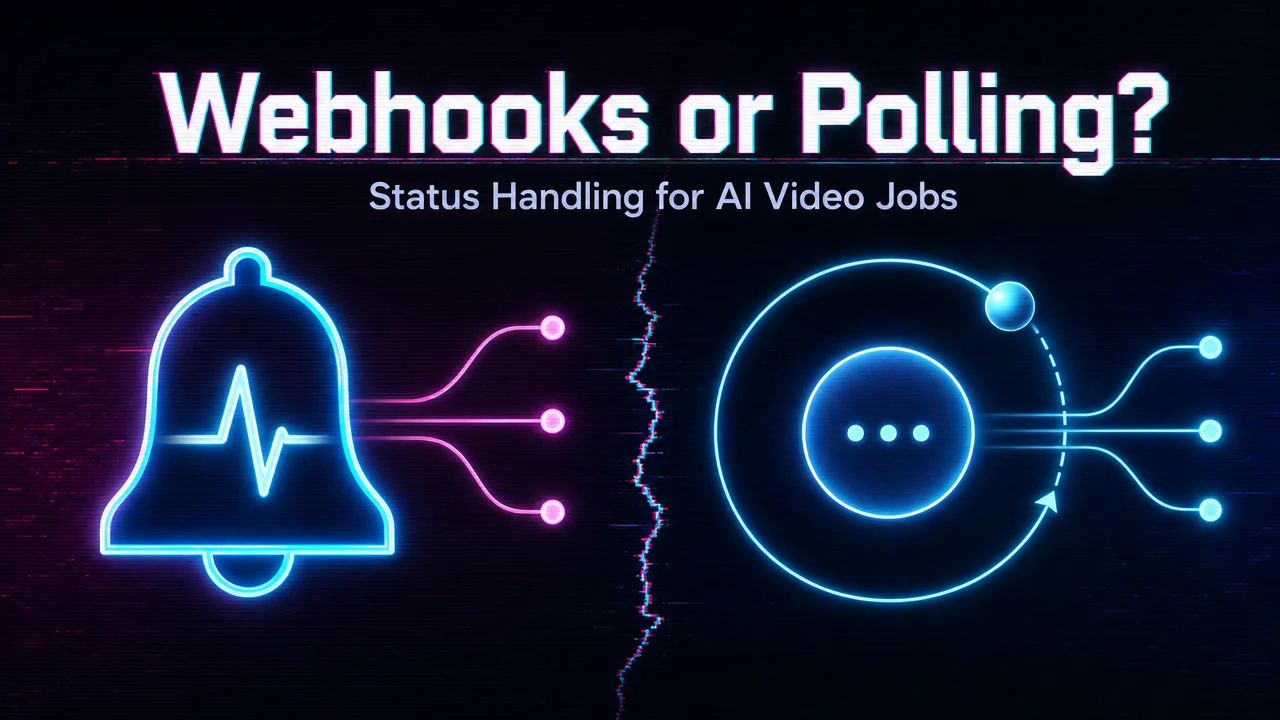
Webhook vs polling for AI video generation is a choice between receiving completion notifications automatically and repeatedly checking job status yourself. Webhooks are usually better for production workflows, while polling can be simpler for early tests or small scripts.
- Use webhooks when jobs are long-running, high-volume, or user-facing.
- Use polling when building a quick prototype or when webhook setup is not available.
- Add timeout handling, retries, and idempotency for both patterns.
Video generation is often asynchronous because jobs take time. A product should not block a user request while waiting for a long render. Instead, it should create a job, store the job ID, update status, and notify the app when the result is ready.
For WaveSpeedAI users, this is part of production readiness. For teams building with image-to-video, text-to-video, or video editing APIs, webhook support can reduce unnecessary status calls and make workflows cleaner. Polling still has value, but it should be controlled with safe intervals and stop conditions. The practical recommendation is to prototype with polling, then move to webhooks for scale. Default to webhooks for production video jobs and keep a slow polling loop as the safety net; then verify your endpoint handles duplicate and out-of-order callbacks, because both will eventually arrive.
Related reading
Related Articles
Best AI Video Platforms for Production Teams in 2027
Best Sora 2 Alternatives for Video Teams in 2027

Lanta AI Review 2027: Best Uses, Pricing, and Limits
Sora 2 Review 2027: API Quality, Cost, and Limits
Build a GPT-6 Astra 3D Workflow With Blender Assets