
What Is Agnes AI? API Ecosystem and Builder Fit
Learn what Agnes AI officially confirms about its API ecosystem and what builders should verify before testing it in production workflows.
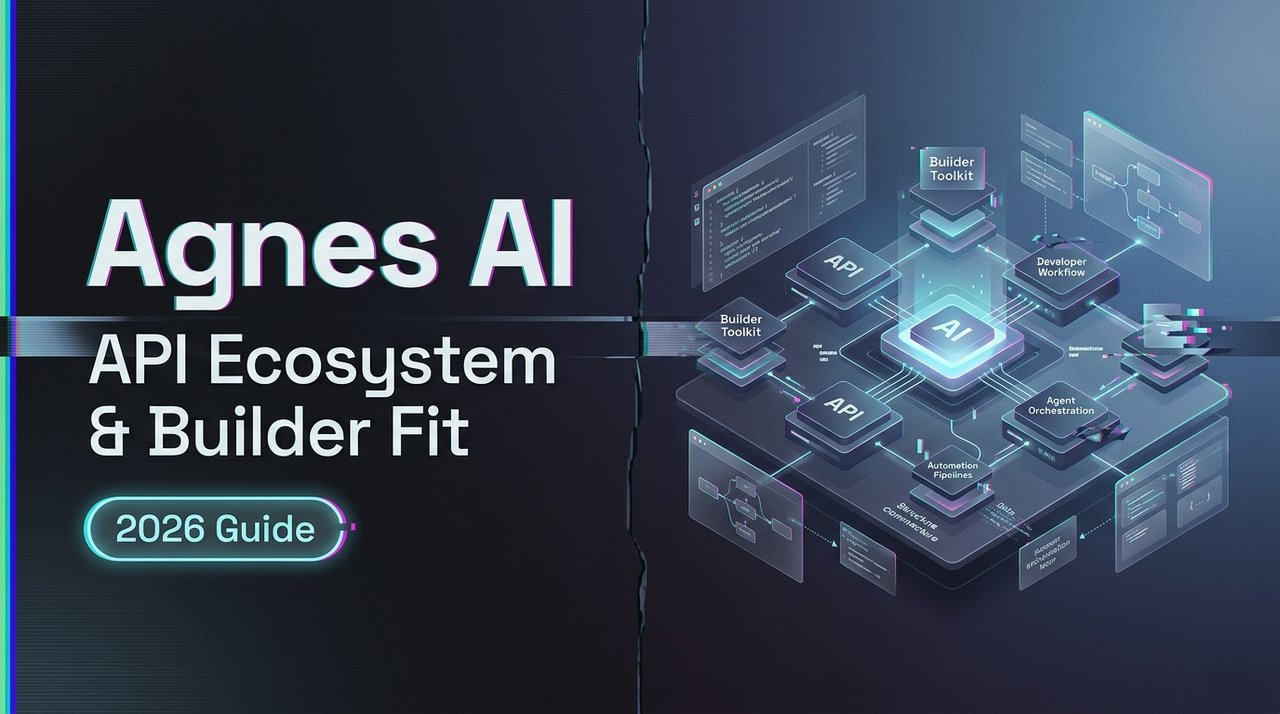
It’s Dora. A developer in my Slack kept mentioning agnes-ai.com. I ignored it twice. The third time I opened it, mostly to shut him up. So here’s the question: what is Agnes beyond the homepage copy? More importantly, does the Agnes API belong in a real product?
This is the work-note version. We’ll look at what Agnes AI officially confirms, what the model naming actually means, and where the documentation leaves gaps you still need to verify. Then we’ll look at where Agnes fits — or doesn’t fit — in a production stack. No verdict on whether you should use it. Not my call.
What Agnes AI officially confirms
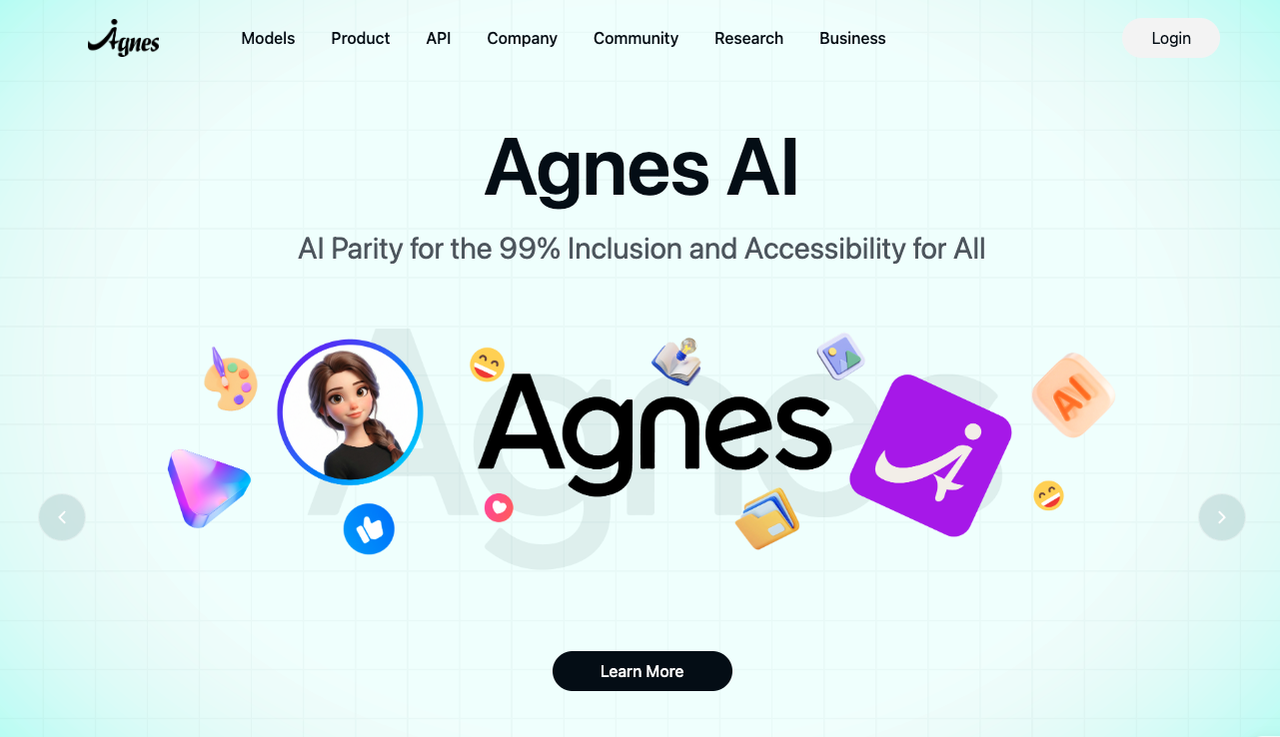
Agnes AI is a Singapore-based platform from Sapiens AI. The Agnes AI homepage describes it in three layers: an AI gateway, a free AI API platform, and an AI application ecosystem featuring Agnes, Echo, and Pavo.
Gateway, API platform, applications, and model access
Four overlapping things under one brand:
Gateway. A unified entry point for accessing their proprietary models. Single API key, OpenAI-compatible endpoint shape. The part most developers care about.
API platform. The developer surface — keys, model selection, docs — at platform.agnes-ai.com and agnes-ai.com/doc.
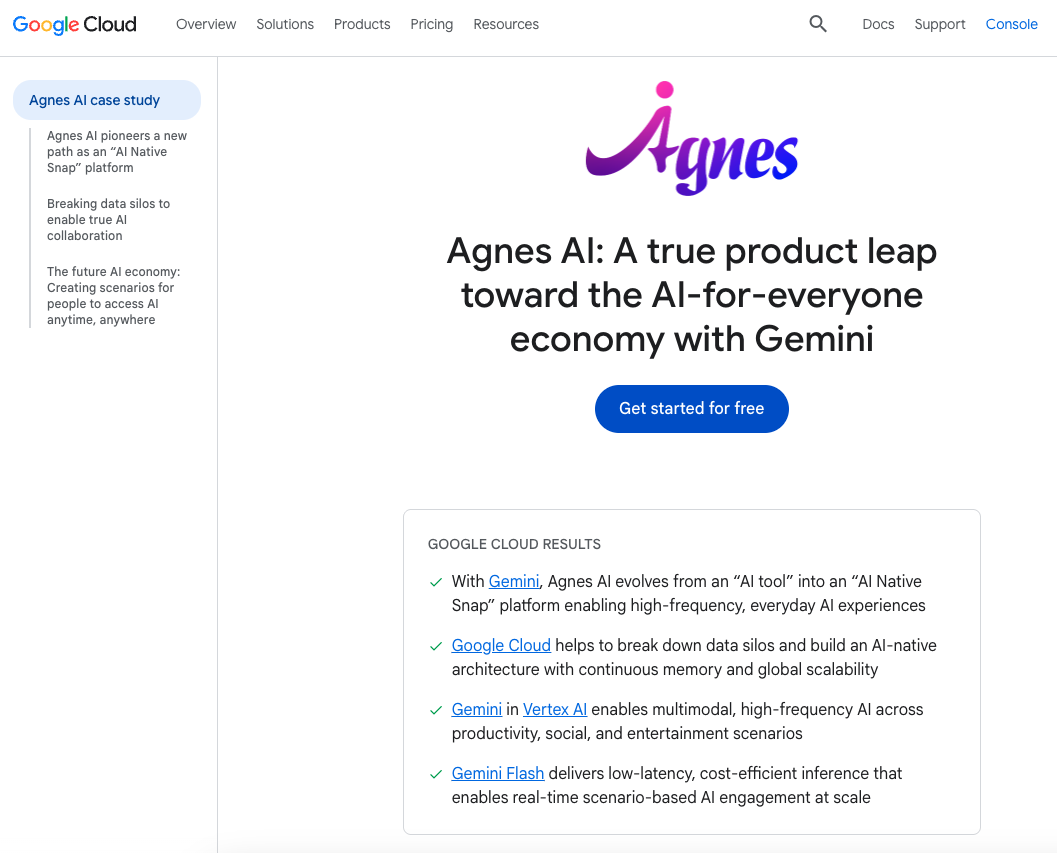
Application ecosystem. Consumer apps — the flagship Agnes app on iOS and Android, plus CoVibe group chat and AgnesClaw (their one-click agent). The Google Cloud case study on Agnes AI describes the company as an AI-native collaborative workspace platform headquartered in Singapore.
Model access. The proprietary model family — Agnes for text, Agnes Image, Agnes Video — which the gateway routes to.
For builders, the relevant slice is the first and the fourth. The application layer is a separate product story.
One thing to register up front: Agnes is model-first, not aggregator-style. It’s not OpenRouter giving you Claude and GPT through a single key. It’s Agnes’s own model family behind a single key. That matters for how you think about portability later.
Agnes 2.0, Flash, and video naming
The naming is where I had to slow down. Multiple model identifiers, multiple version numbers, and the marketing copy uses them somewhat loosely.
Confirmed information vs reported capabilities
Agnes 2.0 is the brand version of the Agnes consumer app. Release notes on the iOS store confirm Agnes 2.0 is an app upgrade launching alongside AgnesClaw. So “Agnes 2.0” in the wild often means the app version, not a model.
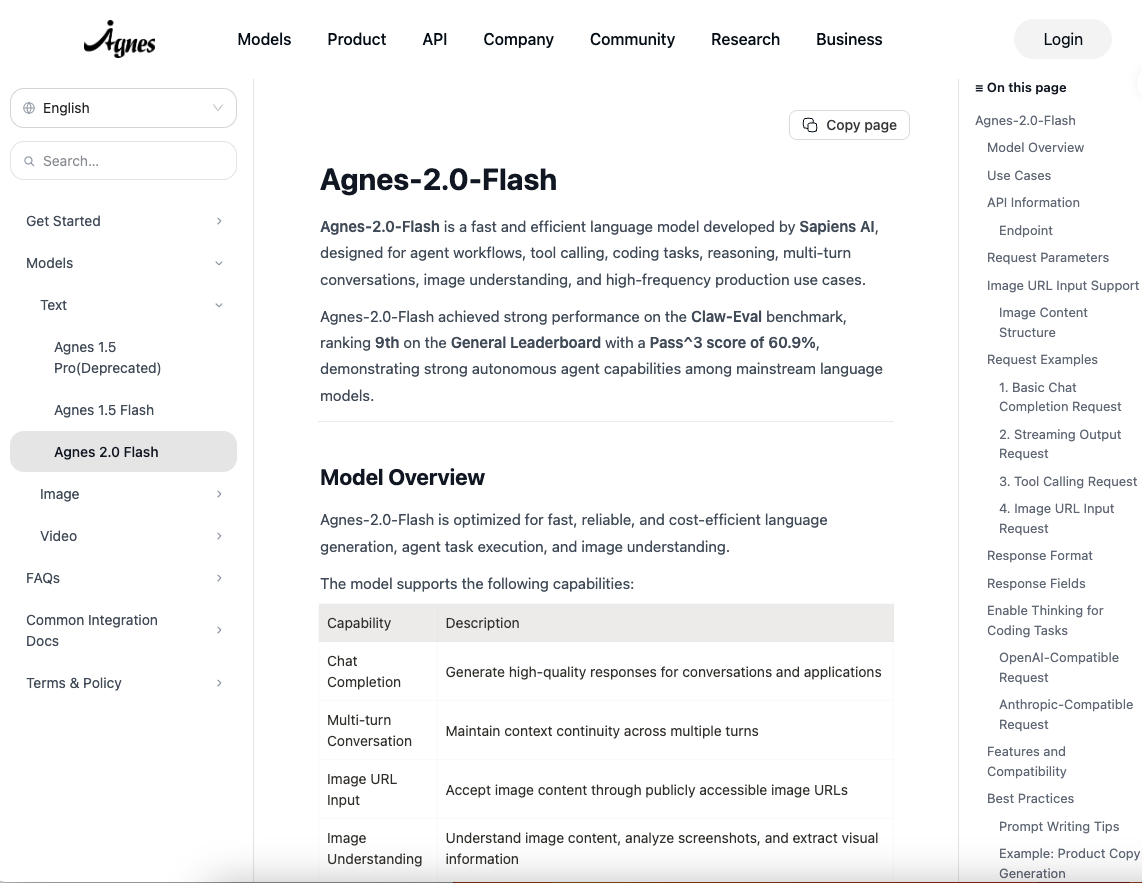
Agnes 2.0 Flash is a specific model in the API. The Agnes 2.0 Flash documentation positions it as a production-ready model. The emphasis is on fast responses, strong task completion, image understanding, and reliable agent workflows. It supports multimodal input, streaming, tool calling, and reasoning. That’s the developer-facing flagship today.
Agnes 1.5 Flash is still in the docs alongside 2.0 Flash. Agnes 1.5 Pro is marked deprecated.
Agnes Image 2.0 / Image 2.1 Flash — image generation and image-to-image editing. External writeups reference both identifiers; check the model-specific page for the exact one you’ll call.
Agnes Video V2.0 is positioned as a text-to-video and image-to-video model with synchronized audio generation. The docs overview lists “Video & Synchronized Audio-Video Generation” as a core capability. Concrete specs — durations, resolutions, async polling — verify on the model page before committing. I haven’t tested it personally.
So when someone says “Agnes 2.0” in a Twitter thread, ask which one: the app, or the Flash model. Related, not the same.
API access and documentation gaps
Docs are where you decide if something is real. Agnes gives me enough to integrate; it doesn’t yet give me enough to commit production load.
Authentication, compatibility, limits, and terms to verify
Clearly documented in the Agnes API integration overview:
- Base URL:
https://apihub.agnes-ai.com/v1/chat/completionsfor text. - Authentication: standard
Authorization: Bearer YOUR_API_KEYheader. - Compatibility: the API follows an OpenAI-style request and response format. The 2.0 Flash docs also expose an Anthropic-compatible thinking field, making it possible to integrate through existing OpenAI or Anthropic SDK workflows.
- Multimodal input: text + image URL via the standard
contentarray structure. - Tool calling and streaming: both supported.
What I’d verify before integrating, because the public docs didn’t make these obvious:
- Rate limits and concurrency caps. “Free” without published per-account RPM/TPM ceilings is a question, not an answer.
- What “free” means six months from now. Free API access from a venture-funded startup is a business decision, not a physical law.
- Data handling for API calls. The consumer app has its own privacy policy; the API-side terms are the document you need if you’re sending customer data through.
- Commercial use of outputs. Don’t assume — read the terms.
- SLA, uptime, status page. I didn’t find a public status page on the routes I checked. For anything past a side project, ask before you commit.
I don’t know the answer to all of these. Better than making something up.
Where Agnes fits in a production stack
Direct access vs an aggregation layer
If your product calls one frontier model and you’re happy, Agnes isn’t replacing that. Different shape of thing.
If you’re experimenting with multiple models, Agnes becomes another model family you can plug into the stack. Comparing outputs or routing requests is straightforward because of the API compatibility. Useful if Agnes 2.0 Flash hits your quality bar. Less useful if you specifically need Claude or GPT and you’re routing for that already.
If your product is a gateway pattern itself — an abstraction layer over multiple providers — Agnes drops in like any OpenAI-compatible provider. The compatibility is the integration shortcut. That’s the part doing real work.
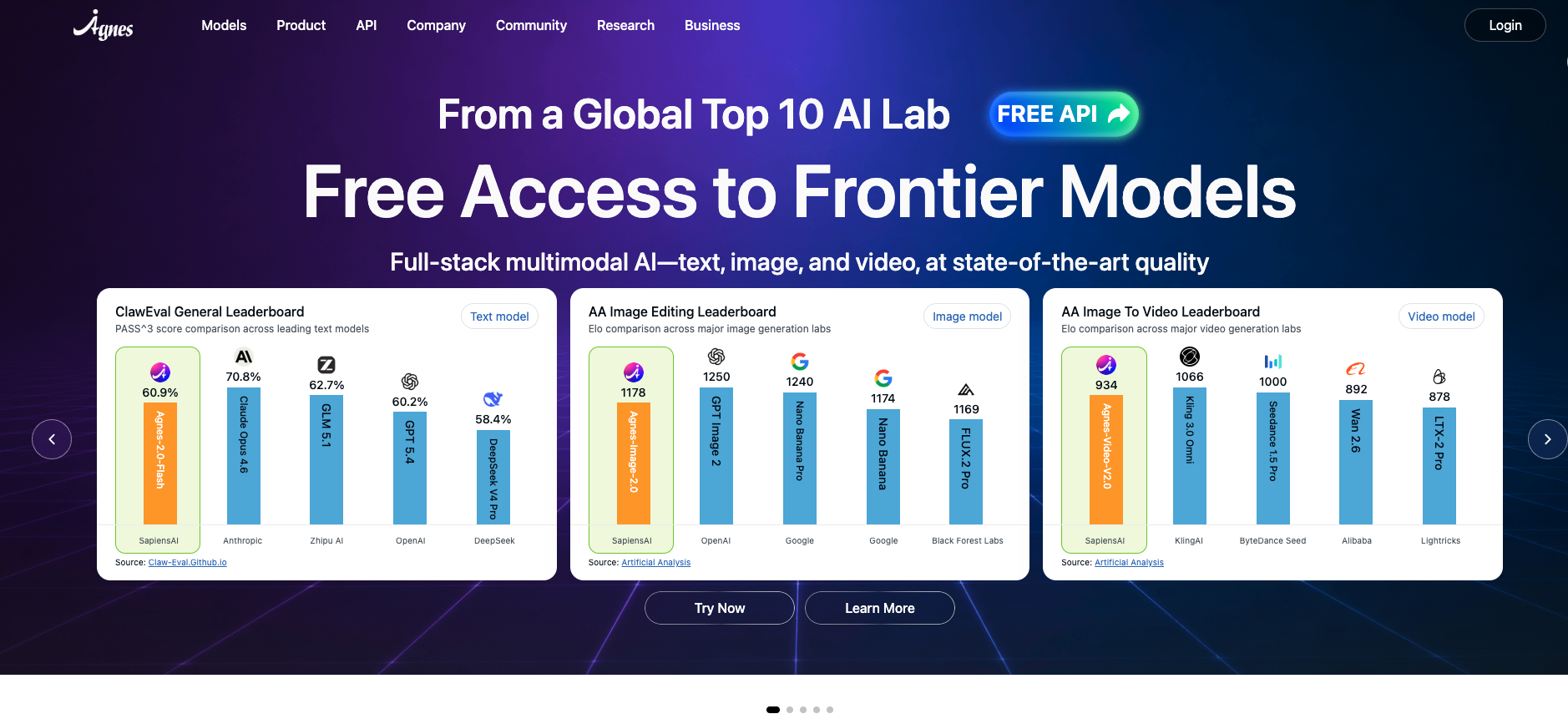
The interesting bit: the same key reportedly covers text, image, and video. If that holds up in testing, the operational simplicity is real. One billing relationship instead of three.
One fewer switch. Sounds small. Adds up fast.
Suitable testing scenarios and poor-fit workloads
Where I’d test it first:
- Internal prototypes.
- Batch summarization, classification, and enrichment.
- Side projects with low switching costs.
Where I’d hesitate without more verification:
- Sensitive customer data.
- Hard latency-SLA workloads.
- Long-term platform dependencies.
- High-volume video generation.
Not a “don’t use it” list. The list of questions I’d answer with my own test runs first.
FAQ
How portable are prompts and logs when leaving Agnes?
Prompts are portable — they’re text. If you keep them in version control, switching providers is a base-URL change and a model-string change. Logs depend on where you stored them — log to your own observability from day one, not a vendor dashboard. Generated outputs you care about, download and store yourself. Don’t treat any vendor’s CDN as your archive.
What customer data should stay outside an unverified gateway?
Default to: PII, regulated data, and contract-restricted customer information should stay outside any gateway you haven’t fully evaluated. Not specific to Agnes — true for every new API provider. Minimum to verify: processing location, retention policy, model-training usage, and subprocessors.
When does free AI API access become an operational risk?
The moment a production feature depends on it without a fallback. Free tiers can be rate-limited, paywalled, or deprecated with little notice. The risk isn’t using a free AI API — it’s coupling business-critical functionality to one without a documented migration path. Build behind an abstraction. Treat free access as runway for evaluation, not infrastructure.
Who owns generated outputs after an Agnes account closes?
The Terms of Service is what answers this. Read the Agnes AI Terms of Service before building anything that depends on a particular answer — sections on User Content, Generated Output, License. Don’t take a blog post’s word for it, including this one. Terms get updated. Operationally: if outputs matter, download to your own storage as part of the generation flow.
Conclusion
So, what is Agnes? A model-first AI platform from Singapore offering a unified gateway to its own proprietary text, image, and video models, currently with free API access, OpenAI- and Anthropic-compatible request formats, and a growing application ecosystem alongside.
Whether it earns a slot in your stack depends on three things. First, does Agnes 2.0 Flash meet your quality bar on real tasks? Second, do the data and commercial terms fit your use case? Third, is your integration flexible enough to switch providers if pricing or policies change?
I haven’t run Agnes long enough to tell you how it behaves under sustained production load. That’s where my data ends. Next piece will get into the model specifics — coding, agents, video — once I’ve put more hours on it.
To be verified. Continuing next week.
Previous posts: