
Claude Capybara Explained: Anthropic's New Model Tier Above Opus
Claude Capybara is the leaked product name for Anthropic's new model tier above Opus. Here's what it means and how it differs from Claude Mythos.
I’ll admit to it: when the leak broke, I spent the first twenty minutes trying to figure out what to call it. Half the headlines said “Claude Mythos.” The other: “Capybara.” Some said both, in the same sentence, as if they were interchangeable.
This naming confusion isn’t trivial, though. As a developer tracking Anthropic’s roadmap, or a product lead trying to brief a procurement team, you need to be precise about what “Capybara” actually refers to versus what “Mythos” refers to — because they’re not the same type of name, and they don’t carry the same implications. That’s exactly what this article is here to sort out.
What Is Claude Capybara?
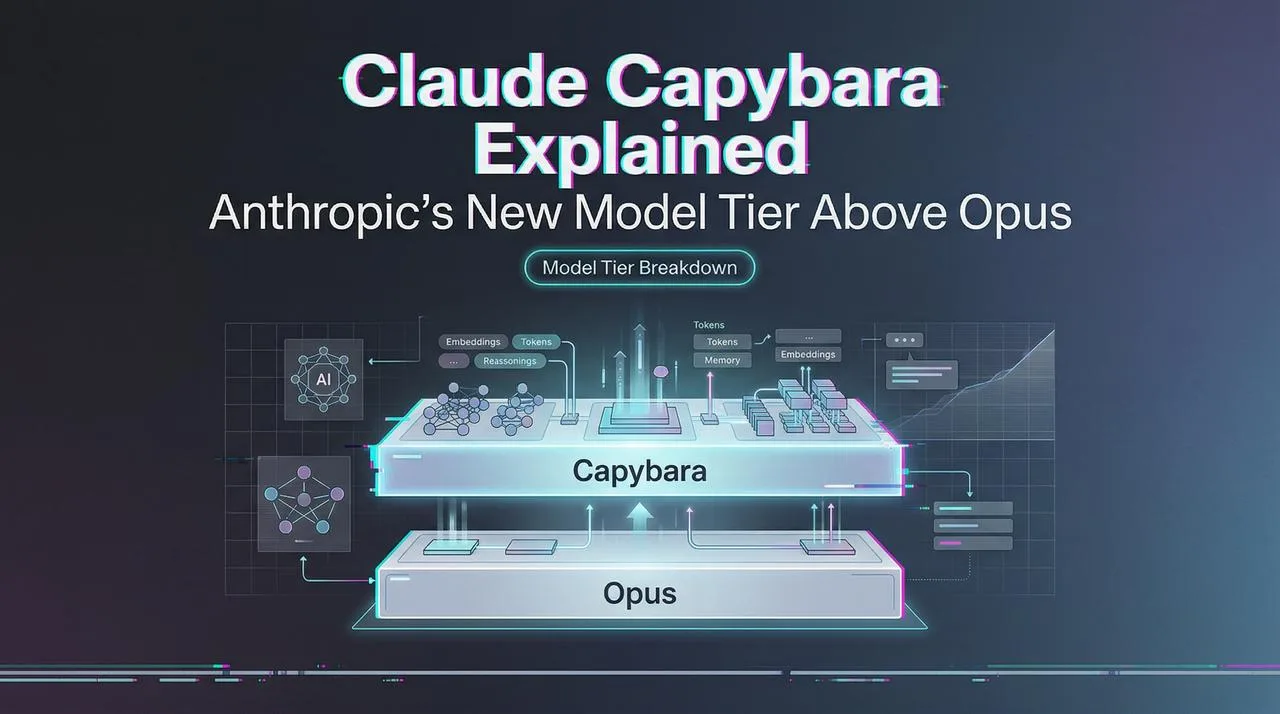
Capybara is a tier name — not a model name. That’s the single most important thing to understand before anything else.
In the leaked draft documents, Anthropic wrote: “‘Capybara’ is a new name for a new tier of model: larger and more intelligent than our Opus models — which were, until now, our most powerful.”
The distinction matters. When Anthropic says “Capybara,” it’s describing a new position in their product hierarchy — the way “Opus,” “Sonnet,” and “Haiku” describe tiers, not specific model versions. The actual model sitting in that Capybara tier has its own name: Claude Mythos. More on that relationship in a moment.
What Capybara represents structurally is a fourth rung added above an existing three-rung ladder. Interestingly, the naming style for Capybara shifted from literature to animals. Capybaras are the world’s largest rodents, known for their gentle nature despite their size — a name Anthropic appears to use to signal a “massive” leap in capability while maintaining a safe and approachable brand image.
As of early April 2026, Claude Mythos / Capybara is available only to a small group of early access customers selected by Anthropic. There is no public API, no announced pricing, and no confirmed release date.
Capybara vs Mythos — Two Names for the Same Model?
This is the question that’s generating the most confusion online, and it deserves a careful answer.
How the Leaked Draft Used Both Names
There were actually two versions of the same blog post that differed only in the model’s name: “Mythos” (v1) and “Capybara” (v2). In the Capybara version, the name was swapped throughout the title and body text, but the subtitle still reads, “We have finished training a new AI model: Claude Mythos.”
So here’s the cleaner way to think about the naming structure:
- Capybara = the tier name (equivalent to “Opus,” “Sonnet,” “Haiku”)
- Mythos = the model/generation name (equivalent to a version like “Claude 4” or “Claude 4.6”)
- The full public designation might logically follow as something like “Claude Mythos Capybara” — though this has not been confirmed
Anthropic’s official public statement after the leak used “Claude Mythos” as the primary reference — a spokesperson confirmed to Fortune that the company is testing a model it considers a “step change” and “the most capable we’ve built to date,” without specifying which name would survive to launch.
Why the Final Product Name May Differ
Whether the model ships as “Claude Mythos,” “Claude Capybara,” or under an entirely different public-facing name has not been confirmed. The fact that two drafts exist signals this was still in flux at the time of the leak.
This is not unusual for pre-launch software. Internal codenames often differ from public product names — sometimes dramatically. The existence of two named drafts for what appears to be the same announcement page is a strong signal that Anthropic’s marketing team hadn’t locked in the final naming convention before the CMS misconfiguration made the decision moot for the moment.
Anthropic described the leaked materials as “early drafts of content considered for publication.” That phrasing leaves open the possibility that the naming, positioning, or even specific capability claims could still change before any official announcement.
The practical implication: if you’re writing API integration code, building roadmap slides, or drafting internal briefings, don’t hardcode either name as the confirmed public designation. Watch the official Anthropic model overview page for whatever string actually ships.
Where Capybara Sits in Anthropic’s Model Tier Structure
The Current Lineup: Haiku, Sonnet, Opus
To understand what adding Capybara changes, you need to understand what existed before it. Anthropic established the Opus/Sonnet/Haiku naming convention in March 2024 with Claude 3, and it has been the foundation everything else built on since.
The three tiers — all with names drawn from literary and musical traditions — map to clearly differentiated cost and capability positions:
(Pricing per million input/output tokens, Anthropic API pricing docs, March 2026)
Claude models are usually released in three sizes: Haiku, Sonnet, and Opus — from smallest and cheapest to largest and most expensive. That’s been stable since Claude 3 launched. Until now.
A Fourth Tier: What Adding Capybara Changes
Before Claude Mythos, Anthropic’s model ecosystem consisted of three tiers: Opus (most capable), Sonnet (balanced), and Haiku (lightweight). The introduction of Capybara disrupts this structure, establishing a new, fourth tier positioned above Opus.
The structural change is significant for several reasons beyond raw capability. It resets what “the best available Claude” means — from a model priced at $5 input / $25 output per million tokens to something described in internal drafts as dramatically more capable and substantially more expensive. It also introduces a naming convention break: Haiku, Sonnet, and Opus all come from literary and musical traditions. Capybara is an animal. Whether this signals a broader naming shift for future model families, or is specific to this tier, is unknown.
Anthropic uses the capybara — the world’s largest rodent, known for its gentle nature despite its size — to signify a “huge” leap in Claude Mythos’s capabilities while maintaining Anthropic’s core focus on safety. It’s a deliberately approachable image for a model that the company’s own internal documents describe as posing unprecedented cybersecurity risks.
What a New Top Tier Means for API Pricing and Enterprise Access
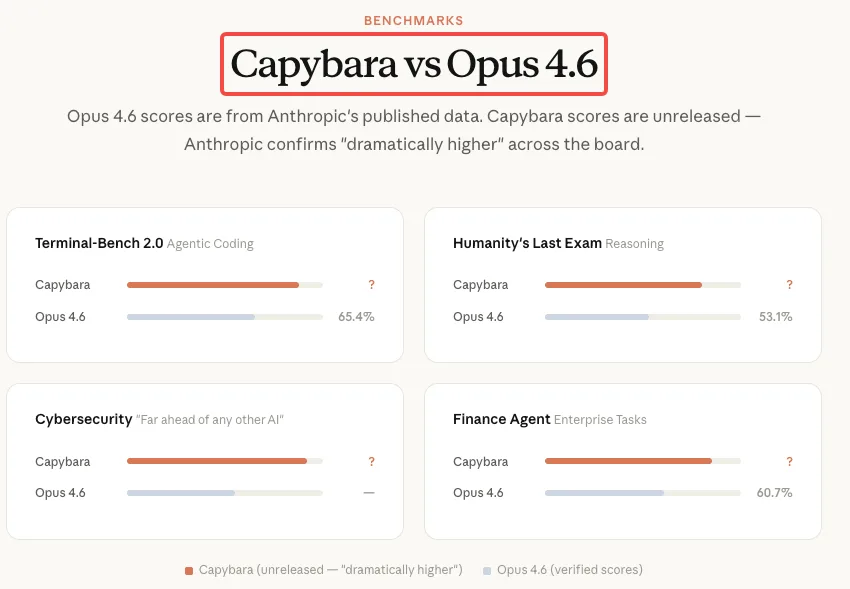
No confirmed pricing exists. Anyone publishing specific dollar figures for Capybara-tier access is speculating. The leaked draft used the phrase “very expensive for us to serve, and will be very expensive for our customers to use” — and that’s the complete extent of what Anthropic put in writing.
What we can do is look at the existing pricing curve and understand the structural expectation. When Anthropic moved from Opus 4.1 ($15/$75 per MTok) to Opus 4.6 ($5/$25 per MTok), that was a 67% price reduction alongside a capability upgrade. But that reduction was driven by efficiency improvements across a generation. Capybara is explicitly described as being before efficiency work is complete — meaning the launch price is likely to reflect higher compute costs, not lower ones.
Mythos is extremely compute-intensive and expensive to run. Anthropic said it is working on making it much more efficient before any general release.
For enterprise procurement teams, the honest framing is: plan for Capybara to cost more than Opus 4.6 at standard rates, with no confirmed ceiling. The access model is also likely to differ — the initial rollout has been explicitly targeted at cybersecurity defense organizations, not general enterprise customers. A broader enterprise access program, if it follows Anthropic’s precedent with Opus 4.6’s 1M context window, may require Tier 4 API organization status or a specific enterprise agreement. None of this has been officially confirmed, but the signals from the leaked draft and Anthropic’s public statement point clearly toward a managed, gated rollout rather than open API access at launch.
When the model does reach the public API, the technical migration should be straightforward. Anthropic’s unified API format means switching from claude-opus-4-6 to whatever Capybara’s model string turns out to be requires a single parameter change. No architectural work needed — just an updated model string and whatever budget approval the new pricing requires.
What Teams Should Know Before Capybara Is Publicly Available
The most useful thing you can do right now is not wait. Claude Opus 4.6 handles complex reasoning, agentic workflows, and long-context analysis at $5/$25 per million tokens with a 1M context window. For the vast majority of production workloads — including sophisticated code generation, multi-step research, and enterprise automation — that capability ceiling is genuinely high. Building and optimizing on Opus 4.6 now means you’ll be positioned to evaluate Capybara accurately when it arrives, with real baseline data rather than speculation.
 The signals worth monitoring before a public launch:
- Anthropic’s models overview page — a new model alias appearing here is the earliest reliable signal
- The API pricing documentation — a new pricing row will appear here at or before launch
- Anthropic’s news page — official early access program announcements will land here first
- The Claude changelog — model strings appear here at release
One additional factor worth noting: with Bloomberg reporting that Anthropic is eyeing an October IPO at a valuation of $380 billion, the company suddenly finds itself with a very public proof point in Capybara. That context matters for timeline estimation — the IPO timing creates some incentive to get the model to market, but safety evaluation timelines and efficiency work remain the stated gating factors.
FAQ
Is Capybara the same as Claude Mythos?
They refer to the same underlying model, but they’re different types of names. Capybara is the tier name (like Opus or Sonnet). Mythos is the model/generation name. The full designation would be something like “Claude Mythos Capybara” — the Capybara-tier model from the Mythos generation — though Anthropic has not published this framing officially.
How does Capybara pricing compare to Opus?
It will be higher, by an unconfirmed amount. The leaked draft described the model as “very expensive for us to serve, and will be very expensive for our customers to use.” For comparison, current Opus 4.6 pricing sits at $5 input / $25 output per million tokens. No specific Capybara rate has been disclosed.
Will Capybara replace Opus?
No — it sits above Opus as a new tier, not a replacement. Haiku, Sonnet, and Opus will continue as the active public tiers until Anthropic signals otherwise. Capybara disrupts the existing three-tier structure by establishing a new, fourth tier positioned above Opus — the existing tiers stay in place beneath it, each serving their current use case at their current price points.
Previous Posts:
/filters:quality(82)/media/images/c347367a-a007-4466-b8f7-d37f5fb52819.webp)
/filters:quality(82)/media/images/cd4db796-7728-45fb-8267-6813ed28e173.webp)
/filters:quality(82)/media/images/1791535252286714222_v4jvJT2a.webp)
/filters:quality(82)/media/images/1791451065663755033_qNqAKS1a.webp)
/filters:quality(82)/media/images/1791359984291066138_tW5eOX6f.webp)
/filters:quality(82)/media/images/1773962750383987480_n3hqzHRZ.webp)