What Is MaxClaw? MiniMax's Cloud AI Agent Explained
Hey, everybody. What a nice day! I’m your old friend, Dora.
I kept seeing MaxClaw mentioned in developer spaces over the past week. Not the loud kind of mentions — more like quiet relief. Someone would say they got their agent running in under a minute. Someone else mentioned they stopped maintaining their Docker setup. That kind of signal makes me pause.
So I tried it. Let’s go!
The Problem MaxClaw Is Solving
Why self-hosted agents frustrate most users
I’ve spent time with OpenClaw. It’s powerful — genuinely powerful — but it asks for something most people don’t want to give: sustained attention to infrastructure.
OpenClaw launched in late January 2026 and earned over 100,000 GitHub stars because it proved AI agents could actually do things, not just chat. It could control your browser, send emails, manage files. But it ran locally. That meant Node.js, dependencies, WebSocket configs, channel integrations that broke when updates shipped.
I’m comfortable with that. Many people aren’t.
The pattern I noticed: excitement at setup, frustration at maintenance, abandonment after the first breaking change. Not because the tool failed — because life got busy and keeping it running became work.
The hidden cost of DIY API setups
There’s another cost that doesn’t show up in tutorials.
When you self-host, you’re the one debugging why Telegram suddenly stopped responding at 2 AM. You’re the one reading error logs that reference internal architecture details you never wanted to learn. Traditional API-based agent interactions are stateless, but persistent agent processes maintain running state and can initiate actions proactively — which sounds great until you realize you’re now responsible for that persistence.
I’m not saying this to discourage self-hosting. I’m saying it because it’s honest. DIY setups trade money for time and attention. Some people have both. Most don’t.
So, What Exactly Is MaxClaw?
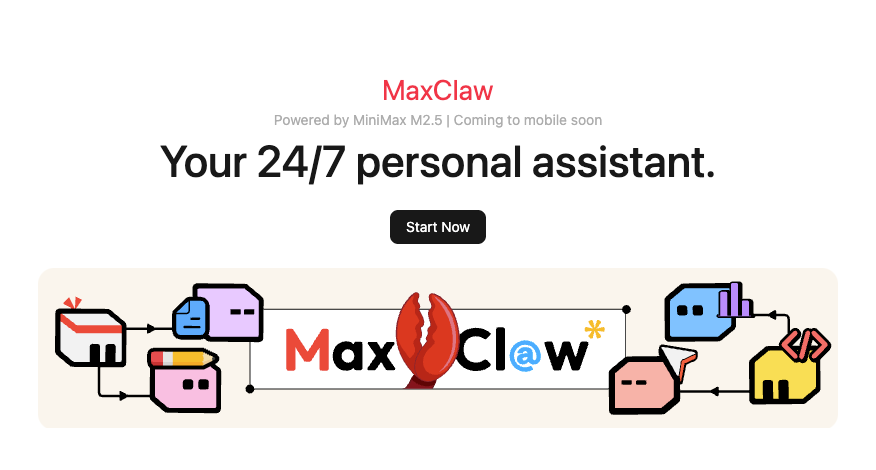
MaxClaw is a cloud-hosted AI agent officially launched by MiniMax on February 25, 2026. It takes the OpenClaw framework — the same agent architecture that went viral — and runs it for you in the cloud.
Cloud-hosted = zero setup
I clicked “Deploy Now” on February 28. Ten seconds later, I had a running agent. If you want to see the exact onboarding flow step by step, this quick guide on how to set up MaxClaw walks through the process. Not an agent that would run after I configured eight more things. A running agent.
No server selection. No Docker commands. No SSH keys. Just a deploy button and a Telegram connection screen.
This felt almost suspiciously simple. I kept waiting for the catch — the part where it would ask me to configure something complex. It never came.
Built on OpenClaw, powered by MiniMax M2.5 (229B MoE)
The underlying architecture matters here, so I looked.
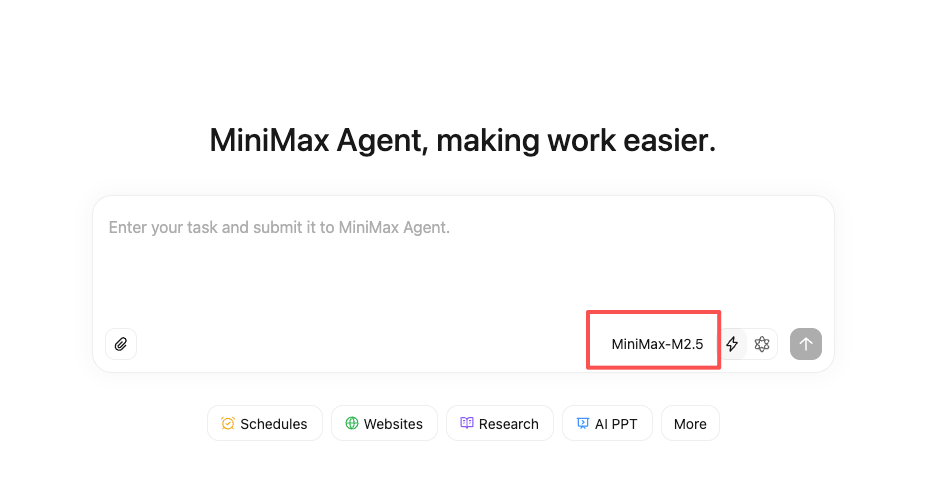
MaxClaw is built on the open-source OpenClaw framework and powered by the MiniMax M2.5 foundation model. M2.5 uses what’s called a Mixture-of-Experts architecture: 229 billion total parameters, but only 10 billion activate per request.
On benchmarks, M2.5 achieves 80.2% on SWE-Bench Verified, matching Claude Opus 4.6’s speed while costing 10-20x less. That efficiency claim got my attention because agent workloads chew through tokens quickly.
I didn’t benchmark it myself, but I did notice: tasks that felt expensive with other models ran without triggering anxiety about API costs. That’s not a technical measurement. It’s just how it felt to use.
Long-term memory — what that actually means
Unlike stateless assistants, MaxClaw agents can remember user preferences and working styles, retain context across days or weeks of interaction, and accumulate knowledge from past tasks.
I tested this by asking it to help with a research task on Tuesday, then coming back Thursday with “continue where we left off.” It did. No re-explaining. No starting over.
This matters more than it might sound. Most chatbots require you to reconstruct context every session. That’s fine for one-off questions. For ongoing projects, it’s exhausting. MaxClaw just… remembered.
What MaxClaw Can Do Out of the Box
Built-in tools (web search, file analysis, scheduling)
The tools shipped with MaxClaw aren’t revolutionary individually. Web search. File reading. Time handling. The kind of capabilities you’d expect.
What surprised me was how they worked together without my intervention.
I asked it to “check recent discussions about transformer alternatives and summarize the key approaches.” It searched, pulled content, cross-referenced sources, and returned a structured summary. No separate tool invocations I had to manage. No multi-step instructions.
This is what the press release calls “from intent to results — without friction”, and in this case, the marketing language matched experience.
Native integrations: Telegram, Slack, Discord, WhatsApp
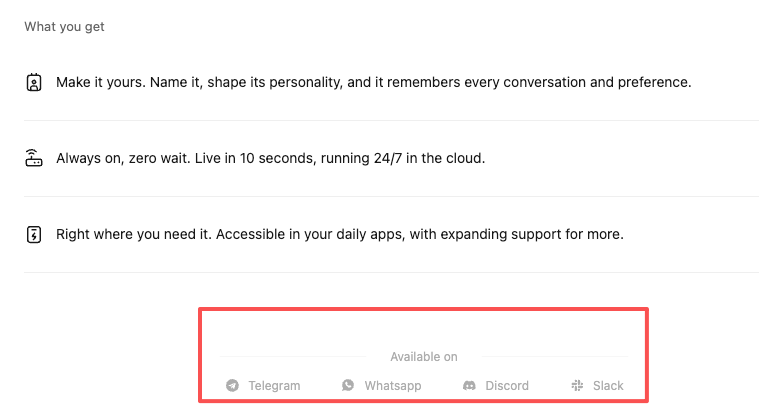
I primarily used Telegram because that’s where I already spend time. Setup took maybe 90 seconds — most of that was waiting for a bot token.
According to MiniMax’s documentation, MaxClaw also connects to Slack, Discord, WhatsApp, Feishu, and DingTalk. I didn’t test all channels, but the principle holds: it meets you in tools you’re already using rather than asking you to adopt something new.
50+ prebuilt Expert agents
MaxClaw provides access to over 10,000 pre-configured Experts covering a wide range of functions, though I suspect that number includes community-contributed agents that haven’t been vetted the same way core features have.
I tried three: a content researcher, a technical writer, and a code reviewer. They worked. Not perfectly — there were moments where outputs needed adjustment — but well enough that I kept using them instead of switching back to my manual workflow.
The code reviewer, specifically, caught things I would have missed on tired Friday afternoons.
Who Is MaxClaw For?
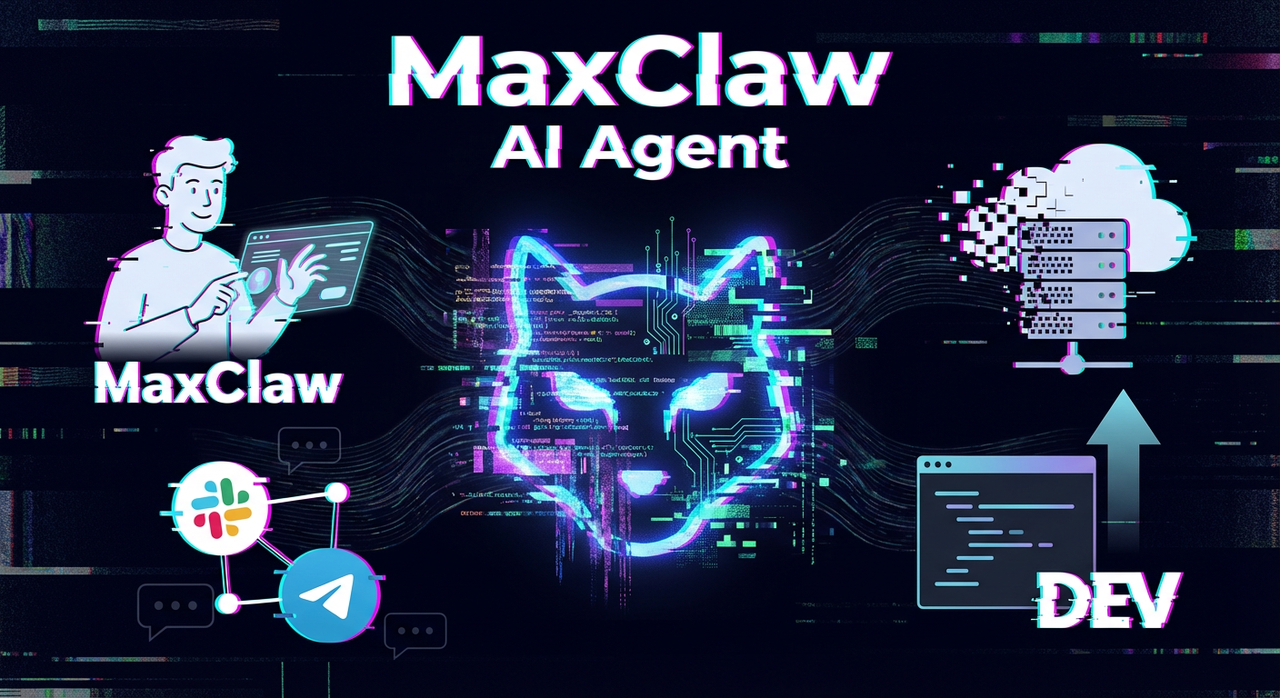
Non-technical users who want a working AI agent today
If you’ve been reading about AI agents but don’t want to learn Docker, MaxClaw removes that barrier completely.
I watched someone with no programming background get their agent running during a video call. They followed the onboarding wizard, connected Telegram, and started delegating tasks. Fifteen minutes, start to finish.
That’s the target user, I think. People who want the result, not the journey.
Teams already living in Slack or Telegram
If your team already communicates in Slack, adding an agent to that same space means it becomes part of workflow instead of a separate tool to remember.
Tasks can be assigned through everyday chat interfaces, eliminating context switching. This matters in practice because tools that require leaving your current environment tend to get forgotten during busy periods.
Developers tired of managing infra
Interestingly, some of the early adopters I saw were developers who could self-host but chose not to.
The calculation seemed straightforward: their time was worth more than the monthly cost of MaxClaw. They’d rather pay MiniMax to handle uptime, updates, and scaling than spend weekend hours keeping their own instance running.
MaxClaw vs. Building Your Own Agent Stack
The comparison depends entirely on what you value.
- If you want full control — the ability to swap models, modify the framework, control exactly where data lives — self-hosting OpenClaw or building with LangChain gives you that. Organizations that need to switch between GPT-4o, Claude, and open-weight models based on cost, capability, or regulatory requirements will find MaxClaw’s single-model dependency constraining.
- If you want something working quickly without ongoing maintenance, MaxClaw delivers. Deploy time is genuinely under a minute. No infrastructure knowledge needed. Updates happen automatically.
- If data sovereignty matters — if you work with medical records, proprietary code, or anything requiring strict data controls — MaxClaw isn’t the right choice. The data lives on MiniMax’s infrastructure. If your threat model requires data sovereignty, MaxClaw is not the right call.
The cost structure also differs. Always-on persistent agents incur continuous compute costs, unlike request-based pricing where you pay per API call. I didn’t see published pricing details for MaxClaw specifically, but the underlying M2.5 model costs significantly less per token than comparable models.
The honest version: MaxClaw trades flexibility for convenience. That’s a good trade for many use cases. Not all.
What MaxClaw Is NOT (Honest Limitations)
I need to be clear about what this doesn’t do.
-
It’s locked to one model. You’re using MiniMax M2.5. That’s it. If M2.5 isn’t good at your specific task, you can’t swap in Claude or GPT-4. For most general agent work, M2.5 performs well. But model lock-in is still lock-in.
-
It’s not local. The data lives on MiniMax’s infrastructure. Your conversations, your tasks, your files — they pass through MiniMax’s servers. For many use cases, this is fine. For sensitive work, it’s a non-starter.
-
Complex custom workflows are limited. Complex custom orchestration patterns that go beyond what OpenClaw supports, such as deeply nested multi-agent workflows or domain-specific reasoning chains, are better served by frameworks like LangChain or AutoGen.
-
There are no published SLA guarantees. No specific SLA percentages or uptime guarantees have been published. “Always-on” is the claim, but there’s no contractual backing for production use cases that depend on specific availability requirements.
-
It’s very new. MaxClaw launched less than a week ago as I write this. The edges haven’t been tested thoroughly by thousands of users in production scenarios. Early adoption always carries that risk.
I’ve kept using MaxClaw since I set it up. Not for everything — for certain recurring tasks where the combination of memory, tool access, and zero-maintenance actually saves time.
It doesn’t feel like the future of AI or any grand statement like that. It feels like someone built a practical implementation of an idea that kept being demonstrated but rarely delivered: an agent that just works, without asking you to become an infrastructure expert first.
Whether that matters to you depends entirely on what you’re trying to do.
Related Articles
DeepSeek V4 Cost per Million Tokens: Full Calculator
What Is SkyReels V4? The First Unified Video-Audio AI Model Explained
How to Use Seedance 2.0 via API: Async Jobs, Retries, and Result Handling

Qwen Image 2.0 Is Coming to WaveSpeed
How to Set Up MaxClaw: Step-by-Step Beginner Guide (2026)