What Is Claude Mythos? Leak, Capybara Tier & What Anthropic Confirmed
Claude Mythos is Anthropic's leaked next-gen model. Here's what the data breach revealed and what the company has officially confirmed.
I was skimming my feed in the morning, when a Fortune headline stopped me cold: Anthropic had accidentally left nearly 3,000 internal files in a publicly searchable data store — including a draft blog post announcing their next model. By the time I clicked through, the story had already gone wide. The model’s name: Claude Mythos. The internal tier name attached to it: Capybara. And Anthropic’s own draft called it “by far the most powerful AI model we’ve ever developed.”
I’m Dora. This article is a factual summary for developers and AI product leads who need a clear-headed read on what was actually confirmed, what came from the leaked draft, and what remains unknown. There are no official benchmark numbers to cite yet — and I won’t invent any.
What the Claude Mythos Data Leak Actually Revealed
Who Found It and How
The leak originated from a configuration error in Anthropic’s content management system. The CMS misconfiguration left close to 3,000 unpublished assets in a publicly accessible, searchable data store. Two security researchers independently located the exposed material: Roy Paz of LayerX Security and Alexandre Pauwels of the University of Cambridge discovered the exposed data store, which contained a draft blog post describing the model in detail. Fortune reviewed the documents and notified Anthropic, after which access was restricted.
Anthropic attributed the incident to “human error” in CMS configuration and described the exposed material as “early drafts of content considered for publication.” A second, separate leak followed days later: Anthropic accidentally uploaded all of Claude Code’s original source code to NPM instead of only the compiled version, exposing around 500,000 lines of code across roughly 1,900 files. That second leak provided additional corroboration that the Capybara model was actively in preparation.
What Was in the Exposed Draft
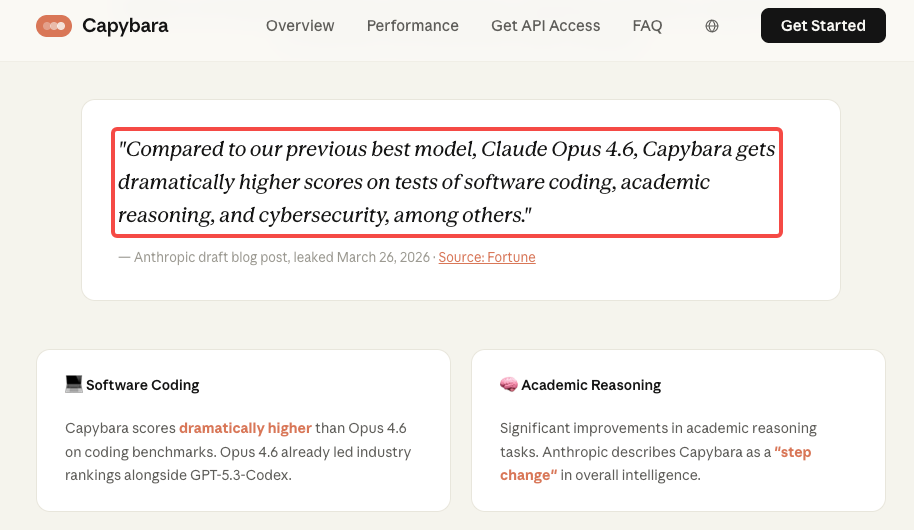
There were actually two versions of the same blog post that differed only in the model’s name: “Mythos” (v1) and “Capybara” (v2). In the Capybara version, the name was swapped throughout the title and body text, but the subtitle still reads, “We have finished training a new AI model: Claude Mythos.” Anthropic told Fortune the documents were “early drafts of content that were being considered for publication,” suggesting the company was still deciding between name candidates for the same model.
The draft also outlined a rollout strategy. According to the documents, Anthropic is planning a deliberately slower release than with previous models, starting with a small group of early-access customers tasked with evaluating cybersecurity applications, with access through the Claude API expanding gradually. The draft also acknowledged the model is “very expensive to serve” and that Anthropic is working to make it “much more efficient before any general release.”
Claude Mythos vs Capybara — Same Model, Two Names
What Capybara Means as a New Tier
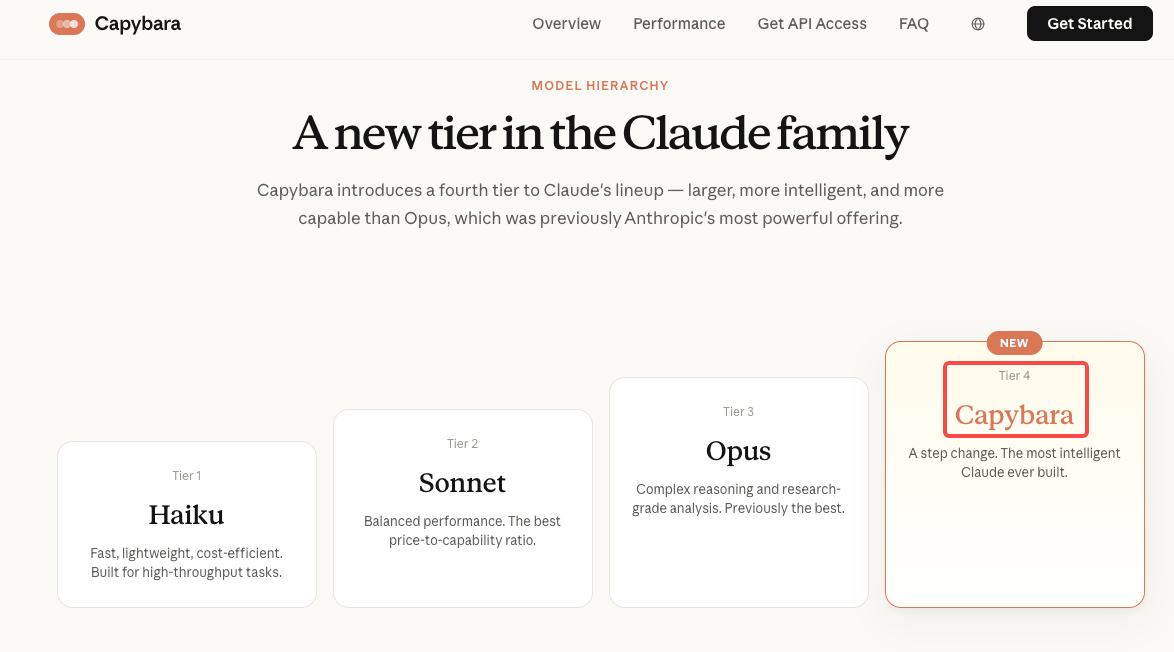
This is the most important structural point to get right. Mythos and Capybara are not two different models. “Claude Mythos” is the product/generation name (like “Claude 4”), while “Capybara” is the tier name (like Haiku, Sonnet, Opus). The full designation would be something like “Claude Mythos Capybara.”
The tier distinction matters because it represents a change to Anthropic’s model lineup architecture. Currently, Anthropic’s model tiers run from Haiku (smallest, fastest, cheapest) through Sonnet to Opus (most capable). Capybara would add a fourth, pricier tier above all three — “larger and more intelligent than our Opus models — which were, until now, our most powerful,” according to the leaked draft.
This is a structural expansion, not just a version increment. Think of it less as “Opus 5” and more as a new product category that sits above the existing lineup.
How the Naming Might Evolve Before Public Launch
Both draft versions use the same justification for the name, saying it was chosen to evoke “the deep connective tissue that links together knowledge and ideas.” Whether the model ships as “Claude Mythos,” “Claude Capybara,” or under an entirely different public-facing name has not been confirmed. The fact that two drafts exist — one is named Mythos, one named Capybara — signals this was still in flux at the time of the leak.
“Claude Mythos 5” is not an official name. It has circulated in coverage as a shorthand but does not appear in the leaked documents or in any Anthropic statement. Do not treat it as a confirmed designation.
Claimed Capabilities vs Claude Opus 4.6
All capability claims below originate from the leaked draft blog post and are attributed accordingly. No official benchmarks have been published by Anthropic as of April 2026.
Coding and Agentic Reasoning
According to the leaked draft, “Compared to our previous best model, Claude Opus 4.6, Capybara gets dramatically higher scores on tests of software coding, academic reasoning, and cybersecurity, among others.” The draft does not give specific benchmark numbers — only the qualitative descriptor “dramatically higher.” No external reproduction of these scores exists yet.
The claim of improved agentic reasoning is consistent with the trajectory of the existing Claude model family, which has been progressively extending tool use and multi-step task handling. Claude Code’s rapid enterprise adoption was already built on Opus 4.6’s agentic capabilities; Mythos would presumably extend that further.
Academic Reasoning Improvements
The leaked draft lists academic reasoning as one of the areas of “dramatically higher” performance versus Opus 4.6. No specifics on which benchmarks (GPQA, MMLU, MATH, etc.) or what score ranges were claimed have surfaced in verified reporting. This is an area where the absence of official numbers matters: making decisions based on unverified benchmark claims from a draft document carries real evaluation risk.
Cybersecurity Performance — and Why It’s Causing Concern
This is where the leak generated the most discussion — and the most caution. The leaked draft stated that the model “presages an upcoming wave of models that can exploit vulnerabilities in ways that far outpace the efforts of defenders.”
The leaked documents describe Mythos as currently far ahead of any other AI model in cyber capabilities, raising serious dual-use concerns. Anthropic’s own statement acknowledged the risk directly: “In preparing to release Claude Capybara, we want to act with extra caution and understand the risks it poses — even beyond what we learn in our own testing.”

The context here isn’t abstract. Anthropic has previously reported that a Chinese state-sponsored group had already been running a coordinated campaign using Claude Code to infiltrate roughly 30 organizations — including tech companies, financial institutions, and government agencies — before the company detected it. Mythos’s claimed cybersecurity capabilities amplify that dual-use risk profile considerably, which is a direct driver of the cautious rollout strategy.
For teams integrating frontier models into security tooling, this is a genuine factor — not just regulatory language. Reviewing Anthropic’s usage policy before building any cybersecurity-adjacent applications on current or future models is worth doing now.
Current Availability: Who Can Access It Now
Early Access Program Details
Anthropic is working with a small group of early access customers to test the model. The leaked draft indicates this group is specifically focused on evaluating cybersecurity applications, suggesting the early access cohort was selected based on relevant domain expertise rather than customer size alone.
According to leaked product information meant for early access customers, the new model could be used by threat actors to implement more powerful attacks. The early access design is partly a controlled risk assessment, not just a feature preview.
There is no public waitlist, no announced application process, and no confirmed timeline for expanding beyond the initial group. If you’ve seen third-party sites offering “Capybara access,” those are not affiliated with Anthropic.
No Public API or Release Date Confirmed
Anthropic’s official statement is the only confirmed public position: “We’re developing a general purpose model with meaningful advances in reasoning, coding, and cybersecurity. Given the strength of its capabilities, we’re being deliberate about how we release it.”
No API endpoint, no pricing, no release quarter. The draft noted the model is “expensive to run” and not ready for general availability. For teams planning roadmaps around this model, the honest answer is: there is no date to plan against yet.
What This Means for Teams Evaluating Frontier Models
A few things worth sitting with if you’re doing model evaluation for product or infrastructure decisions:
The naming ambiguity is a practical problem. If your evaluation framework references “Claude Mythos 5” or treats Capybara as a confirmed public product, you’re building on draft language that Anthropic may change entirely before launch. Keep your internal documentation loose on naming until there’s an official release.
The cybersecurity capability claim changes the risk calculus for certain use cases. If your application touches vulnerability scanning, penetration testing, or code security analysis, the claimed capabilities of Mythos raise both the upside and the compliance burden. Start assessing that now rather than after access opens.
Claude Opus 4.6 remains the production-grade option. For teams that need to ship today, Opus 4.6 is still Anthropic’s publicly available flagship and performs well on complex reasoning tasks. Chasing an unreleased model for current projects doesn’t make sense. Review Anthropic’s current model documentation for API access and capability specs.
The dual-leak situation is a signal, not just a story. Two major unintentional disclosures in one week — CMS files and Claude Code source — suggest internal release coordination is under pressure. The model may be closer to launch than a cautious public posture implies. Or it may ship significantly later if safety testing raises issues. Neither interpretation is wrong; the uncertainty is the actual state of things.
FAQ
Is Claude Mythos publicly available?
No. As of April 2026, Claude Mythos / Capybara is available only to a small group of early access customers selected by Anthropic. There is no public API, no announced pricing, and no confirmed release date.
How does it compare to Opus 4.6?
According to the leaked draft blog post, Capybara gets “dramatically higher scores” than Claude Opus 4.6 on software coding, academic reasoning, and cybersecurity benchmarks. No specific numbers have been published. All capability comparisons currently come from that draft source, not from official benchmark releases.
Will there be a public Claude Mythos API?
Likely yes at some point — the leaked draft described a phased rollout through the Claude API — but no timeline has been confirmed. The model is currently described as expensive to serve and not yet optimized for general availability. Monitor Anthropic’s official news channel for announcements.
Previous Posts:
Related Articles
Claude Code Leaked Source: BUDDY, KAIROS & Every Hidden Feature Inside
What Is claw-code? The Claude Code Rewrite Explained