Google Veo 4: What We Might See From Google's Next AI Video Model
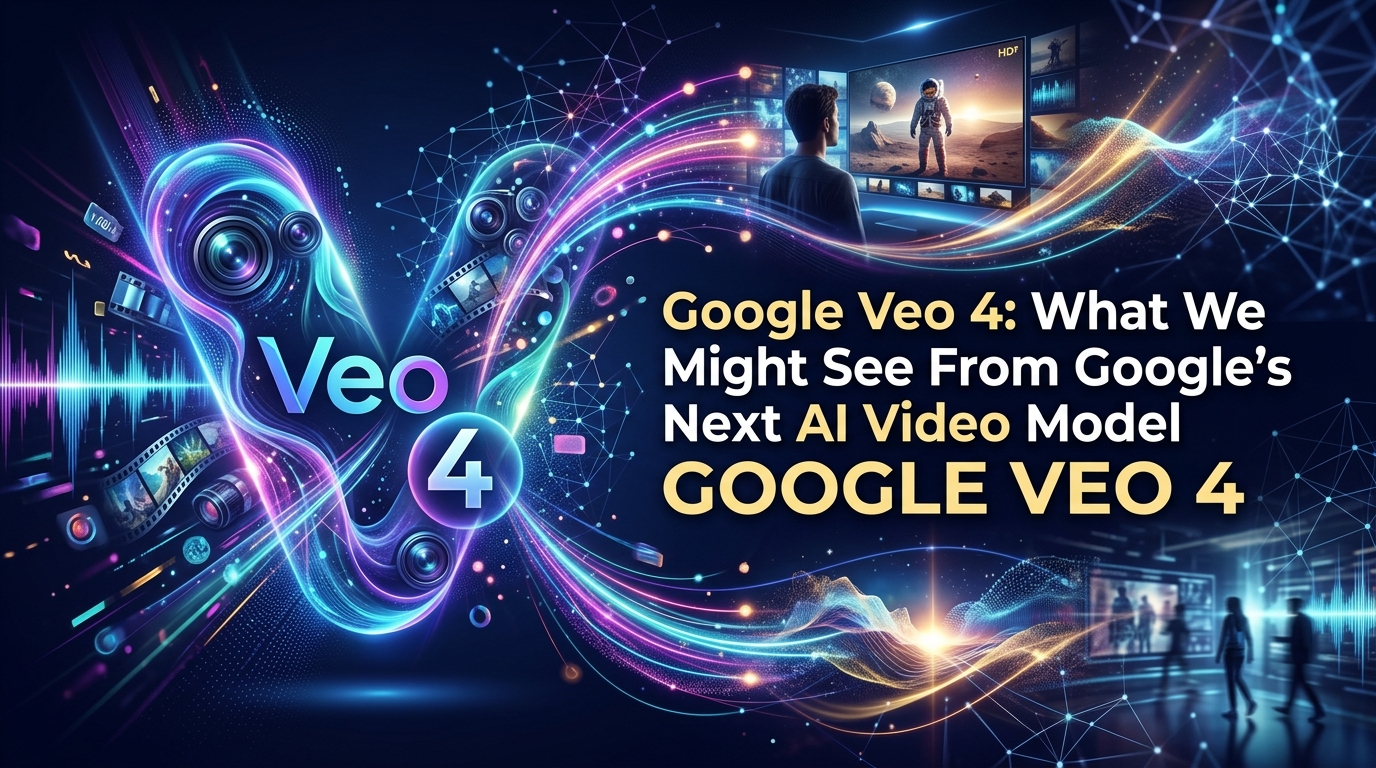
Google Veo 4: What Could Google’s Next AI Video Model Look Like?
Google’s Veo series has been one of the strongest entries in the AI video generation space. Veo 3 introduced native audio generation. Veo 3.1 pushed image-to-video quality to new heights with 1080p output and cinematic motion. Now, the AI community is buzzing about what comes next.
Veo 4 hasn’t been officially announced, but based on Google’s release cadence, competitive pressure from models like Seedance 2.0, and the rapid pace of innovation across the industry, the next generation is likely on the horizon. Here’s what we might expect — and more importantly, what you can already do today with the best AI video models available right now.
What Veo 4 Could Bring to the Table
Based on where the industry is heading and the trajectory from Veo 3 to 3.1, here are the capabilities a next-gen Veo model might deliver:
Longer Video Duration
Veo 3.1 caps at 8 seconds per generation. The entire industry is pushing toward longer coherent output — Wan 2.6 already supports video extend for continuous clips, and Seedance offers multiple duration tiers. A Veo 4 could reasonably push to 15-30 seconds in a single pass while maintaining temporal consistency.
Native 4K Resolution
1080p is the current ceiling for most AI video models. 4K native generation — where every pixel is generated from scratch rather than upscaled — would be a significant differentiator. The compute cost would be substantial, but Google has the infrastructure to make it happen.
Personalized Character Consistency
One of the biggest pain points in AI video: generating the same character across multiple scenes. Veo 4 might introduce persistent character IDs or avatar systems — upload a photo and voice, and generate videos featuring that consistent identity. This capability would compete directly with what Sora 2’s character system offered before its shutdown.
Advanced Camera Controls
Cinematic camera techniques — dolly zoom, crane shots, steadicam tracking, rack focus — are largely left to chance in current models. Explicit camera control parameters would make AI video generation genuinely useful for professional filmmakers and advertisers.
Could It Surpass Seedance 2.0?
Seedance 2.0 currently sets the bar for cinematic AI video quality — film-grade color grading, professional lighting, and Hollywood-level visual fidelity. A Veo 4 would need to match or exceed this level while adding Google’s strengths in audio integration and multi-modal understanding. It’s possible, but Seedance 2.0 is a high bar to clear.
You Don’t Have to Wait: The Best AI Video Models Available Right Now
While Veo 4 remains speculation, WaveSpeedAI already hosts an arsenal of production-ready AI video models that cover every capability a next-gen model might promise. Here’s what you can use today:
Google Veo 3.1 — The Current Best From Google
Veo 3.1 Image-to-Video on WaveSpeedAI →
Veo 3.1 is already excellent — native 1080p output, built-in synchronized audio (dialogue, ambient sound, music), start-and-end-frame transitions, and cinematic motion quality. At $0.20-0.40/second, it delivers Google-grade quality right now.
- Native 1080p at 24 FPS
- Synchronized audio generation in a single pass
- Landscape and portrait aspect ratios
- Start and end frame control for precise narrative arcs
Alibaba Wan 2.6 — The Most Complete Video AI Ecosystem
Wan 2.6 Collection on WaveSpeedAI →
Wan 2.6 isn’t just one model — it’s a complete ecosystem: text-to-video, image-to-video, reference-to-video, video extend, image editing, and more. With Pro, Flash, and Spicy variants for different speed/quality trade-offs, it’s the most versatile platform available. And with Wan 2.7 bringing first/last-frame control and instruction-based editing, Alibaba is moving fast.
- Text-to-video, image-to-video, reference-to-video
- Video extend for longer clips
- Multiple quality tiers (Pro, Flash, Spicy)
- Open-source weights available
Kuaishou Kling O3 Pro — Cinematic Quality With Audio
Kling O3 Pro Image-to-Video → Kling O3 Pro Text-to-Video →
Kling O3 Pro uses MVL (Multi-modal Visual Language) technology for physics-aware motion — fabric, fire, water, and hair all move with realistic physical behavior. Built-in voiceover and ambient audio generation, plus start-and-end-frame control for precise narrative direction.
- Physics-aware motion dynamics
- Synchronized audio generation
- Start and end frame control
- Professional-grade cinematic output
ByteDance Seedance 1.5 Pro — The Motion King
Seedance v1.5 Pro Image-to-Video →
Seedance’s strength is motion quality — the most natural, physically plausible movement in the AI video space. Characters move like real people, camera work feels intentionally directed, and temporal consistency across frames is best-in-class. Multiple resolution tiers from 480p to 1080p.
- Best-in-class motion dynamics
- Physics-aware rendering
- Multiple resolution and speed tiers
- Fast and standard variants for different workflows
Vidu Q3 — Quality Meets Flexibility
Vidu Q3 offers exceptional visual fidelity with 1080p output, 1-16 second clip length, adjustable motion intensity, and built-in synchronized sound effects. The prompt enhancer tool helps craft better descriptions, and at $0.07-0.16/second, it’s competitively priced.
- Up to 1080p, 1-16 seconds
- Adjustable motion intensity
- Built-in sound effects generation
- Prompt enhancer for better results
The Landscape: AI Video Generation in 2026
The AI video generation field has never been more competitive. With Sora’s shutdown, Google preparing what could be Veo 4, and models like Seedance 2.0 pushing cinematic quality to new heights, the options for creators and developers are expanding rapidly.
The advantage of using WaveSpeedAI is that you’re not betting on any single model or provider. When Veo 4 launches — or the next breakthrough from any provider — it’ll be available alongside everything else through the same API. No migration, no new accounts, no infrastructure changes.
FAQ
When will Google Veo 4 be released?
No official release date has been announced. Based on Google’s release cadence, a next-gen Veo model could arrive in 2026, but timing remains unconfirmed.
Will Veo 4 be better than Seedance 2.0?
Seedance 2.0 currently leads in cinematic quality. Veo 4 could match or exceed it, particularly if Google leverages its strengths in audio integration and multi-modal AI, but it remains to be seen.
Can I use Veo 3.1 right now?
Yes. Google Veo 3.1 is available on WaveSpeedAI via REST API with native 1080p output, synchronized audio, and no cold starts.
What’s the best AI video model available today?
It depends on your use case: Veo 3.1 for Google-grade quality with audio, Wan 2.6 for ecosystem versatility, Kling O3 Pro for cinematic production, Seedance 1.5 Pro for motion quality, and Vidu Q3 for flexibility and value. All are available on WaveSpeedAI.
Will WaveSpeedAI support Veo 4 when it launches?
WaveSpeedAI consistently adds new models as they become available. When Veo 4 launches, expect it on the platform alongside 200+ other models.
Don’t Wait for the Future — Build With the Best of Today
Veo 4 might be impressive when it arrives. But the models available right now — Veo 3.1, Wan 2.6, Kling O3 Pro, Seedance 1.5 Pro, Vidu Q3 — are already delivering production-quality AI video. Whatever Veo 4 promises, there’s likely a model on WaveSpeedAI that does something similar today.
Related Articles

WaveSpeedAI vs Media.io Watermark Remover: Which One Actually Delivers?
Goodbye Sora: Top 5 Best Sora Alternatives for Making AI Videos in 2026

Introducing AI Photo Colorizer on WaveSpeedAI
Introducing Image Body Swap on WaveSpeedAI
Introducing Video Body Swap on WaveSpeedAI