
SkyReels V4 vs Veo 3.1 vs Sora 2: Which AI Video Model Wins in 2026?
Hello, Dora here. This started with a small annoyance: I kept exporting short explainer videos, then hopping between tools to patch timing, fix a hand, or smooth a transition. It wasn’t broken, just needlessly fussy. So I ran a simple experiment. For a few weeks, whenever I needed a quick clip, I reached for three models, SkyReels V4, Veo 3.1, and Sora 2, and let them carry more of the weight. If you’re not familiar with SkyReels V4 yet, this overview explains what it is and how it fits into the current motion model landscape.
SkyReels V4 vs Veo 3.1 vs Sora 2 isn’t a “who wins?” question for me. It’s: which one actually reduces friction when I’m trying to get a believable shot out the door without turning my brain into a prompt router? I wasn’t looking for fireworks. I wanted steadier days.
Why This Comparison Matters Now
I’ve noticed something odd this past winter: motion models feel less like demos and more like utilities. Not perfect, not fully predictable, but steady enough that a draft shot can replace three separate steps in a traditional workflow. Two or three months ago, that would’ve sounded optimistic. February made it feel normal.
I also saw teams around me move from “let’s test this” to “let’s spec a pipeline,” which changes the questions. Instead of “can it make a dog on a skateboard,” I’m hearing “can it hit 24 fps, loop cleanly, and respect color profiles?” That’s why this comparison matters right now. The baseline is rising, and small gaps, rate limits, mask stability, how models treat faces or hands, matter more than a flashy reel.
V4’s leaderboard ranking (2nd on Artificial Analysis, Feb 2026)
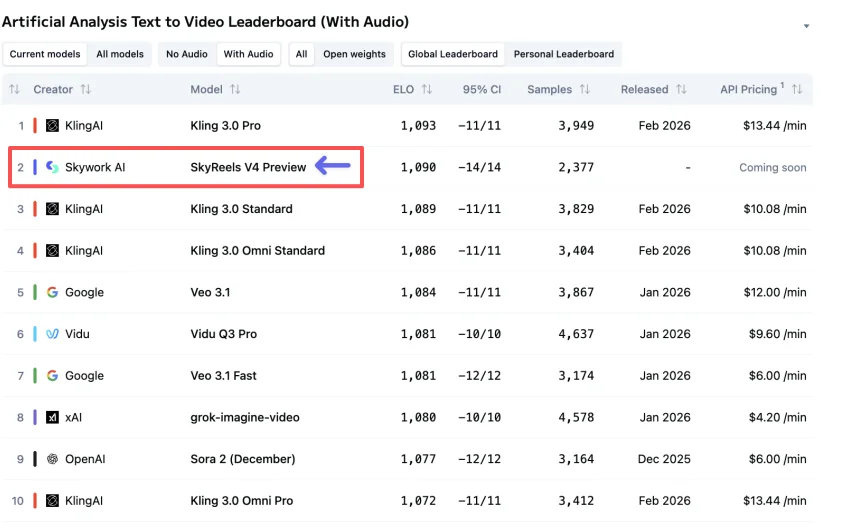
I don’t treat leaderboards as gospel, but they’re useful context. In February 2026, SkyReels V4 showed up as 2nd on the Artificial Analysis leaderboard, which tracks mixed community and structured evals. It matched my week-to-week experience: V4 didn’t always wow me, but it was rarely chaotic. The consistency stood out more than the peaks.
Feature Comparison Table
I’m allergic to feature dumps, so think of this as field notes. Specs shift. What matters is what I could actually produce between Feb 5 and Mar 1, 2026.
Resolution / FPS / Max duration
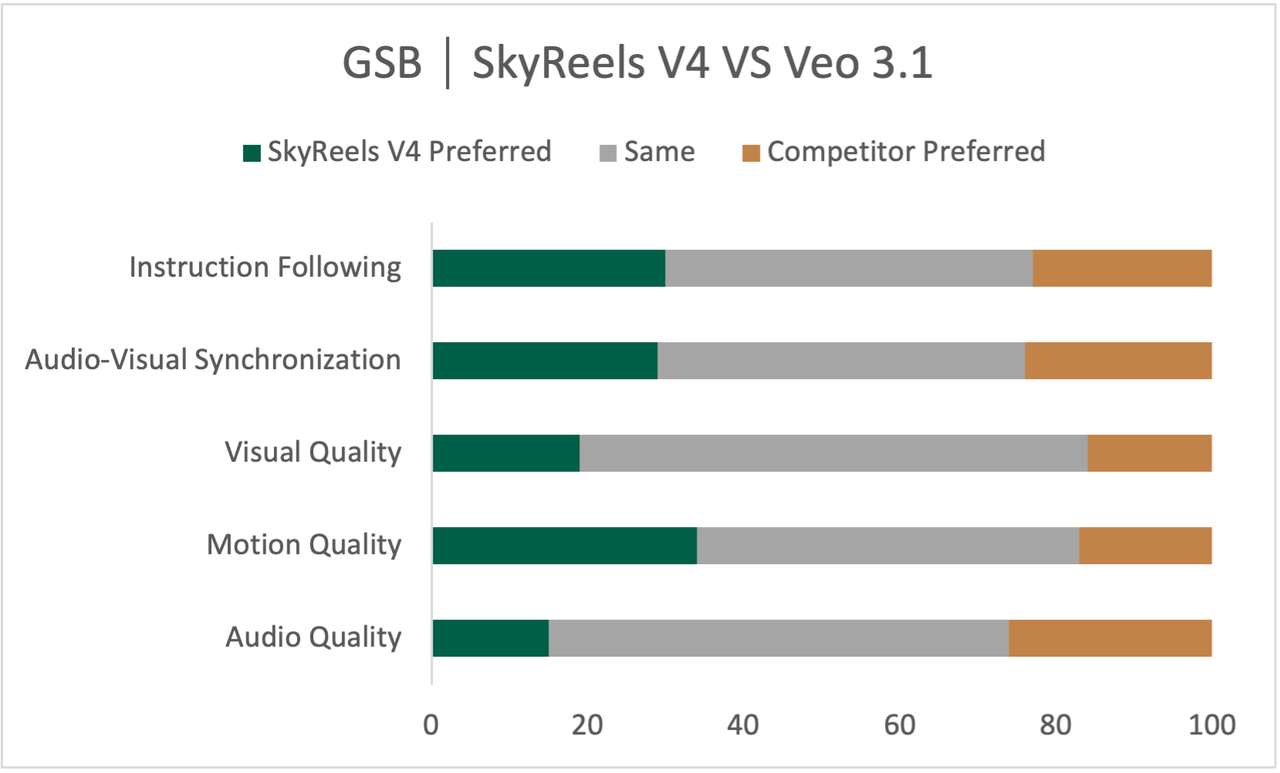
- SkyReels V4: Most of my outputs landed at 1080p by default. I could nudge to 1440p and do a clean upscale pass that held edges decently. Frame rate control was reliable at 24–30 fps: 60 fps sometimes looked over-smoothed. Max duration felt stable around 45–60 seconds per render before quality drifted. Longer sequences worked fine by stitching.
- Veo 3.1: Gave me the most consistent 1080p with fewer compression artifacts. 4K upscales looked the least plasticky of the three. Frame rate controls (24/30/60) obeyed prompts more strictly than V4. I capped most shots at ~60 seconds: past that, motion coherence slipped unless I storyboarded.
- Sora 2: Strong subject coherence at 1080p, especially on mid shots. 4K upscales were hit-or-miss, great on static scenes, brittle on fast motion. 24 fps looked cinematic: 30 was fine: 60 showed temporal wobble in backgrounds. I kept single shots under 45 seconds: longer clips worked with guided extensions.
What mattered: all three can hit “broadcastable” 1080p. If you live and die by native 4K, Veo 3.1’s upscale pass felt the cleanest to me.
Audio generation (native vs add-on)
- SkyReels V4: Basic native ambience was available in my tests (wind, room tone, simple foley). Music and nuanced SFX needed an external track. Lip-sync from an audio reference worked, but only in tighter shots.
- Veo 3.1: No meaningful native audio in my runs. I paired it with a separate audio model and manual mixing. The upside: total control. The downside: one more step.
- Sora 2: Similar to Veo, no full-scene audio generation in my access. I treated it as picture-first and layered sound later.
Net: If you want everything in one render, V4 gets you a passable temp track. For publish-ready sound, you’ll still want a DAW or a dedicated audio model.
Input modes (text / image / video / audio ref)
- SkyReels V4: Text prompts plus image conditioning (style refs, color palettes) worked well. Short video refs (5–10s) guided motion better than I expected. Audio reference drove mouth movement, but not body rhythm.
- Veo 3.1: Strong at adhering to image boards. Video extension/in-betweening felt the most stable of the three with masked areas. Text-only prompts sometimes drifted on small physical details (hands, laces) unless I anchored with an image.
- Sora 2: Best at text-only “vibe” shots. When I gave it a single hero frame, Sora 2 kept lighting and material properties unusually well across 10–15 seconds.
Editing & inpainting support
- SkyReels V4: Masked edits were fast. Object removals held up in medium shots: wide shots revealed seams if I looked closely. Inpainting inside motion (like removing a logo on a moving jacket) was okay after two passes.
- Veo 3.1: Strongest mask stability for me. I could swap props and patch small continuity errors without re-rendering whole segments.
- Sora 2: Inpainting felt more finicky, good when the background was simple, messy when it wasn’t. I leaned on re-generations instead of surgical fixes.
Open source vs proprietary / access
- SkyReels V4: Proprietary. I used a limited API during Feb 2026 with moderate rate limits.
- Veo 3.1: Proprietary. Access came through a managed service: quotas were predictable, but peaks required planning.
- Sora 2: Proprietary research access. Throughput varied and queues were a factor at busy times.
SkyReels V4 — Strengths & Weaknesses
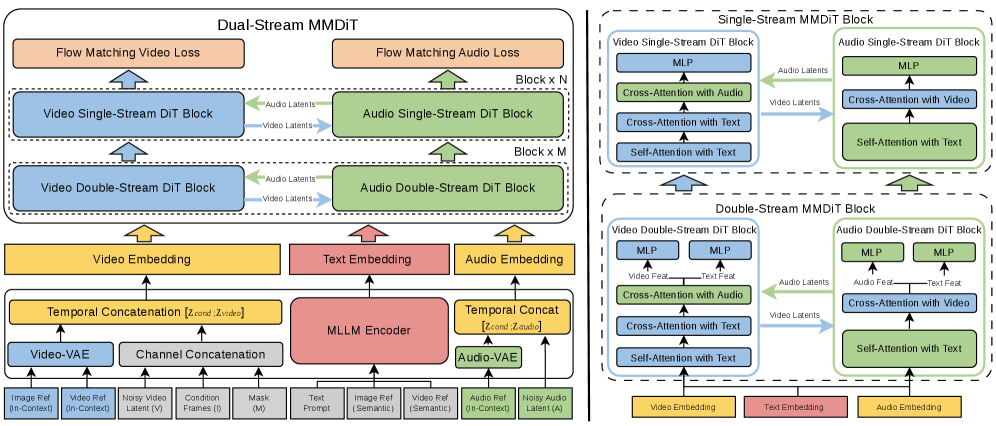
What I liked: V4 respected structure. When I gave it a rough beat sheet, “3s wide, 5s push-in, 10s cutaway”, it behaved. I could keep my editor brain on and still let it handle the grunt work. Hands and small props improved noticeably across my February runs: fewer rubbery frames.
What slowed me down: V4 sometimes flattened contrast in low light. Solvable with a grade, but it added a step. The built-in ambience was handy as a temp track, yet I always replaced it. And if I chased highly specific choreography from text alone, V4 resisted until I added a motion reference.
Where it clicked: tight product loops, app explainers, tabletop shots, anything that benefits from crisp continuity and clear edges. I also had good luck with short social cuts where the first frame had to read instantly.
Veo 3.1 — Strengths & Weaknesses
 What I liked: Veo 3.1 gave me the cleanest upscale path. I could deliver 1080p masters and feel comfortable pushing to 4K for larger screens. Masked edits felt surgical. If I needed to swap a label or fix a background flicker at the last minute, Veo stayed calm.
What slowed me down: text-only prompting wandered on physical plausibility. I learned to anchor it with a style board or a hero frame. Also, no native audio meant another pass in the DAW every time, fine for me, but it’s a step.
Where it clicked: cinematic b‑roll, outdoor motion, and anything with subtle camera moves. It handled parallax and lens feel with less warping than the others, especially on slow arcs.
Sora 2 — Strengths & Weaknesses
What I liked: Sora 2 surprised me with material realism from simple prompts. Fabric behaved like fabric. Glass caught light the way my head expected it to. When I needed a moody establishing shot fast, Sora 2 often won on first pass.
What slowed me down: surgical edits were harder. When something was off, an extra finger, a logo creeping in, I sometimes spent longer coaxing a fix than if I’d just re-rendered a new variant. Also, long shots drifted unless I storyboarded more than I wanted to.
Where it clicked: atmospheric openers, texture studies, and vibe-led clips where precise continuity wasn’t the point. Give it a clear tone and it paints the moment.
Best Choice by Use Case
For social content creators
I’d start with SkyReels V4. It keeps edges clean, respects beats, and doesn’t collapse when you change aspect ratios. If I needed a fast loop with legible first frames, V4 saved me two or three micro-fixes per post. Sora 2 is a nice second pick for mood pieces and intro shots.
For filmmakers & cinematic work
Veo 3.1 felt the most predictable in camera motion and lens character. If you’re mixing generated shots with live action, that matters. I’d still storyboard and anchor with reference frames. For beauty shots or textured atmospherics, Sora 2 can add a lift, just plan your fix path.
For developers & open-source workflows
None of these are open source. If your requirement is fully local or permissive licensing, you’ll have to look elsewhere. If “developer-friendly” just means stable APIs and predictable quotas, Veo 3.1 edged out the others in my runs. SkyReels V4’s image/video conditioning endpoints were straightforward, which made prototyping fast.
For enterprise teams
Pick the one that matches your governance reality. In my tests, Veo 3.1 had the steadiest throughput under load. SkyReels V4 gave me reliable structure adherence, which helps when you’re templating lots of similar shots. Sora 2 is compelling for creative exploration, but I’d budget extra time for revisions if you need precise continuity.
Our Verdict
Across a few quiet weeks, SkyReels V4 vs Veo 3.1 vs Sora 2 turned into less of a showdown and more of a casting choice. I reached for V4 when I wanted structure without fuss. I leaned on Veo when I cared about lens feel and a clean upscale to 4K. I used Sora when I needed a mood that felt lived-in, fast.
None of them erased work. What they did, on good days, was reduce mental load. A shot that used to require three tools and six micro-decisions now took one render and two small fixes. That’s not headline material, but it’s what gets me through a week.
If your constraints look like mine, short explainers, social loops, light b‑roll, you’ll likely find a groove with SkyReels V4 or Veo 3.1 and keep Sora 2 nearby for tone. Your mileage will vary, and it should. The interesting part isn’t which model is “best.” It’s noticing when a tool makes you breathe a little easier while you work.
Related Articles
DeepSeek V4 GPU Requirements: VRAM & Hardware Guide
MaxClaw vs OpenClaw: Which Should You Actually Use?
DeepSeek V4 Cost per Million Tokens: Full Calculator

What Is MaxClaw? MiniMax's Cloud AI Agent Explained
What Is SkyReels V4? The First Unified Video-Audio AI Model Explained
