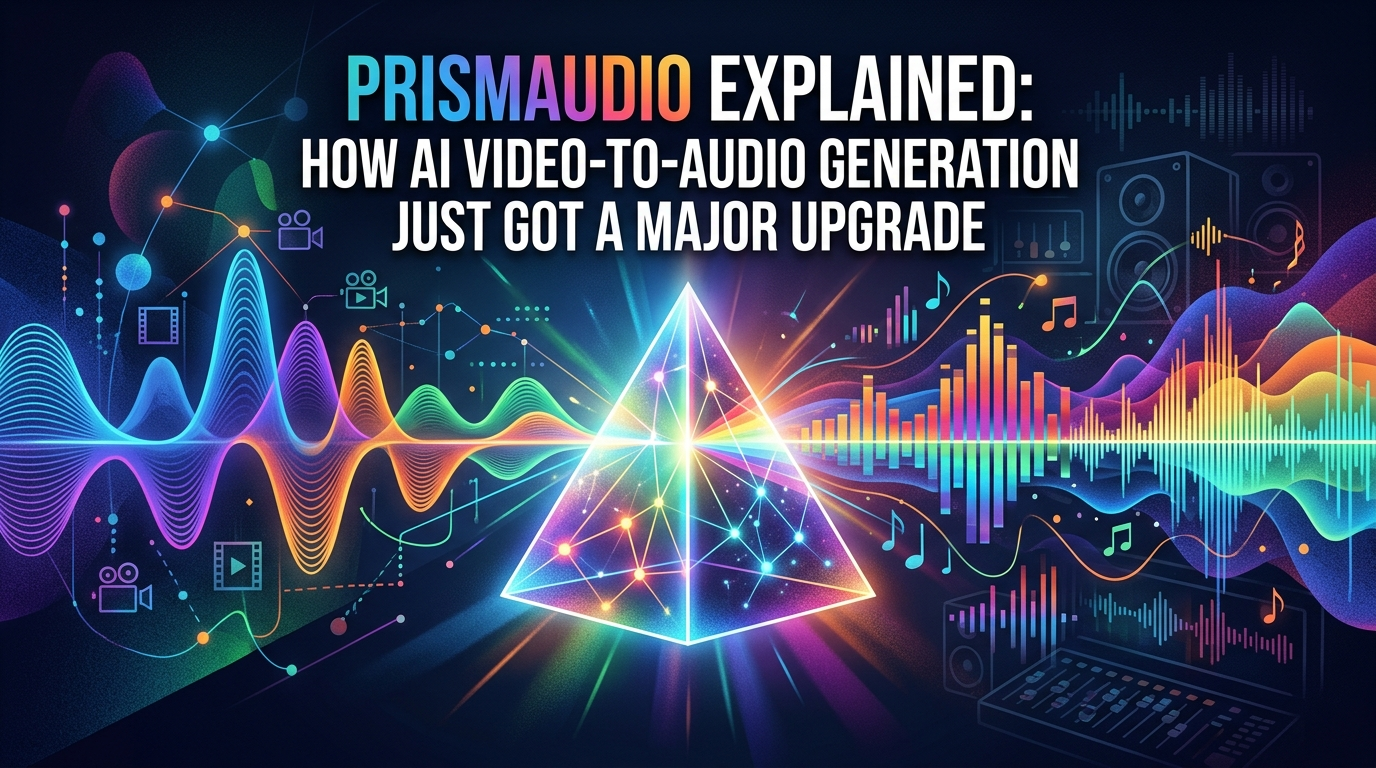
PrismAudio Explained: How AI Video-to-Audio Generation Just Got a Major Upgrade
PrismAudio: The AI That Watches Videos and Creates Perfect Sound Effects
What if AI could watch a video and automatically generate all the sound — footsteps, door slams, ambient noise, spatial audio — perfectly synchronized to every visual event? That’s exactly what PrismAudio does, and it just got accepted to ICLR 2026, one of the world’s top AI conferences.
PrismAudio represents a fundamental shift in how AI approaches video-to-audio (V2A) generation. Instead of treating audio as a single monolithic task, it breaks the problem into four distinct perceptual dimensions — semantic meaning, temporal sync, aesthetic quality, and spatial positioning — and optimizes each one separately using specialized Chain-of-Thought reasoning and reinforcement learning.
The result: AI-generated audio that doesn’t just sound good, but sounds right — the correct sounds, at the correct times, in the correct spatial positions, at professional quality.
How PrismAudio Works: Decomposed Chain-of-Thought Audio Generation
Most V2A models try to solve everything at once: understand the video, generate matching audio, sync it to events, and make it sound good — all in a single pass. This inevitably leads to trade-offs. Good sync but bad quality. Correct sounds but wrong timing. PrismAudio eliminates these trade-offs by decomposing the problem.
Four Specialized CoT Modules
PrismAudio uses four independent Chain-of-Thought (CoT) reasoning modules, each focused on one dimension of audio quality:
-
Semantic CoT — Analyzes what’s happening in the video and determines what sounds should exist. A dog running on grass needs paw sounds and rustling, not mechanical noise.
-
Temporal CoT — Ensures every sound starts and stops at exactly the right moment. A glass breaking in frame 47 produces its crash sound at precisely frame 47, not frame 45 or 50.
-
Aesthetic CoT — Optimizes the audio for perceptual quality — clarity, richness, dynamic range, and professional-grade sound design rather than generic noise.
-
Spatial CoT — Manages stereo positioning and panning. A car passing from left to right in the video produces audio that moves from the left speaker to the right speaker.
Each module has its own reward function, enabling the model to optimize all four dimensions simultaneously without one sacrificing another.
Fast-GRPO: Efficient Reinforcement Learning for Audio
PrismAudio introduces Fast-GRPO (Group Relative Policy Optimization), a training technique that uses hybrid ODE-SDE sampling to dramatically reduce computational overhead compared to standard GRPO — making reinforcement learning practical for audio generation at scale.
PrismAudio Benchmark Results
PrismAudio achieves state-of-the-art performance across every metric on both in-domain and out-of-domain benchmarks:
| Metric | PrismAudio | What It Measures |
|---|---|---|
| CLAP score | 0.52 | Semantic alignment (audio matches video content) |
| DeSync | 0.36 | Temporal synchronization (lower = better) |
| PQ | 6.68 | Perceptual quality |
| MOS Quality | 4.21/5 | Human-rated sound quality |
| MOS Consistency | 4.22/5 | Human-rated audio-visual consistency |
| Inference time | 0.63 seconds | Real-time capable |
All of this from a model with just 518 million parameters — proving that architecture matters more than raw model size.
Why PrismAudio Matters for Creators and Developers
The End of Manual Foley Work
Foley — the art of creating sound effects for film and video — has always been manual, expensive, and time-consuming. A professional Foley artist might spend hours creating the perfect footstep sounds for a 30-second clip. PrismAudio-class models do it in under a second, with spatial accuracy and temporal precision that’s increasingly competitive with human work.
Audio for AI-Generated Video
As AI video generation explodes (Sora, Wan 2.6, Seedance, Veo 3.1), a critical gap has emerged: these models generate silent video. Every generated clip needs audio added separately. V2A models like PrismAudio fill that gap, completing the pipeline from text prompt to finished video with sound.
Accessibility and Cost Reduction
Professional sound design costs thousands of dollars per minute of finished content. AI V2A generation costs pennies. This doesn’t replace professional sound designers for Hollywood productions, but it makes quality audio accessible to indie filmmakers, content creators, educators, and anyone producing video at scale.
Try Video-to-Audio AI on WaveSpeedAI Right Now
PrismAudio is a research framework (ICLR 2026), but you don’t have to wait for it to be productionized. WaveSpeedAI already offers production-ready video-to-audio generation via the Hunyuan Video Foley model.
Hunyuan Video Foley: Production-Ready V2A on WaveSpeedAI
Hunyuan Video Foley generates realistic Foley and ambient audio directly from video content — timing-accurate, high-quality, and ready for production use.
Key capabilities:
- Multi-scene synchronization — Handles complex, fast-cut visuals with precise audio alignment
- 48 kHz hi-fi output — Professional audio clarity with minimal noise and artifacts
- Text-guided sound design — Add optional text prompts to steer the audio (“kitchen ASMR: chopping vegetables, sizzling pan”)
- State-of-the-art V2A performance — Leading results in fidelity, sync, and semantic alignment benchmarks
- Reproducible results — Use seed control for consistent outputs
Pricing: Just $0.05 per run (~20 runs per dollar). No subscription required.
How to Use Hunyuan Video Foley
- Upload a silent (or low-sound) video clip
- Optionally describe the desired audio (“rain on windows, distant thunder, soft jazz”)
- Click to generate — receive your video with synchronized audio in seconds
- Iterate by adjusting prompts or seeds for the perfect result
Best Use Cases for AI Video-to-Audio
- Post-production — Fast Foley for animatics, rough cuts, and indie films
- Content creators — Auto-generate sound for social media shorts and reels
- AI video pipeline — Add audio to AI-generated silent videos from Wan 2.6, Seedance, Veo 3.1, or any text-to-video model
- ASMR content — Realistic ambient textures and Foley with precise timing
- Prototyping — Demo AV concepts before committing to professional sound design
- Education — Teach sound design and audio-visual alignment principles
The Future of AI Audio: From Research to Production
PrismAudio shows where V2A technology is headed: decomposed reasoning, multi-dimensional optimization, spatial audio, and real-time inference. Hunyuan Video Foley puts production-ready V2A in your hands today, with more advanced models arriving as research like PrismAudio gets productionized.
The gap between “silent AI video” and “finished video with sound” is closing fast. On WaveSpeedAI, it’s already closed.
FAQ
What is PrismAudio?
PrismAudio is an AI research framework (ICLR 2026) for video-to-audio generation that uses decomposed Chain-of-Thought reasoning across four perceptual dimensions (semantic, temporal, aesthetic, spatial) to generate synchronized, spatially accurate stereo audio from video.
Can I use PrismAudio right now?
PrismAudio is a research project with open-source code and models on Hugging Face. For production-ready V2A, use Hunyuan Video Foley on WaveSpeedAI at $0.05 per run.
What is video-to-audio (V2A) generation?
V2A is AI technology that watches a video and generates matching audio — sound effects, ambient noise, and Foley — synchronized to visual events. It automates the traditionally manual and expensive Foley process.
How much does AI video-to-audio cost on WaveSpeedAI?
Hunyuan Video Foley costs $0.05 per run on WaveSpeedAI, with no subscription and no cold starts.
Can I add AI audio to AI-generated videos?
Yes. Generate a video with any text-to-video model (Wan 2.6, Seedance, Veo 3.1, etc.), then run it through Hunyuan Video Foley to add synchronized audio — a complete silent-to-finished pipeline.
From Silent Videos to Full Productions
AI video generation created a new problem: millions of silent videos that need sound. PrismAudio points to the research frontier, and Hunyuan Video Foley delivers the production solution today. The complete AI video pipeline — from text to video to sound — is now available on WaveSpeedAI.
Related Articles

WaveSpeedAI vs Media.io Watermark Remover: Which One Actually Delivers?
Goodbye Sora: Top 5 Best Sora Alternatives for Making AI Videos in 2026
Google Veo 4: What We Might See From Google's Next AI Video Model

Introducing AI Photo Colorizer on WaveSpeedAI